
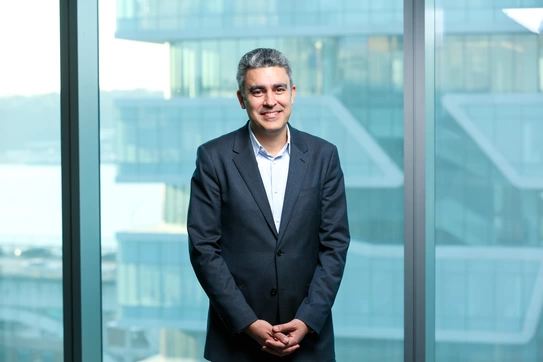
Omar Besbes
· Vikram S. Pandit Professor of Business and Reynolds Family Professor of Digital Economy in the Faculty of BusinessColumbia University · Decision Sciences and Operations
Active 2000–2026
Academic metrics are sourced from OpenAlex and public funding records; values may differ from Google Scholar.
Research topics
- Computer Science
- Mathematics
- Economics
- Machine Learning
- Artificial Intelligence
- Mathematical optimization
- Business
- Operations research
- Computer network
- Marketing
Selected publications
Surge Pricing and Its Spatial Supply Response
Management Science · 2020 · 161 citations
1st authorCorrespondingWe consider the pricing problem faced by a revenue-maximizing platform matching price-sensitive customers to flexible supply units within a geographic area. This can be interpreted as the problem faced in the short term by a ride-hailing platform. We propose a two-dimensional framework in which a platform selects prices for different locations and drivers respond by choosing where to relocate, in equilibrium, based on prices, travel costs, and driver congestion levels. The platform’s problem is…
Operations Research · 2021 · 67 citations
1st authorCorrespondingWe study the relationship between capacity and performance for a service firm with spatial operations, in the sense that requests arrive with origin-destination pairs. An example of such a system is a ride-hailing platform in which each customer arrives in the system with the need to travel from an origin to a destination. We propose a parsimonious representation of a spatial multiserver system through a state-dependent queueing model that captures spatial frictions as well as spatial economies…
How Big Should Your Data Really Be? Data-Driven Newsvendor: Learning One Sample at a Time
Management Science · 2023 · 62 citations
1st authorCorrespondingWe study the classical newsvendor problem in which the decision maker must trade off underage and overage costs. In contrast to the typical setting, we assume that the decision maker does not know the underlying distribution driving uncertainty but has only access to historical data. In turn, the key questions are how to map existing data to a decision and what type of performance to expect as a function of the data size. We analyze the classical setting with access to past samples drawn from th…
Workforce Scheduling with Heterogeneous Time Preferences: Effective Wages and Workers’ Supply
Manufacturing & Service Operations Management · 2024-08-01 · 12 citations
article1st authorCorrespondingProblem definition: Motivated by the debate around workers’ welfare in the gig economy, we propose a framework to evaluate current practices and possible alternatives. We study a setting in which customers seek service from workers and a platform facilitates such matches over the course of the day. The platform allocates time slots to workers using an allocation policy, and the workers are strategic agents (with respect to “when to work”) who maximize their expected utility that depends on their…
Contextual Inverse Optimization: Offline and Online Learning
Operations Research · 2023-08-02 · 11 citations
article1st authorCorrespondingLearning from data are critical across applications. However, in many applications, past data only gives partial information about the future. In “Contextual Inverse Optimization: Offline and Online Learning,” Besbes, Fonseca, and Lobel study a general setting in which historical data are associated with observations of past optimal actions from experts in specific contexts but without the underlying rewards associated with these actions. To what extent can one “reverse engineer” the underlying…
Frequent coauthors
- 27 shared
Assaf Zeevi
Columbia University
- 25 shared
Santiago Balseiro
- 17 shared
Yonatan Gur
Netflix (United States)
- 14 shared
Amine Allouah
Menlo School
- 13 shared
Ilan Lobel
New York University
- 11 shared
Jerry Anunrojwong
Columbia University
- 10 shared
Omar Mouchtaki
- 9 shared
Gabriel Y. Weintraub
Similar researchers at Columbia University
- Resume-aware match score
- Save to shortlist
- AI-drafted outreach
See your match with Omar Besbes
PhdFit ranks faculty by your research interests, methods, and publications — grounded in their actual work, not templates.
- Free to start
- No credit card
- 30-second signup