
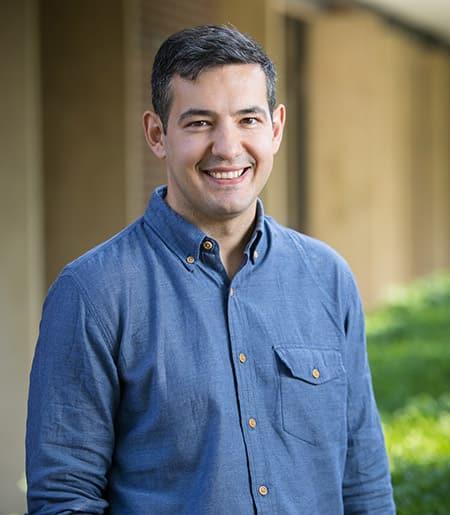
Nicholas Battaglia
· Associate Professor Director of Graduate Studies Astronomy, CCAPSVerifiedCornell University · Astronomy
Active 2008–2026
About
Professor Nicholas Battaglia works on observational cosmology and is particularly interested in fundamental physics, the epoch of reionization, and galaxy evolution. His research specializes in the data analysis and simulations of large-scale structure and secondary anisotropies in the cosmic microwave background, such as the thermal and kinetic Sunyaev-Zeldovich effects. He focuses on extracting astrophysical and cosmological information from observations related to these phenomena. He is directly involved with experiments including the Atacama Cosmology Telescope, CCAT-prime, and the Simons Observatory, contributing to advancing our understanding of the universe through these large-scale observational efforts.
Research topics
- Astrophysics
- Astronomy
- Physics
- Optics
- Geography
- Quantum mechanics
- Statistics
- Remote sensing
Selected publications
Physical review. D/Physical review. D. · 2026-02-24
article(An incomplete) Clusters Overview
2026-01-01
otherOpen access1st authorCorrespondingarXiv (Cornell University) · 2026-04-15
preprintOpen accessThe mean pairwise velocity of massive halos reflects the gravitational force law on cosmic scales. We combine cosmic microwave background intensity maps from the Atacama Cosmology Telescope and a galaxy catalog from the Sloan Digital Sky Survey to estimate the mean pairwise velocity using the kinematic Sunyaev-Zeldovich (kSZ) effect. On scales from 30 -- 230 megaparsecs, we constrain the gravitational acceleration between pairs of halos at separation $r$ to be $g\propto 1/r^n$ with $n=2.1\pm 0.3$, which is consistent with Newtonian gravity in an expanding spacetime (\textit{i.e.}, the standard $Λ$CDM model). This constraint shows agreement with an inverse quadratic radial dependence over the large distances separating galaxy halos, as expected in standard cosmology. Upcoming surveys have the potential to rule out $n = 1$ at $10σ$ significance. Our results establish the kSZ effect as a powerful tool for testing gravity on cosmological scales.
Monthly Notices of the Royal Astronomical Society · 2026-01-16
articleOpen accessABSTRACT We present the first joint analysis of the kinetic Sunyaev–Zeldovich (kSZ) effect with galaxy–galaxy lensing (GGL) for CMASS galaxies in the Baryon Oscillation Spectroscopic Survey. We show these complementary probes can disentangle baryons from dark matter in the outskirts of galactic haloes by alleviating model degeneracies that are present when fitting to kSZ or GGL measurements alone. In our joint kSZ + GGL analysis we show that the baryon density profile is well constrained on scales from 0.3 to 50 Mpc$\,h^{-1}$. With our well-constrained profile of the baryon density, we provide direct comparisons to simulations. For our model we find an outer slope of the baryon distribution that is shallower than predicted by some hydrodynamical simulations, consistent with enhanced baryonic feedback. We also show that not including baryons in a model for GGL can shift halo mass estimates by $\sim 20~{{\ \rm per\ cent}}$ compared to a model that includes baryons and is jointly fit to kSZ + GGL measurements. Our modelling code GGL and kSZ (glasz) is publicly available at https://github.com/James11222/glasz.
The Atacama Cosmology Telescope: DR6 Sunyaev-Zel’dovich Selected Galaxy Clusters Catalog
The Open Journal of Astrophysics · 2026-01-27 · 2 citations
articleOpen accessWe present the results of a search for galaxy clusters in the Atacama Cosmology Telescope (ACT) Data Release 6 (DR6) microwave sky maps covering 16293 square degrees in three frequency bands, using data obtained over the lifetime of the project (2008-2022). We report redshifts and mass estimates for 10040 clusters detected via their Sunyaev-Zel’dovich (SZ) effect with signal-to-noise greater than 4 at a 2.4 arcminute filter scale. The catalog includes 1180 clusters at redshifts greater than 1, and 123 clusters at redshifts greater than 1.5. Using a relation between cluster SZ signal and mass that is consistent with recent weak-lensing measurements, we estimate that clusters detected with signal-to-noise greater than 5 form a sample which is 90% complete for clusters with masses greater than <mml:math xmlns:mml="http://www.w3.org/1998/Math/MathML" display="inline"> <mml:mrow> <mml:mn>5</mml:mn> <mml:mo>×</mml:mo> <mml:msup> <mml:mn>10</mml:mn> <mml:mn>14</mml:mn> </mml:msup> </mml:mrow> </mml:math> MSun (measured within a spherical volume with mean density 500 times the critical density). El Gordo, a cluster found in an initial ACT survey of 755 square degrees, remains the most extreme cluster in mass and redshift; we find no cluster with a mass and redshift combination high enough to falsify the standard LCDM cosmology with Gaussian initial perturbations. We make public a variety of data products, including the full cluster candidate list, noise maps, and sky masks, along with our software for cluster detection and instructions for reproducing our cluster catalogs from the public ACT maps.
Monthly Notices of the Royal Astronomical Society · 2026-01-16 · 1 citations
articleOpen accessABSTRACT We present the first joint analysis of the kinetic Sunyaev–Zeldovich (kSZ) effect with galaxy–galaxy lensing (GGL) for CMASS galaxies in the Baryon Oscillation Spectroscopic Survey. We show these complementary probes can disentangle baryons from dark matter in the outskirts of galactic haloes by alleviating model degeneracies that are present when fitting to kSZ or GGL measurements alone. In our joint kSZ + GGL analysis we show that the baryon density profile is well constrained on scales from 0.3 to 50 Mpc$\,h^{-1}$. With our well-constrained profile of the baryon density, we provide direct comparisons to simulations. For our model we find an outer slope of the baryon distribution that is shallower than predicted by some hydrodynamical simulations, consistent with enhanced baryonic feedback. We also show that not including baryons in a model for GGL can shift halo mass estimates by $\sim 20~{{\ \rm per\ cent}}$ compared to a model that includes baryons and is jointly fit to kSZ + GGL measurements. Our modelling code GGL and kSZ (glasz) is publicly available at https://github.com/James11222/glasz.
Physical review. D/Physical review. D. · 2025-11-07 · 12 citations
articleOpen accessThe gas density profile around galaxies, shaped by feedback and affecting the galaxy lensing signal, is imprinted on the cosmic microwave background (CMB) by the kinematic Sunyaev-Zel'dovich effect (kSZ). We precisely measure this effect ($S/N\ensuremath{\approx}10$) via velocity stacking with 825,283 spectroscopically confirmed luminous red galaxies (LRG) from the Dark Energy Spectroscopic Instrument Year 1 (DESI Y1) survey, which overlap with the Atacama Cosmology Telescope (ACT) Data Release 6 temperature maps over $\ensuremath{\ge}4,000\text{ }\text{ }{\mathrm{deg}}^{2}$. We explore the kSZ dependence with various galaxy parameters and find no significant trend with redshift but clear trends with stellar mass and absolute magnitude in $g$, $r$, and $z$ bands. Our analysis suggests that the gas extends beyond the dark matter halo (99.5% confidence level, i.e., probability to exceed $(\mathrm{PTE})=0.005$). We find a tentative preference for hydrodynamical simulation models with stronger feedback that drives gas further out (Illustris $z=0.5$, $\mathrm{PTE}=0.37$) over weaker-feedback cases (IllustrisTNG $z=0.8$, $\mathrm{PTE}=0.045$), though with limited statistical significance. In all cases, a free multiplicative amplitude was fit to the simulated profiles, and further modeling work is required to firm up these conclusions. We find consistency between kSZ profiles around spectroscopic and photometric LRG, with comparable statistical power, thus increasing our confidence in the photometric analysis. Additionally, we present the first kSZ measurement around the DESI Y1 bright galaxy sample (BGS) and the emission-line galaxies (ELG) whose features match qualitative expectations. Finally, we forecast $S/N\ensuremath{\sim}50$ for future stacked kSZ measurements using data from the ACT, the DESI Y3, and the Rubin Observatory. These measurements will serve as an input for galaxy formation models and baryonic uncertainties in galaxy lensing.
The Atacama Cosmology Telescope: DR6 power spectrum foreground model and validation
Journal of Cosmology and Astroparticle Physics · 2025-10-01 · 4 citations
articleOpen accessAbstract We discuss the model of astrophysical emission at millimeter wavelengths used to characterize foregrounds in the multi-frequency power spectra of the Atacama Cosmology Telescope (ACT) Data Release 6 (DR6), expanding on Louis et al. (2025) ( 2503.14452 ). We detail several tests to validate the capability of the DR6 parametric foreground model to describe current observations and complex simulations, and show that cosmological parameter constraints are robust against model extensions and variations. We demonstrate consistency of the model with pre-DR6 ACT data and observations from Planck and the South Pole Telescope. We evaluate the implications of using different foreground templates and extending the model with new components and/or free parameters. In all scenarios, the DR6 ΛCDM and ΛCDM+ N eff cosmological parameters shift by less than 0.5 σ relative to the baseline constraints. Some foreground parameters shift more; we estimate their systematic uncertainties associated with modeling choices. From our constraint on the kinematic Sunyaev-Zel'dovich power, we obtain a conservative limit on the duration of reionization of Δ z rei < 4.4, assuming a reionization midpoint consistent with optical depth measurements and a minimal low-redshift contribution, with varying assumptions for this component leading to tighter limits. Finally, we analyze realistic non-Gaussian, correlated microwave sky simulations containing Galactic and extragalactic foreground fields, built independently of the DR6 parametric foreground model. Processing these simulations through the DR6 power spectrum and likelihood pipeline, we recover the input cosmological parameters of the underlying cosmic microwave background field, a new demonstration for small-scale CMB analysis. These tests validate the robustness of the ACT DR6 foreground model and cosmological parameter constraints.
Probing Gravity at Large Scales with kSZ-Reconstructed Velocities and CMB Lensing
ArXiv.org · 2025-10-31
preprintOpen accessWe present a new method for measuring the $E_G$ statistic that combines two CMB secondaries -- the kinematic Sunyaev-Zeldovich (kSZ) effect and CMB lensing -- for the first time to probe gravity on linear scales. The $E_G$ statistic is a discriminating tool for modified gravity theories, which leave imprints in lensing observables and peculiar velocities. Existing $E_G$ measurements rely on redshift space distortions (RSD) to infer the velocity field. Here, we employ kSZ velocity-reconstruction instead of RSD, a complementary technique that constrains the largest-scale modes better than the galaxy survey it uses. We construct a novel $\widehat{V}_G$ estimator that involves a ratio between cross-correlations of a galaxy sample with a CMB convergence map and that with a 3D kSZ-reconstructed velocity field. We forecast for current and upcoming CMB maps from the Atacama Cosmology Telescope (ACT) and the Simons Observatory (SO), respectively, in combination with three spectroscopic galaxy samples from the Dark Energy Spectroscopic Instrument (DESI). We find cumulative detection significances in the range $S/N \sim 20-55$, which can robustly test the scale-independent $E_G$ prediction under general relativity (GR) at different effective redshifts of the galaxy samples ($z\approx 0.73, 1.33, 1.84$). In particular, the SO$\times$DESI LRG measurement would be able to distinguish between GR and certain modified gravity models, including Hu-Sawicki $f(R)$ and Chameleon theories, with high confidence. The proposed $\widehat{V}_G$ estimator opens up a new avenue for stress-testing gravity and the $Λ$CDM+GR model at the largest observable scales.
Measurements of the thermal Sunyaev-Zel’dovich effect with ACT and DESI luminous red galaxies
Physical review. D/Physical review. D. · 2025-07-28 · 3 citations
articleCosmic Microwave Background (CMB) photons scatter off the free-electron gas in galaxies and clusters, allowing us to use the CMB as a backlight to probe the gas in and around low-redshift galaxies. The thermal Sunyaev-Zel'dovich effect, sourced by hot electrons in high-density environments, measures the thermal pressure of the target objects, shedding light on halo thermodynamics and galaxy formation, and providing a path toward understanding the baryon distribution around cosmic structures. We use a combination of high-resolution CMB maps from the Atacama Cosmology Telescope and photometric luminous red galaxy catalogs from the Dark Energy Spectroscopic Instrument to measure the thermal Sunyaev-Zel'dovich signal in four redshift bins from $z=0.4$ to $z=1.2$, with a combined detection significance of $19\ensuremath{\sigma}$ when stacking on the fiducial CMB Compton-$y$ map. We discuss possible sources of contamination, finding that residual dust emission associated with the target galaxies is important and limits current analyses. We discuss several mitigation strategies and quantify the residual modeling uncertainty. This work complements closely related measurements of the kinematic Sunyaev-Zel'dovich and weak lensing of the same galaxies.
Recent grants
Frequent coauthors
- 198 shared
David N. Spergel
- 157 shared
Michael D. Niemack
- 142 shared
Thibaut Louis
Laboratoire de Physique des 2 Infinis Irène Joliot-Curie
- 140 shared
J. Colin Hill
Columbia University
- 126 shared
Jonathan Sievers
- 126 shared
Edward J. Wollack
Goddard Space Flight Center
- 120 shared
Adam D. Hincks
University of Toronto
- 117 shared
Matt Hilton
University of the Witwatersrand
- Resume-aware match score
- Save to shortlist
- AI-drafted outreach
See your match with Nicholas Battaglia
PhdFit ranks faculty by your research interests, methods, and publications — grounded in their actual work, not templates.
- Free to start
- No credit card
- 30-second signup