
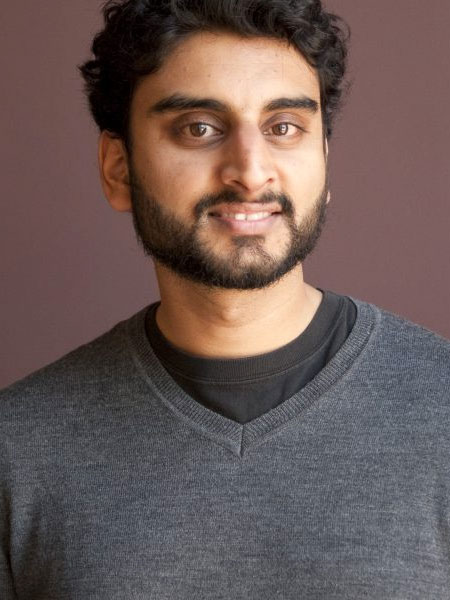
Neel Joshi
VerifiedNortheastern University · Biomedical Engineering
Active 1982–2025
About
Neel Joshi is an Associate Professor in the Department of Chemistry and Chemical Biology at Northeastern University, with an affiliate appointment in Bioengineering. He completed his PhD at UC Berkeley in the lab of Matt Francis and a postdoctoral fellowship at Boston University in the lab of Mark Grinstaff before starting his independent academic career at Harvard University and then moving to Northeastern in 2020. Prof. Joshi teaches courses in Chemical Biology and Biomaterials. His research focuses on engineered living materials, synthetic biology, and biochemistry, with a particular interest in protein self-assembly and biointerfaces. He leads the Joshi Lab for Biologically Fabricated Materials, which explores biologically inspired materials, protein engineering, and the biofabrication of complex functional materials through microbial biosynthesis. His group works at the intersection of biomaterials science and synthetic biology, aiming to harness microbial biosynthetic potential for manufacturing and biomedical applications. Notable projects include developing genetically programmed bacteria to assemble customizable materials, such as biofilm matrix proteins, for uses ranging from bioremediation to therapeutic probiotics. Prof. Joshi has contributed to the field through numerous publications and patents, and has been recognized as a Kavli Fellow in 2016.
Research topics
- Biology
- Microbiology
- Computer Science
- Sociology
- Medicine
- Computational biology
- Nanotechnology
- Engineering ethics
- Biochemistry
- Biomedical engineering
- Materials science
- Immunology
- Internal medicine
- Data science
- Engineering
Selected publications
bioRxiv (Cold Spring Harbor Laboratory) · 2025-03-03 · 1 citations
preprintOpen accessSenior authorCorrespondingAbstract Self-organization of multicellular systems is vital for building structure in living system but remains underexplored in engineered living materials. We developed iDP 2 , a platform enabling high-density display of intrinsically disordered proteins on the surface of E. coli using CsgF as a surface-bound anchor protein to which other protein domains can be fused. Display depends on a lack of intrinsic structure and enable multivalent weak interactions that drive environmental responsiveness and sequence-programmable self-segregation. iDP 2 allow the programming of material properties like viscoelasticity, stability, offering a method to rationally control cell-cell interactions. This approach could be applied to engineer self-organizing tissues or materials with customized properties.
What MLLMs Learn about When they Learn about Multimodal Reasoning
ArXiv.org · 2025-10-02
preprintOpen accessEvaluation of multimodal reasoning models is typically reduced to a single accuracy score, implicitly treating reasoning as a unitary capability. We introduce MathLens, a benchmark of textbook-style geometry problems that exposes this assumption by operationally decomposing performance into perception, reasoning, and multimodal-specific components. Each problem is derived from a symbolic specification and accompanied by visual diagrams, text-only variants, multimodal questions, and targeted perceptual probes, enabling controlled measurement of each component. Using this decomposition, we show that common training strategies induce systematically different capability profiles that are invisible under aggregate accuracy. Reinforcement learning primarily improves perceptual grounding and robustness to diagram variation, while textual SFT yields gains through reflective reasoning. In contrast, as perception and reasoning improve, a growing fraction of remaining errors fall outside these components and are categorized as multimodal-specific. These results suggest that apparent progress in multimodal reasoning reflects shifting balances among subskills rather than uniform advancement, motivating evaluation beyond scalar accuracy.
Nature Microbiology · 2025-12-23
articleOpen accessSurface expression of antitoxin on engineered bacteria neutralizes genotoxic colibactin in the gut
Nature Microbiology · 2025-12-08 · 2 citations
articleOpen accessProceedings of the National Academy of Sciences · 2025-10-30
articleOpen accessSenior authorCorrespondingSelf-organization underpins the emergence of complex structure in living systems but remains a major challenge for engineering synthetic multicellular materials. Here, we present intrinsically disordered protein display platform (iDP 2 ), a generalizable platform for high-density display of intrinsically disordered proteins (IDPs) on the surface of Escherichia coli . iDP 2 uses CsgF as a surface-tethered scaffold, enabling efficient fusion and presentation of protein domains that lack stable tertiary structure. Successful display selectively favors disordered sequences, which, when endowed with phase separation propensity, drive the formation of dynamic cellular condensates. Programming cells with orthogonal IDPs enables sequence-specific segregation of mixed populations, allowing the design of spatially organized living assemblies. The aggregation state of these condensates is dynamically tunable by environmental cues such as ionic strength, and temperature, with responses predictable from the known phase behavior of the displayed IDPs. Extrusion processing of condensates generates macroscale filaments that maintain structural integrity and population segregation. By linking protein sequence to emergent collective behaviors, iDP 2 offers a programmable framework for rational control of cell–cell interactions. This approach establishes a foundation for engineering living materials with customizable viscoelastic properties, environmental responsiveness, and multicellular organization. More broadly, our work highlights the potential of disordered protein motifs as versatile tools for the design of adaptive, self-organizing biological systems.
Inference-Time Scaling for Complex Tasks: Where We Stand and What Lies Ahead
ArXiv.org · 2025-03-31
preprintOpen accessInference-time scaling can enhance the reasoning capabilities of large language models (LLMs) on complex problems that benefit from step-by-step problem solving. Although lengthening generated scratchpads has proven effective for mathematical tasks, the broader impact of this approach on other tasks remains less clear. In this work, we investigate the benefits and limitations of scaling methods across nine state-of-the-art models and eight challenging tasks, including math and STEM reasoning, calendar planning, NP-hard problems, navigation, and spatial reasoning. We compare conventional models (e.g., GPT-4o) with models fine-tuned for inference-time scaling (e.g., o1) through evaluation protocols that involve repeated model calls, either independently or sequentially with feedback. These evaluations approximate lower and upper performance bounds and potential for future performance improvements for each model, whether through enhanced training or multi-model inference systems. Our extensive empirical analysis reveals that the advantages of inference-time scaling vary across tasks and diminish as problem complexity increases. In addition, simply using more tokens does not necessarily translate to higher accuracy in these challenging regimes. Results from multiple independent runs with conventional models using perfect verifiers show that, for some tasks, these models can achieve performance close to the average performance of today's most advanced reasoning models. However, for other tasks, a significant performance gap remains, even in very high scaling regimes. Encouragingly, all models demonstrate significant gains when inference is further scaled with perfect verifiers or strong feedback, suggesting ample potential for future improvements.
Phi-4-reasoning Technical Report
ArXiv.org · 2025-04-30
preprintOpen accessWe introduce Phi-4-reasoning, a 14-billion parameter reasoning model that achieves strong performance on complex reasoning tasks. Trained via supervised fine-tuning of Phi-4 on carefully curated set of "teachable" prompts-selected for the right level of complexity and diversity-and reasoning demonstrations generated using o3-mini, Phi-4-reasoning generates detailed reasoning chains that effectively leverage inference-time compute. We further develop Phi-4-reasoning-plus, a variant enhanced through a short phase of outcome-based reinforcement learning that offers higher performance by generating longer reasoning traces. Across a wide range of reasoning tasks, both models outperform significantly larger open-weight models such as DeepSeek-R1-Distill-Llama-70B model and approach the performance levels of full DeepSeek-R1 model. Our comprehensive evaluations span benchmarks in math and scientific reasoning, coding, algorithmic problem solving, planning, and spatial understanding. Interestingly, we observe a non-trivial transfer of improvements to general-purpose benchmarks as well. In this report, we provide insights into our training data, our training methodologies, and our evaluations. We show that the benefit of careful data curation for supervised fine-tuning (SFT) extends to reasoning language models, and can be further amplified by reinforcement learning (RL). Finally, our evaluation points to opportunities for improving how we assess the performance and robustness of reasoning models.
MM-GEN: Enhancing Task Performance Through Targeted Multimodal Data Curation
arXiv (Cornell University) · 2025-01-07
preprintOpen accessVision-language models (VLMs) are highly effective but often underperform on specialized tasks; for example, Llava-1.5 struggles with chart and diagram understanding due to scarce task-specific training data. Existing training data, sourced from general-purpose datasets, fails to capture the nuanced details needed for these tasks. We introduce MM-Gen, a scalable method that generates task-specific, high-quality synthetic text for candidate images by leveraging stronger models. MM-Gen employs a three-stage targeted process: partitioning data into subgroups, generating targeted text based on task descriptions, and filtering out redundant and outlier data. Fine-tuning VLMs with data generated by MM-Gen leads to significant performance gains, including 29% on spatial reasoning and 15% on diagram understanding for Llava-1.5 (7B). Compared to human-curated caption data, MM-Gen achieves up to 1.6x better improvements for the original models, proving its effectiveness in enhancing task-specific VLM performance and bridging the gap between general-purpose datasets and specialized requirements. Code available at https://github.com/sjoshi804/MM-Gen.
Leveraging the “Superpowers” of Engineered Living Materials to Craft Soft Living Artefacts
2025-02-25
articleOpen accessIn recent years several scholars from the design discipline attempted to conceptualize and frame “Living Artefacts” as a novel class of objects, alive and responsive in their relationship with humans. Simultaneously, a lesser explored but promising area is a synergetic collaboration between design, Human-Computer Interaction and synthetic biology, where the Engineered Living Materials (ELMs) developed by bioengineers could be explored and exploited to craft Living Artefacts and improve user experience. ELMs possess some hallmark features of life, such as self-regeneration, autonomy and environmental responsiveness. This Studio would engage participants in design-driven explorations of an ELM, specifically a “augmented silicone” (silicone with embedded proteins), a material with programmed “superpowers”, while exploring applications of ELMs beyond the sole bioengineering field. Participants and organizers would critically reflect on the Studio's outcomes and map the challenges, opportunities and ethical considerations while integrating design and biology.
Exploring the Role of Irradiance on Bidirectional Control of Engineered Microbes
2025-08-13
articleWe built a living light sensor from engineered Escherichia coli that can sense and respond to visible light and elicit changes in pH to power display components. By varying blue light irradiance, we identified minimum dosage parameters that enable spatiotemporal control of pH responsive hydrogels through controlled protein production.
Recent grants
CAS:Scalable platform for materials fabrication from genetically engineered bacterial biomass
NSF · $458k · 2020–2023
SusChEM: Engineered protein-based biofilms as functional advanced materials
NSF · $500k · 2014–2019
NIH · $412k · 2017–2022
NIH · $1.4M · 2017–2022
Frequent coauthors
- 29 shared
Matthew B. Francis
University of California, Berkeley
- 27 shared
Avinash Manjula‐Basavanna
Northeastern University
- 27 shared
Anna Duraj‐Thatte
Virginia Tech
- 21 shared
Prashant N. Bansal
- 17 shared
Vibhav Vineet
Microsoft Research (United Kingdom)
- 17 shared
Brian D. Snyder
Harvard University
- 17 shared
Joshua M. Gilmore
Stowers Institute for Medical Research
- 16 shared
Mark W. Grinstaff
Boston University
Education
- 2006
Ph.D., Chemistry
University of California Berkeley
- 2001
B.S., Chemistry
Harvey Mudd College
Awards & honors
- Kavli Fellow (2016)
- NSF Idea Machine 2026 Challenge – Grand Prize winner – "Engi…
- Resume-aware match score
- Save to shortlist
- AI-drafted outreach
See your match with Neel Joshi
PhdFit ranks faculty by your research interests, methods, and publications — grounded in their actual work, not templates.
- Free to start
- No credit card
- 30-second signup