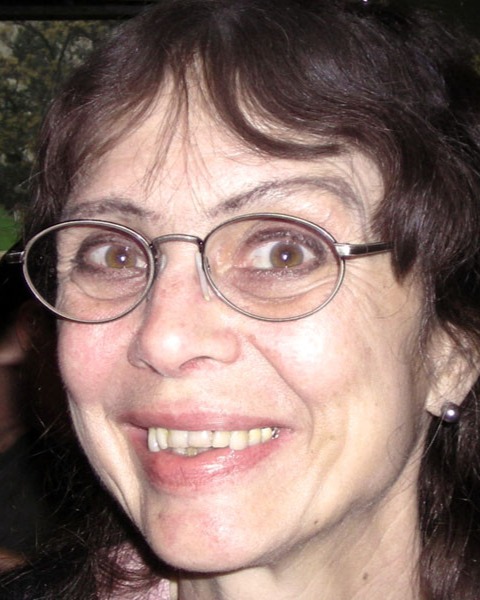
Naomi Lindstrom
· Gale Family Foundation Professor in Jewish Arts and Culture; Professor of Spanish and Portuguese; Director, Gale Collaborative on Jewish Life in the Americas, Schusterman Center for Jewish StudiesVerifiedUniversity of Texas at Austin · Comparative Literature
Active 1976–2025
About
Naomi Lindstrom is the Gale Family Foundation Professor in Jewish Arts and Culture at the University of Texas at Austin, within the College of Liberal Arts. She is also a Professor of Spanish and Portuguese and serves as the Director of the Gale Collaborative on Jewish Life in the Americas at the Schusterman Center for Jewish Studies. Her academic interests include gender and the study of Latin American literature, literary translation, transnational studies, sociology of the arts, and Jewish life in the Americas. Her work focuses on exploring the intersections of Jewish culture, Latin American literature, and the arts, contributing to a deeper understanding of Jewish life and cultural expression in the Americas.
Research topics
- Sociology
- Political Science
- Computer Science
- Library science
- Art
- Anthropology
- Aesthetics
- History
- Gender studies
Selected publications
Gender, Religion, and Indefinability in La burladora de Toledo
Revista Canadiense de Estudios Hispánicos · 2025-12-03
articleOpen access1st authorCorrespondingThe 2008 novel La burladora de Toledo by Angelina Muñiz-Huberman is the fictional recreation of the wandering life of an individual who lived in sixteenth-century Spain as, at various times, a man and as a woman. The novel at first appears to have two themes: the main character’s unrecognizable gender and their highly syncretistic and extraofficial religious life. My thesis is that in La burladora gender and religion, which initially manifest as two concerns, are facets of a broader concept that the narrative promotes. Burladora assigns a positive value to identities that are fluid, mutable, and indefinable.
The prophet, the warrior, and the Guru in the <i>Incal</i> saga of Alejandro Jodorowsky
Journal of Graphic Novels & Comics · 2024-04-04
article1st authorCorrespondingFrustrated by the film industry, Alejandro Jodorowsky (born to a Jewish-Chilean family in 1929; naturalised French) turned to graphic narrative as a medium through which to express his surrealistic esthetic and impart spiritualistic and arcane concepts. In this medium he created his most extensive body of imaginative narratives, most of which unfold in a science-fiction universe. In examining Jodorowsky's Incal saga, I seek the most adequate way of characterising the protagonist John Difool and understanding the significance of the leadership that he exercises. In the original series, Difool exhibits recognisable traits of the prophet as defined by Abraham Joshua Heschel. Yet his role is not limited to the prophet; as he carries out his missions, he reveals features of the warrior leader and the guru, among others. In the sequels, he continues to function as a leader, but the nature of his role grows increasingly difficult to identify. The protagonist may possess messianic features, as Henri-Simon Blanc-Hoang asserts, although in the ending he more closely resembles a New Age spiritual guide. Finally, I evaluate the extent to which the recent trend in Jodorowsky studies of stressing the creator's artistic Jewishness is useful in understanding the leadership exemplified in the Incal narratives.
5 Prophets and Sinners in the 1970s Films of Alejandro Jodorowsky
Edinburgh University Press eBooks · 2023-10-13 · 1 citations
book-chapter1st authorCorrespondingStudies in 20th & 21st century literature · 2023 · 1 citations
- Computer Science
- Computer Science
- Library science
Oral Histories and the Literature of Reminiscence: Writing Up the Jewish Argentine Past
2021-11-15 · 1 citations
book-chapter1st authorCorrespondingThe nonliterary texts in question are the first-person accounts gathered from now-elderly Jewish immigrants to Argentina by oral historians who are, inevitably, younger and more absorbed into cosmopolitan culture than were their informants. These oral historians or collectors of personal testimony are like the writers to be discussed shortly in their concern with the recovery and recording of the Jewish Argentine past and with the meanings to be assigned the material retrieved and reassembled out of reminiscences. Yet, the elderly informants claim attention as witnesses to a form of life, Jewish community life of pre-Holocaust Eastern Europe and its New World transforms, that was organized with Jewish law as its backbone. A number of other Argentine literary works could well be examined for the same concern with documenting the Jewish Argentine past, and particularly the immigrant experience. The search must be taken back beyond the Jewish Argentine experience to an era before immigration.
Leer el infinito by Jenny Asse Chayo: Novel Jewish Visions in Poetry
Journal of Jewish identities · 2021-01-01
article1st authorCorrespondingLeer el infinito by Jenny Asse Chayo: Novel Jewish Visions in Poetry Naomi Lindstrom (bio) Born in Mexico in 1963, Jenny Asse Chayo has been developing a highly original Jewish visionary discourse. While there are varying concepts of visionary literature, in this analysis of poems from Asse’s 2016 Leer el infinito (translated by Stephen A. Sadow as Reading Infinity),1 I use the term to refer specifically to writing that describes visions. Leer el infinito consists primarily of texts in which the speaking subject gives accounts of scenes witnessed and new knowledge acquired by means of divinely inspired revelations. Examination of these poems shows how Asse has created a highly original poetic discourse that stands out first through the unexpected and often idiosyncratic ways in which she links her poems to other texts, most of them Jewish, second, through a fervent piety exceptional among urbane contemporary poets, and third, through the concepts of language, communication, and gender expressed by the speaking subject in Leer el infinito. The emergence of a Jewish mystic writer from Spanish America is not in and of itself new or unusual. The canon of Spanish American Jewish literature includes a number of authors renowned for their work in this vein. Among the most noted are three Kabbalistic writers: the Spanish-Mexican Angelina Muñiz-Huberman (b. 1936) and two Argentine-born inhabitants of Spain, Mario Satz (b. 1944) and Marcos Ricardo Barnatán (b. 1946). Muñiz-Huberman, Satz, and Barnatán are students of Kabbalah who have authored books introducing its texts and concepts;2 their literary production clearly announces their debt to this tradition.3 Descriptions of visions in the Hebrew prophets also provide material to these three and to such contemporaries as the Paris-based Argentine writer Luisa Futoransky (b. 1939), the Cuban exile poet José Kozer (b. 1940), and the Mexican poet and novelist Esther Seligson (1941–2010).4 Asse is not a linear heir or descendant of these or other established authors; as this discussion will show, her poetry is a distinct outlier. Having published her first collection of poetry, Busco en mi carne el nombre (I Seek the Name in My Flesh) in 1997 and her subsequent works in the twenty-first century, she is a generation younger. Asse draws only sparingly upon Kabbalah and the prophets. Instead, her poetic discourse displays a novel hybridity [End Page 197] in the sense that she connects her work to an unusually eclectic range of texts and traditions. Some of her intertexts—texts to which she links her poetry by means of verbatim citations, paraphrase, allusions, and stylistic mimicry—have features of mysticism, but many would not ordinarily be considered in this category. They range from sacred writings to manifestly secular works of literature from recent decades. Leer especially highlights its connections to the French-language writing of the celebrated Egyptian Jewish writer Edmond Jabès (1912–1991) the author of Le Livre des questions (published in seven volumes 1963–1973).5 However, the following reading of her poetry examines ways in which in Leer Asse follows a very different thematic path from that taken by Jabès. In other cases, her intertexts are early modern, such as the poetry of the celebrated Spanish mystic St. John of the Cross, a Carmelite friar of converso background.6 Asse also connects her verse to apocalyptic literature and beliefs; two of the poetic apocalypses collected in Leer will be analyzed in this essay. Radical reworkings of biblical tales are another of Asse’s poetic specialties; indeed, her 2004 collection Es sed de morir el paraíso (Paradise is the Thirst to Die) is composed entirely of altered versions of stories from Genesis and Exodus.7 The lengthier narrative poems in Leer refashion elements of Genesis; two of these texts will be examined closely in this essay and two others discussed briefly. The texts to which Asse links the poems of Leer are predominantly Jewish; moreover, the speaker in the volume identifies herself as Jewish. In the following discussion of poems from Leer, I view Asse as a writer who explicitly inserts herself into, and contributes to, Jewish literature. At the same time, she persistently...
Ariel Dorfman: The Trajectory of a Transnational Jewish Intellectual
Contemporary Jewry · 2021 · 1 citations
1st authorCorresponding- Sociology
- Sociology
- Gender studies
Guest Editors’ Introduction to the Special Issue: Jews in the Americas: Transnational Perspectives
Contemporary Jewry · 2021
- Sociology
- Sociology
- Political Science
DAVID WILLIAM FOSTER (1940-2020) IN MEMORIAM
Revista Iberoamericana · 2020-09-18
articleOpen access1st authorCorrespondingN/A
La comunicación profética en La morada en el tiempo de Esther Seligson
EIAL - Estudios Interdisciplinarios de América Latina y el Caribe · 2019-05-13
articleOpen access1st authorCorrespondingOf the numerous traditions that the Mexican writer Esther Seligsonadapts in La morada en el tiempo (1981), which spans Jewish history fromthe creation to the second part of the twentieth century, the present analysisfocuses on prophetic communication. This study puts forward a readingthat shows that many passages in Morada could be considered examples ofprophetic discourse. Not only does Morada include modified versions of theprophets’ stories, the central speaker also constitutes an updated figure ofthe prophet. At the same time, the speaker examines the meaning of silencein human-divine communications.Keywords: poetic prose, Esther Seligson, prophetic literature, Mexicanliterature, Spanish American Jewish writers
Frequent coauthors
- 234 shared
Sharon Magnarelli
Quinnipiac University
- 231 shared
Lawrence D. Kritzman
Dartmouth Hospital
- 229 shared
Ben Robinson
University of Cincinnati
- 226 shared
Nichole Neuman
Indiana University – Purdue University Indianapolis
- 226 shared
Amy L. Hubbell
University of Queensland
- 226 shared
Derek Hillard
Kansas State University
- 226 shared
Necia Chronister
Kansas State University
- 226 shared
Verena Andermatt Conley
Harvard University
Awards & honors
- Gale Family Foundation Professor in Jewish Arts and Culture
- Resume-aware match score
- Save to shortlist
- AI-drafted outreach
See your match with Naomi Lindstrom
PhdFit ranks faculty by your research interests, methods, and publications — grounded in their actual work, not templates.
- Free to start
- No credit card
- 30-second signup