
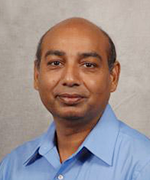
Mustaque Ahamad
· SCP Interim Chair, USG Regents Entrepreneur…Georgia Institute of Technology · Computer Science
Active 1970–2025
Academic metrics are sourced from OpenAlex and public funding records; values may differ from Google Scholar.
About
Dr. Mustaque Ahamad is a professor in the School of Computer Science at the Georgia Institute of Technology, where he has served on the faculty since 1985. He was the director of the Georgia Tech Information Security Center (GTISC) from 2004 to 2012, during which he helped develop major research thrusts in security of converged communication networks, identity and access management, and healthcare information technology security. Currently, he leads Georgia Tech’s educational programs in cybersecurity as associate director of its Institute for Information Security and Privacy. His research interests include distributed systems, computer security, and dependable systems. Dr. Ahamad is also a co-founder and serves as chief scientist of Pindrop Security and FraudScope.
Research topics
- Computer Science
- Computer Security
- Data science
- Environmental health
- Geography
- Environmental science
- Ecology
- Environmental protection
- Medicine
- Biology
Selected publications
An Inside Look into the Practice of Malware Analysis
Proceedings of the 2022 ACM SIGSAC Conference on Computer and Communications Security · 2021 · 58 citations
Senior authorCorrespondingMalware analysis aims to understand how malicious software carries out actions necessary for a successful attack and identify the possible impacts of the attack. While there has been substantial research focused on malware analysis and it is an important tool for practitioners in industry, the overall malware analysis process used by practitioners has not been studied. As a result, an understanding of common malware analysis workflows and their goals is lacking. A better understanding of these w…
2023-04-26 · 46 citations
articleOpen accessThe spread of online misinformation threatens public health, democracy, and the broader society. While professional fact-checkers form the first line of defense by fact-checking popular false claims, they do not engage directly in conversations with misinformation spreaders. On the other hand, non-expert ordinary users act as eyes-on-the-ground who proactively counter misinformation – recent research has shown that 96% counter-misinformation responses are made by ordinary users. However, researc…
The Role of the Crowd in Countering Misinformation: A Case Study of the COVID-19 Infodemic
2020-12-10 · 33 citations
preprintOpen accessFact checking by professionals is viewed as a vital defense in the fight against misinformation. While fact checking is important and its impact has been significant, fact checks could have limited visibility and may not reach the intended audience, such as those deeply embedded in polarized communities. Concerned citizens (i.e., the crowd), who are users of the platforms where misinformation appears, can play a crucial role in disseminating fact-checking information and in countering the spread…
arXiv (Cornell University) · 2023-03-11 · 18 citations
preprintOpen accessThe spread of online misinformation threatens public health, democracy, and the broader society. While professional fact-checkers form the first line of defense by fact-checking popular false claims, they do not engage directly in conversations with misinformation spreaders. On the other hand, non-expert ordinary users act as eyes-on-the-ground who proactively counter misinformation -- recent research has shown that 96% counter-misinformation responses are made by ordinary users. However, resear…
2021-08-12 · 17 citations
articleWhat should a malicious user write next to fool a detection model? Identifying malicious users is critical to ensure the safety and integrity of internet platforms. Several deep learning based detection models have been created. However, malicious users can evade deep detection models by manipulating their behavior, rendering these models of little use. The vulnerability of such deep detection models against adversarial attacks is unknown. Here we create a novel adversarial attack model against…
Recent grants
ITR/SI: Guarding the Next Internet Frontier: Countering Denial of Information
NSF · $2.0M · 2001–2008
NSF · $900k · 2015–2021
TWC: Small: Securing the New Converged Telephony Landscape
NSF · $500k · 2013–2017
Frequent coauthors
- 23 shared
Roberto Perdisci
Georgia Institute of Technology
- 21 shared
Mostafa Ammar
Georgia Institute of Technology
- 17 shared
Michel Raynal
Institut de Recherche en Informatique et Systèmes Aléatoires
- 14 shared
Payas Gupta
- 13 shared
Sumeer Bhola
Google (United States)
- 10 shared
Francisco J. Torres-Rojas
Instituto Tecnológico de Costa Rica
- 10 shared
Manos Antonakakis
Georgia Institute of Technology
- 10 shared
Karsten Schwan
Delft University of Technology
Similar researchers at Georgia Institute of Technology
- Resume-aware match score
- Save to shortlist
- AI-drafted outreach
See your match with Mustaque Ahamad
PhdFit ranks faculty by your research interests, methods, and publications — grounded in their actual work, not templates.
- Free to start
- No credit card
- 30-second signup