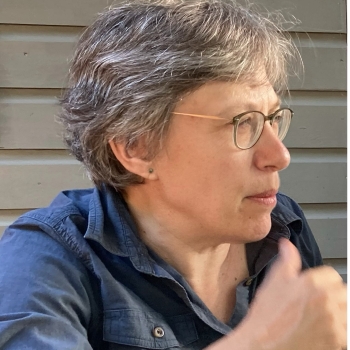
Lisa Gitelman
· Professor of Media, Culture, and Communication; Professor of EnglishNew York University · Communication Studies
Active 1800–2025
About
Lisa Gitelman is a media historian whose research concerns American book history, techniques of inscription, and the new media of yesterday and today. She is particularly concerned with tracing the patterns according to which new media become meaningful within and against the contexts of older media. Her most recent book is entitled Paper Knowledge: Toward A Media History of Documents (Duke University Press 2014). She has an edited collection, "Raw Data" Is an Oxymoron (MIT 2013). Previous works include Always Already New: Media, History, and the Data of Culture (MIT Press 2006). She holds a Ph.D. in English from Columbia University and is a former editor of the Thomas A. Edison Papers at Rutgers University. She joins Steinhardt after teaching at Harvard University and at The Catholic University of America.
Research topics
- Sociology
- Political Science
- Computer Science
- Law
- Social Science
- Philosophy
- Linguistics
- Literature
- Social psychology
- World Wide Web
- Psychology
- Marketing
- Media studies
- Art
- History
- Environmental ethics
- Library science
Selected publications
Material intelligence, or, knowing by hand
Journal of Communication · 2025-09-25
articleOpen access1st authorCorrespondingThe British Journal for the History of Science · 2024
1st authorCorresponding- Sociology
- Political Science
- Media studies
That the world we live in is shaped by science seems indisputable, even if the histories of that shaping remain difficult to delineate.As Adrian Johns's compelling new book argues, 'We live today in a world shaped by the science of reading ' (p.416).Johns makes the case that there is such a thing as the science of reading, and that tracing its development is worthwhile in some measure because it has made a difference.The history of the science of reading has been neglected until now not because the subject of reading is unimportantit is anything butbut rather because of the ways in which all scholarly inquiries morph across time, subject to institutional vicissitudes, competing research programmes, disciplinary shifts and the interests and attentions of a broader public.The science of reading began in the late nineteenth century, entwined with the beginnings of the modern research university and amid the contexts of newly industrial print production.James McKeen Cattell helped establish the science in Americaafter training with Hermann von Helmholtz and Wilhelm Wundt in Germanyand went on to a lengthy career editing Science magazine and presiding over a scientific news agency.For Cattell and his colleagues, questions about reading were psychophysical in nature, and reading begged for anthropometric measurement.Specialized laboratory instruments were developed to detect and record eye movements and gauge reaction times.For Edmund Burke Huey, author of the field's foundational book, reading was a matter of mental hygiene, one with obvious social implications.New tools like eye movement cameras and tachistoscopes would soon be deployed to measure, record and eventually optimize reading.America needed better, more readable fonts, for one thing, and elementary education needed a complete overhaul.'The experience of modernity' itself, Johns writes, had turned the science of reading into an urgent matter (p.93).In the twentieth century, psychophysics was superseded by new disciplinary and institutional formations.Some scholars, like Charles Hubbard Judd at the University of Chicago's School of Education, stuck with laboratory science.(Chicago even started a 'lab school'.)Others took up questions about reading as a social-scientific inquiry, looking into reading as a shared social practice to be understood demographically, for instance, researched by librarians, among others, and cultivated as a civic virtue.(The University of Chicago started its Graduate Library School.)Disparate lines of inquiry like these would eventually lead to a new, resilient concept: communication (p.116; and Chicago started 'the world's first graduate degree-granting body in the prospective field of communications'p.205).
9 Nineteenth-Century Media Technologies
Princeton University Press eBooks · 2024-09-06
book-chapter1st authorCorrespondingNineteenth-Century Media Technologies
Princeton University Press eBooks · 2024-09-10
book-chapter1st authorCorrespondingGordon Fraser, <i>Star Territory: Printing the Universe in Nineteenth-Century America</i>
American Literary History · 2023-02-01
article1st authorCorresponding2023-11-29
book-chapter1st authorCorrespondingThomas Edison was the first to demonstrate the phonograph in public, when he took his prototype to the New York City offices of the Scientific American magazine in 1877. In keeping with the important public uses of shorthand for court and legislative reports, the phonograph would also provide a cultural repository, a library for sounds. The Edison Speaking Phonograph Company functioned by granting regional demonstration rights to exhibitors; individuals purchased the right to exhibit a phonograph within a protected territory. While the Edison Speaking Phonograph Company was getting on its feet, several of Edison’s friends and associates held public exhibitions that paired demonstrations of the telephone with the phonograph and raised the expectations of company insiders. Lecturers introduced Edison’s machine as an important scientific discovery by giving an explanation of how the phonograph worked and then enacting this explanation with demonstrations of recording and playback.
Afterword: Exit this way: afterward
2023-01-03
book-chapter1st authorCorrespondingI wish I could say that when my colleague Paula McDowell approached me about having a McLuhan symposium at New York University that I had been supportive, or at least warily accepting in the practised mien of an admiring if preoccupied colleague. Instead, I was resistant. Over the many months that Paula and her team worked to pull off the ‘Reading McLuhan Reading’ symposium, which was held on campus in early March 2020, I was a sea anchor pulled along by her energies. I was a drag. And I regret it. When the day of the event finally arrived, Paula had convened a distinguished group of many of my favourite thinkers, a small number of them now represented in these pages. My role was simply to help host a final discussion and offer a few words of thanks to all of those assembled, which I framed partly as my apology (I’m sorry Paula!).
Archives · 2023-12-18
book-chapter1st authorCorrespondingAbstract Beginning with the computational contexts within which the term metadata was initially deployed, this chapter first addresses ways that the idea may have achieved its belated power within the so-called archival turn and then explores its continued currency. If the notion of the archive can point us towards questions of power, truth, and fiction, then the concept of metadata stands to call our attention to matters of control. While suggesting the fantasy of a total description or a total ontology of information resources, the metadata concept helps to support a particular epistemic frame—vernacular, trenchant, inescapable—in which finding ostensibly equals knowing.
Citation and Mediation: The Evolution of MLA Style
De Gruyter eBooks · 2022 · 2 citations
1st authorCorresponding- Sociology
- Social Science
- Computer Science
The Modern Language Association’s rules for citation are traced across nine editions of the MLA Handbook, 1977-2021, paying particular attention to the ways that changes have been introduced to readers as reasonable in light of the citational field that those readers by implication share. The citational field implied by each edition is considered primarily in relation to the diverse media and publication formats that it contains. The evolution of the MLA style offers an opportunity to glimpse the discipline defining itself for itself, while successive revisions suggest that literary studies has become both more settled in its service role with regard to undergraduate writers and more catholic in its attention to the text as such as the media landscape has continued to change.
From documentary practices to WikiLeaks: interview with Lisa Gitelman, by Monika Dommann
Zurich Open Repository and Archive (University of Zurich) · 2021-01-01
book-chapter
Frequent coauthors
- 3 shared
Theresa M. Collins
- 3 shared
Thomas S. Mullaney
- 2 shared
Geoffrey B. Pingree
- 2 shared
Ceci Moss
- 1 shared
Ulrike Bergermann
- 1 shared
Brian Larkin
- 1 shared
Paul Edwards
- 1 shared
Erhard Schüttpelz
- Resume-aware match score
- Save to shortlist
- AI-drafted outreach
See your match with Lisa Gitelman
PhdFit ranks faculty by your research interests, methods, and publications — grounded in their actual work, not templates.
- Free to start
- No credit card
- 30-second signup