
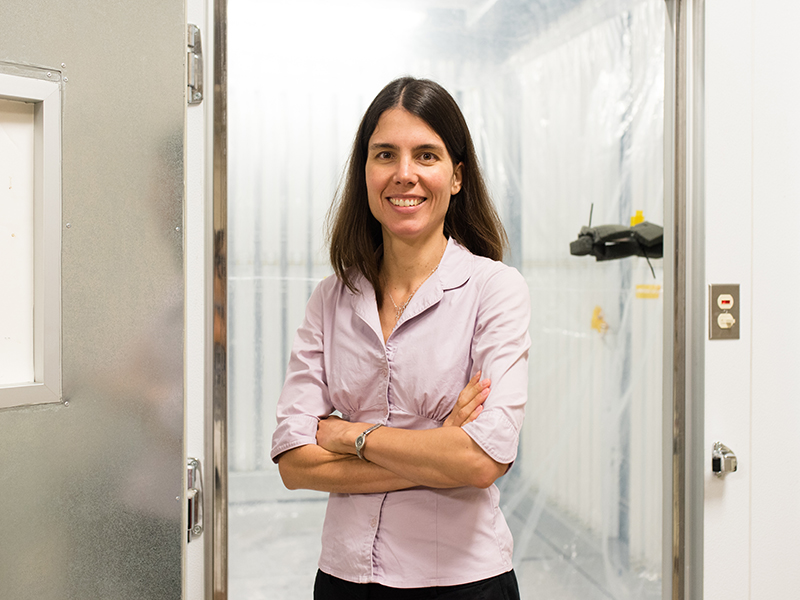
Lea Hildebrandt Ruiz
· Associate ProfessorVerifiedUniversity of Texas at Austin · Music
Active 1979–2026
About
Lea Hildebrandt Ruiz is an Associate Professor in the Department of Chemical Engineering at The University of Texas at Austin. She holds dual Ph.D. degrees in Chemical Engineering and Engineering and Public Policy from Carnegie Mellon University, both earned in 2011, and a B.S. in Chemical Engineering from the California Institute of Technology, obtained in 2006. Her academic background combines rigorous training in chemical engineering with a strong foundation in public policy, reflecting an interdisciplinary approach to her research and teaching. The information provided does not include specific details about her research focus or key contributions.
Research topics
- Chemistry
- Cell biology
- Atmospheric sciences
- Environmental science
- Meteorology
- Inorganic chemistry
- Environmental chemistry
- Biology
- Organic chemistry
- Climatology
- Thermodynamics
- Molecular biology
- Physics
- Geology
- Geography
- Genetics
- Biochemistry
- Mineralogy
Selected publications
ACS Environmental Au · 2026-03-30
articleOpen accessThe performance of four widely used dispersion models (AERMOD, a single-equation Gaussian formulation, and two versions of CALPUFF) for predicting ambient hydrocarbon concentrations at a regional air quality monitor in the Eagle Ford Shale oil and gas production region was assessed. Model performance was found to vary considerably based on the performance objective, meteorological conditions, and temporal resolution. Among the models evaluated in this work, the methods used to estimate the dispersion coefficients and whether the model was plume- or puff-based strongly influenced model performance. Uncertainties in meteorological and emissions inputs also played an important role in model performance, but the significance of their impact varied depending on the performance objective. Techniques to identify and address model uncertainties and for selecting the best performing model for a given application are suggested.
ChemRxiv · 2026-02-05
articleOpen accessParticle emissions may persist in wildland-urban interface (WUI) fire burn zones during the post-fire period, yet their characteristics remain poorly understood. Following full containment of the 2025 Eaton Fire, we conducted mobile and stationary aerosol measurements to characterize the spatial variability and temporal dynamics of fine and ultrafine particles within and around the burn zone. Our results show that the median PM 2.5 concentrations were slightly lower within the burn zone (inside the fire perimeter) than at locations >1000 m outside the perimeter (11.1 vs 12.0 μg/m 3 ), but the burn zone exhibited a higher frequency of PM2.5 spikes (2.8 vs 2.2 peaks/km) with greater peak prominence (9.0 vs 6.0 μg/m 3 ) and shorter durations (2.9 vs 7.5 s). These results indicate transient and intense PM2.5 emissions within the burn zone, which may not be captured by time-integrated measurements. In addition, particle number concentrations within the burn zone were higher than the urban background measured ~23 km downwind (1.2×10 4 vs 9.5×10 3 particles/cm 3 ). Distinct aerosol dynamics were observed within the burn zone that may contribute to elevated particle number concentrations, including (1) formation and growth of ultrafine particles and (2) shrinkage and disintegration of submicron particles. Together, these observations demonstrate that post-fire period represents an active and evolving phase of WUI particle emissions with important implications for human exposure and health.
ChemRxiv · 2026-04-10
articleParticle emissions may persist in wildland-urban interface (WUI) fire burn zones during the post-fire period, yet their characteristics remain poorly understood. Following full containment of the 2025 Eaton Fire, we conducted mobile and stationary aerosol measurements to characterize the spatial variability and temporal dynamics of fine and ultrafine particles within and around the burn zone. Our results show that the median PM 2.5 concentrations were slightly lower within the burn zone (inside the fire perimeter) than at locations >1000 m outside the perimeter (11.1 vs 12.0 μg/m 3 ), but the burn zone exhibited a higher frequency of PM2.5 spikes (2.8 vs 2.2 peaks/km) with greater peak prominence (9.0 vs 6.0 μg/m 3 ) and shorter durations (2.9 vs 7.5 s). These results indicate transient and intense PM2.5 emissions within the burn zone, which may not be captured by time-integrated measurements. In addition, particle number concentrations within the burn zone were higher than the urban background measured ~23 km downwind (1.2×10 4 vs 9.5×10 3 particles/cm 3 ). Distinct aerosol dynamics were observed within the burn zone that may contribute to elevated particle number concentrations, including (1) formation and growth of ultrafine particles and (2) shrinkage and disintegration of submicron particles. Together, these observations demonstrate that post-fire period represents an active and evolving phase of WUI particle emissions with important implications for human exposure and health.
Environmental Science & Technology Letters · 2026-04-21
articleParticle emissions may persist in wildland–urban interface (WUI) fire burn zones during the postfire period, yet their characteristics remain poorly understood. Following full containment of the 2025 Eaton Fire, we conducted aerosol measurements to characterize the spatial variability and temporal dynamics of fine and ultrafine particles within and around the burn zone. We found that the burn zone (inside the fire perimeter) exhibited slightly lower median PM2.5 concentrations than locations >1000 m outside the perimeter (11.1 vs 12.0 μg/m3) but more frequent transient PM2.5 concentration peaks (2.8 vs 2.2 peaks/km) with greater prominence (9.0 vs 6.0 μg/m3) and shorter durations (2.9 vs 7.5 s). These results indicate intermittent and intense PM2.5 emissions that were not captured by time-integrated measurements. In addition, particle number concentrations within the burn zone were higher than the urban background measured ∼23 km downwind (1.2 × 10⁴ vs 9.5 × 10³ particles/cm3). Distinct aerosol dynamics were observed within the burn zone that may contribute to elevated particle number concentrations, including (1) formation and growth of ultrafine particles and (2) shrinkage and disintegration of submicron particles. Together, these observations demonstrate that the postfire period represents an active and evolving phase of WUI particle emissions with important implications for human exposure and health.
Attributing Ambient Hydrocarbon Concentrations to Local Oil and Gas Emission Sources
ChemRxiv · 2026-04-20
articleOpen accessEmissions from oil and gas sources located near populated regions can have impacts on air quality, resulting in potential acute and chronic exposures. This work couples a highresolution emission inventory with dispersion modeling to quantify the contribution of hydrocarbon emissions from oil and gas operations to populated areas in Midland, Texas, within the Permian Basin oil and gas production region. The analyses examine the impacts of oil and gas emission sources within three concentric zones extending 5, 10, and 15 km from the Midland city center. The spatially and temporally resolved inventory provides hourly emission estimates for oil and gas operations including pre-production activities, production, gathering, and flaring. Dispersion modeling was conducted at an hourly resolution for a representative one-week period in February 2022. Results predict that sources within the 15-km radius contribute average concentrations of 24 ppb, 25 ppb, and 0.28 ppb for ethane, propane, and benzene, respectively. These nearby sources account for an average of about 50% of the total predicted concentrations for ethane, propane, and benzene from oil and gas sources. The analyses also show that nearby sources, coupled with certain meteorological conditions, can lead to acute episodic concentrations exceeding 600 ppb for ethane and propane, and 7 ppb for benzene.
ChemRxiv · 2025-12-22
articleThe performance of four widely used dispersion models (AERMOD, a single equation Gaussian formulation, and two versions of CALPUFF) for predicting ambient hydrocarbon concentrations at a regional air quality monitor in the Eagle Ford Shale oil and gas production region was assessed. Model performance is found to vary considerably based on the performance objective, meteorological conditions, and temporal resolution. Among the models evaluated in this work, the methods used to estimate the dispersion coefficients and whether the model was plume- or puff-based strongly influenced model performance. Uncertainties in meteorological and emissions inputs also played an important role in model performance, but the significance of their impact varied depending on the performance objective. Techniques to identify and address model uncertainties and for selecting the best performing model for a given application are suggested.
Chlorine-Initiated Oxidation of Limonene under Simulated Indoor and Outdoor Lighting Conditions
ACS ES&T Air · 2025-07-22
articleSenior authorCorrespondingLimonene is the fourth most emitted biogenic volatile organic compound and is often used as a fragrance and emitted from personal care products, cleaning products, and others. Chlorine gas (Cl2), a precursor for Cl atoms, is emitted from anthropogenic activities, including cleaning, disinfection, and industrial activities, and it also forms from heterogeneous reactions involving sea salt. Thus, limonene and Cl radical precursors can both be present in indoor and outdoor environments. We studied the chlorine-initiated oxidation of limonene under indoor lighting (LED lights) and simulated outdoor lighting (a combination of UVA and LED lights) using an environmental chamber and a suite of instruments measuring gas and particle phase products. OH radicals formed and dominated the oxidation of limonene in the presence of NOx, Cl2, and LED lights, highlighting that Cl-initiated chemistry can generate OH chemistry in indoor environments, even in the absence of sunlight. Measurements from an iodide chemical ionization mass spectrometer showed gas phase reaction products from both Cl and OH addition to limonene, including nitrated species LIMANO3 (C10H17NO4) and LIMALNO3 (C10H17NO6). Secondary organic aerosol (SOA) yields were high, exceeding 1.1 in experiments with low NOx and high limonene concentrations, and showed strong dependence on temperature, NOx, and the VOC/Cl2 ratio. These findings suggest that Cl2 can contribute to the indoor and outdoor SOA formation from limonene oxidation through direct oxidation and secondary OH chemistry.
ACS ES&T Air · 2025-08-05 · 2 citations
articleOpen accessMeasurements of ambient ethane concentrations at a regional air quality monitor in the Eagle Ford oil and gas production region are compared to concentrations predicted using site-level hydrocarbon emission inventories coupled with a Gaussian puff dispersion model (CALPUFF). To account for more than half of mean concentrations due to routine emissions, sites at distances 20-50 km from the receptor site were included in the simulations. Nearly all of the highest observed concentrations were observed at night. For each night in the simulation, the location and magnitude of the maximum predicted concentration and maximum observed concentration were compared, and approximately two-thirds of the highest observed nighttime maximum concentrations were accounted for by routine emissions. In contrast, approximately a third of the highest daytime maxima could be accounted for by routine emissions. Most of the large observed maxima that are attributable to routine emissions are predicted to be caused by sources that were within 10 km of the receptor site, but sources up to 20 or more kilometers from the receptor also contributed to the predicted concentrations. A case study is provided demonstrating the potential of coupling site-level inventories of routine emissions with dispersion modeling for attributing sources of elevated hydrocarbon concentrations.
Atmosphere · 2025-09-03
articleOpen accessSenior authorTemporal variability in emissions from oil and gas supply chains depends on the spatial scale at which emissions are aggregated. This work demonstrates a framework for simulating temporally and spatially resolved emission inventories that can be broadly applied in oil and gas production regions. Emissions of methane, ethane, volatile organic compounds (VOCs), and nitrogen oxides (NOxs) from oil and gas facilities in the Marcellus production region were estimated at a one-hour time resolution for the calendar year 2023 and were aggregated at the grid cell (4 km by 4 km), county, and basin level. Maximum to average emission rate ratios decreased as the scale of spatial aggregation increased and differed by pollutant. At the grid cell level, ratios of maximum to average emission rates exceeded 100 in some grid cells for VOCs. In contrast, basin level maximum to average ratios for NOx emission rates were less than 1.1. The sources driving temporal variability in hydrocarbon emissions were well completions and liquid unloadings, while the sources driving temporal variability in NOx emissions were preproduction activities such as drilling and hydraulic fracturing. Temporally and spatially resolved inventories can inform pollutant- and region-specific measurement campaigns and mitigation strategies. Reconciliation between inventories and observations must consider event frequency, duration, and persistence, along with the spatial scale and timing of measurements.
Modelling indoor radical chemistry during the HOMEChem campaign
Environmental Science Processes & Impacts · 2024-12-11 · 7 citations
articleOpen access). This underlines the high oxidation capacity of the indoor atmospheric environment through determining the abundance of volatile organic compounds.
Recent grants
Collaborative Research: ICARUS - Index of Chamber Atmospheric Research in the United States
NSF · $73k · 2017–2021
NSF · $191k · 2019–2023
RAPID: COVID Response: Identifying practices that minimize exposure to disinfection byproducts
NSF · $190k · 2020–2021
CAREER: Air-Quality Effects of Atmospheric Chlorine Chemistry
NSF · $624k · 2017–2022
AGS-PRF: Understanding the Early Growth of Atmospheric Nanoparticles
NSF · $86k · 2011–2012
Frequent coauthors
- 41 shared
Joshua S. Apte
University of California, Berkeley
- 34 shared
Sahil Bhandari
Environmental Defense Fund
- 33 shared
Gazala Habib
Indian Institute of Technology Delhi
- 30 shared
Shahzad Gani
The University of Texas at Austin
- 26 shared
Kanan Patel
- 24 shared
Dongyu Wang
Southwest University of Science and Technology
- 23 shared
Zainab Arub
- 18 shared
J. L. Jiménez
Labs
Education
- 2006
B.S., Chemical Engineering
California Institute of Technology
- 2011
Ph.D., Chemical Engineering and Engineering & Public Policy
Carnegie Mellon University
Awards & honors
- James J. Morgan Early Career Award, American Chemical Societ…
- Early Career Award – American Institute of Chemical Engineer…
- CAREER Award, U.S. National Science Foundation (2017–2022)
- Postdoctoral Research Fellowship – National Science Foundati…
- Graduate Research Fellowship – EPA (2010–2011)
- Resume-aware match score
- Save to shortlist
- AI-drafted outreach
See your match with Lea Hildebrandt Ruiz
PhdFit ranks faculty by your research interests, methods, and publications — grounded in their actual work, not templates.
- Free to start
- No credit card
- 30-second signup