
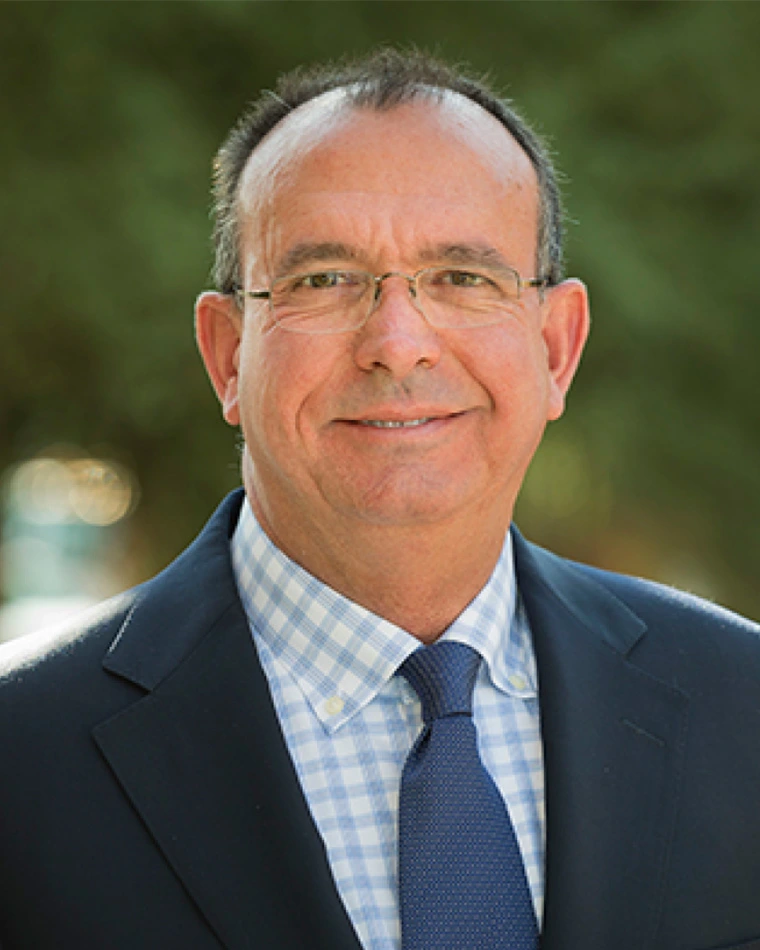
Larry Head
· Professor of Systems and Industrial Engineering, Director of the Craig M. Berge Engineering Design Program, Member of the Graduate FacultyUniversity of Arizona · Systems Engineering
Active 1989–2026
Academic metrics are sourced from OpenAlex and public funding records; values may differ from Google Scholar.
About
Larry Head is a professor of systems and industrial engineering at the University of Arizona with over 30 years of academic and industry experience. His expertise encompasses systems engineering, engineering management, adaptive traffic signal control and signal priority, as well as connected and automated vehicle systems. He has served in various leadership roles including interim dean of the College of Engineering, interim vice provost for Online Learning, director of the Transportation Research Institute, and department head of the Systems and Industrial Engineering Department at the university. His research interests focus on cyber-physical systems, intelligent systems, connected and autonomous vehicles, urban traffic operations, transportation modeling, and intelligent transportation systems. He is actively involved in professional organizations such as the Transportation Research Board, SAE, ASEE, INFORMS, IISE, and IEEE, and serves as an associate editor for Transportation Research – Part C. Dr. Head contributes to the field through his work on traffic signal systems, connected vehicle environments, and transportation safety, and has been recognized with multiple awards for his scholarly contributions.
Research topics
- Computer Science
- Real-time computing
- Engineering
- Transport engineering
- Simulation
- Operations research
- Remote sensing
- Telecommunications
Selected publications
Peer-to-Peer Priority Signal Control Strategy in a Connected Vehicle Environment
Transportation Research Record Journal of the Transportation Research Board · 2018-05-22 · 22 citations
articleThis paper presents a methodology that enhances the priority signal control model in the multi-modal intelligent traffic signal system (MMITSS). To overcome the range limit of vehicle to infrastructure (V2I) and the intersection geometry message (MAP) distance limits, peer-to-peer intersection communications are utilized to send priority requests from adjacent intersections. Through integrated communication, the peer priority control strategy can create a signal plan for prioritized vehicles tha…
Transportation Research Record Journal of the Transportation Research Board · 2021 · 20 citations
This paper presents an emergency vehicle priority control system based on connected vehicle technology, called MMITSS priority. Traditional preemption does not consider the effect of the current traffic situation, such as the presence of a freight vehicle in the dilemma zone, on an opposing movement and can have a significant negative impact on the minor movements of vehicles. A mixed integer linear programming model is developed which can consider the priority requests from multiple emergency v…
Transportation Research Record Journal of the Transportation Research Board · 2018-07-11 · 14 citations
articleOpen accessConflicts between vehicles and vulnerable road users (VRUs) often result in injuries and fatalities. This paper presents a vehicle-to-infrastructure and Wi-Fi based pedestrian conflict avoidance system to improve VRUs’ safety. Compared with the vision based systems, the proposed system can improve VRUs’ safety in non-line-of-sight situations. In particular, it can be helpful in a situation when drivers are making a right or left turn where there is a crosswalk and visibility conditions are poor.…
Quantitative Analysis of Smooth Progression in Traffic Signal Systems
Journal of Transportation Engineering Part A Systems · 2017-12-28 · 14 citations
articleTraffic signal coordination has been widely used to provide smooth progression for platoons on signalized arterials to enhance performance measures such as travel times, number of stops, and delay. Considering smooth progression as the significant factor of coordination, many studies have been conducted to measure the quality of progression. However, none of these studies concentrated on measuring a continuous smooth driving pattern of each vehicle in terms of speed. In order to quantify the smo…
Reducing Conflict Between Vulnerable Road Users and Automated Vehicles
Lecture notes in mobility · 2017-06-28 · 13 citations
book-chapter
Frequent coauthors
- 47 shared
Yiheng Feng
- 25 shared
Shayan Khoshmagham
- 22 shared
Mehdi Zamanipour
Federal Highway Administration
- 18 shared
Wanjing Ma
Shaanxi University of Science and Technology
- 14 shared
Pitu B. Mirchandani
Arizona State University
- 14 shared
Byungho Beak
- 12 shared
Rahul Bhadani
- 11 shared
Douglas Gettman
Awards & honors
- Trevor O. Jones Outstanding Paper Award 2021
- Exceptional Paper Award, Committee on Traffic Signal Systems…
- 2016 Best ITS Implementation Project ITS Arizona, Fall 2016
- 2016 Member of the Year ITS Arizona, Fall 2016
- da Vinci Fellow College of Engineering University of Arizona…
Similar researchers at University of Arizona
- Resume-aware match score
- Save to shortlist
- AI-drafted outreach
See your match with Larry Head
PhdFit ranks faculty by your research interests, methods, and publications — grounded in their actual work, not templates.
- Free to start
- No credit card
- 30-second signup