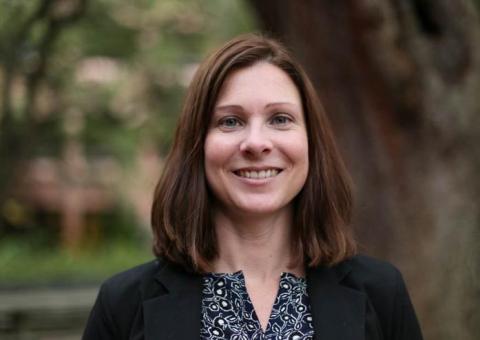
Kristen Apraiz
· Clinical Associate ProfessorUniversity of Florida · Education
Active 2015–2025
About
Dr. Kristen Apraiz is a Clinical Associate Professor in the School of Teaching and Learning at the University of Florida. She has been engaged in mathematics teacher preparation in both elementary and secondary school programs. She is currently most involved in the mathematics coordination and teaching in the UFTeach program, a UTeach institute member program with minors in secondary mathematics and science education. The program emphasizes providing preservice teachers with field experiences that challenge their notions of teaching secondary mathematics and structuring opportunities for reflection to foster their growth as educators. Dr. Apraiz helps build partnerships with local K-12 schools and non-profit organizations, offering preservice teachers opportunities to work with educators and students. Her research interests include teacher education for both preservice and practicing teachers, with a focus on field experiences for secondary mathematics preservice teachers, developing reflective preservice teachers, and the role of technology in preservice teacher education. She currently serves as the mathematics facilitator for the Prime Online project, which focuses on teacher pedagogical content knowledge and research-based practices in inclusive elementary mathematics classrooms.
Research topics
- Political Science
- Sociology
- Computer Science
- Pedagogy
- Psychology
- Mathematics education
Selected publications
Advances in early childhood and K-12 education · 2025-01-10
book-chapterSenior authorA novel approach to an initial field experience for prospective secondary mathematics and science teachers is described. This field experience is based on a partnership between a university teacher preparation program and a local elementary after-school extended day enrichment program to found a STEM club, providing supplementary STEM instruction to the elementary students while also creating opportunities for prospective teachers to plan, teach, and reflect upon weekly lessons in a shared field experience. Across 10 weeks of STEM club meetings, prospective teachers implemented lessons and activities to small groups of elementary students, sorted by grade levels. Lessons were guided by state standards, the mathematical, science, and engineering practices, and based on the 5E lesson cycle format. This chapter describes the reasoning behind the design of the STEM club field experience, the cycle of planning, teaching, and reflection, and includes insights gained in the implementation of this model across spring and fall semesters since 2016.
Robot Sharks: An AI and STEM Adventure for 5th Grade Students
Journal of Technology-Integrated Lessons and Teaching · 2025-12-11
articleOpen accessThis five-lesson artificial intelligence (AI) and STEM integrated unit was designed for 5th graders in an informal learning context. Each lesson featured 45 minutes of instruction following the 5E model, which centered on the topic of sharks. Students explored sharks from multiple disciplinary perspectives, including computational thinking (CT), math, statistics, and science. They then employed educational robots (Sphero Bolt) to design and program their own robot sharks through inquiry-based activities oriented in the engineering design process. This course concluded by having the students design and code their robots to represent and explain the knowledge they gained about sharks.
Creating Opportunities for Struggling Mathematics Learners in Inclusive Schools
Routledge eBooks · 2021
- Computer Science
- Sociology
- Political Science
This chapter includes literature on mathematics instruction in inclusive schools from the perspectives of two professional fields (i.e., mathematics education and special education). This knowledge base is grounded in several interrelated areas including: Response-to-Intervention (RTI), factors affecting students’ mathematics performance, professional collaboration, professional preparation and teacher development, research on mathematics instruction, and school and classroom practice. Reflecting on this literature, the chapter concludes with recommendations for future research, policy, and practice.
2018-01-01
article1st authorCorresponding2018-01-01 · 1 citations
articleSenior authorWhat goes right, when things go wrong during a project-based learning field experience
2018-01-01 · 1 citations
articleSenior authorUsing Technology to Think Critically about Mathematical Content
Society for Information Technology & Teacher Education International Conference · 2016-03-21
article1st authorCorrespondingSociety for Information Technology & Teacher Education International Conference · 2016-03-21
articleSenior authorModeling Technology Integration Through Online Course Design
Society for Information Technology & Teacher Education International Conference · 2015-03-02
articleSenior authorSociety for Information Technology & Teacher Education International Conference · 2015-03-02
articleSenior author
Frequent coauthors
- 4 shared
Cheryl A. McLaughlin
- 4 shared
Krista Ruggles
Utah Valley University
- 2 shared
Julie C. Brown
University of Florida
- 2 shared
Kent J. Crippen
University of Florida
- 2 shared
Gayle N Evans
- 2 shared
Rich Busi
James Madison University
- 2 shared
Ali TEMURTAŞ
Adıyaman University
- 2 shared
Derya Evran
Awards & honors
- Preview Advisor for the College of Liberal Arts and Sciences…
- Faculty Advising/Mentor of the Year, College of Education, U…
- Undergraduate Teacher of the Year, College of Education, Uni…
- Resume-aware match score
- Save to shortlist
- AI-drafted outreach
See your match with Kristen Apraiz
PhdFit ranks faculty by your research interests, methods, and publications — grounded in their actual work, not templates.
- Free to start
- No credit card
- 30-second signup