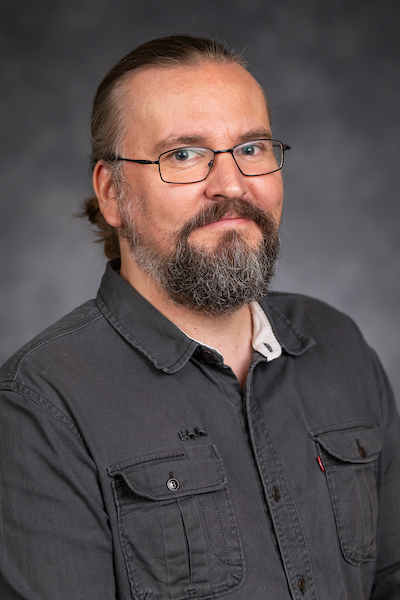
Kevin W. Conway
· Professor and Curator of FishesVerifiedTexas A&M University · Ecology and Conservation Biology
Active 1981–2026
About
Kevin W. Conway, Ph.D., is an associate professor in the Texas A&M University Department of Ecology and Conservation Biology and serves as the Curator of Fishes at the Texas A&M University Biodiversity Research and Teaching Collections. His research program is focused on the taxonomy, phylogenetic relationships, and comparative anatomy of ray-finned fishes. He has conducted ichthyological field work to collect freshwater and marine fishes across North, Central, and South America, Africa, Asia, and Australasia. Dr. Conway has published 100 scientific papers, including the description of 43 new species and 6 new genera of fishes. He holds a B.Sc. (Hon.) in Zoology from the University of Glasgow, an M.Sc. in Advanced Methods in Taxonomy and Biodiversity from Imperial College London, and a Ph.D. in Biology from Saint Louis University. His expertise encompasses ichthyology, taxonomy, phylogenetics, and comparative anatomy.
Research topics
- Biology
- Genetics
- Evolutionary biology
- Computer Science
- Artificial Intelligence
- Zoology
- Anatomy
- Geography
- Multimedia
- World Wide Web
- Developmental psychology
- Telecommunications
- Psychology
- Cartography
- Data science
- Fishery
- Neuroscience
Selected publications
The Catalogue of Life · 2026-02-16
datasetOpen access1st authorCorrespondingThe Catalogue of Life · 2026-02-16
datasetOpen accessSenior authorScientific Reports · 2026-04-06
articleOpen accessDams and their associated reservoirs have become so ubiquitous on the world's riverscapes that only 23% of rivers now flow freely to the ocean. These artificial structures have known ecological consequences, but ecological studies often suffer from a lack of historical baseline data and uncertainty regarding the degree to which concepts are transferable among altered river systems. We reviewed historical fish assemblage survey data collected over 373 km of the upper Sabine River, Texas, USA during 1954-1955, prior to construction of large reservoirs at the upstream and downstream extents of the study area. We then repeated surveys using identical methods in 2023 after reservoirs were in place for multiple decades. The resulting dataset provided opportunity to measure impoundment-driven deviations from historical baseline conditions and test a suite of hypotheses centered on fish assemblage changes across a gradient of proximities (i.e., distances) from reservoirs. We found support for the proximity replacement hypothesis in which fish assemblages nearest to reservoirs experience the highest temporal beta diversity; support for the longitudinal recovery gradient hypothesis in which relative abundance of periodic life history strategists returns to a natural baseline with greater downstream distance from dam tailwaters; support for the proximity host loss hypothesis in which fishes that serve as hosts to Unionid mussels decline in reservoir tailwaters; and support for the proximity host gain hypothesis in which fishes that serve as hosts to Unionid mussels increase in the river-reservoir interface upstream of a dam. This work advances knowledge of ecological consequences associated with dam construction by revealing that concepts developed using space-for-time substitutions (i.e., without historical baseline information) remain pertinent when tested against historical benchmarks and these same concepts are applicable to unstudied systems.
The Catalogue of Life · 2026-02-17
datasetOpen accessThe Catalogue of Life · 2026-02-16
datasetOpen access1st authorCorrespondingThe Catalogue of Life · 2026-02-16
datasetOpen access1st authorCorrespondingVertebrate Zoology · 2026-03-11
articleOpen accessSenior authorThe Catalogue of Life · 2026-02-16
datasetOpen access1st authorCorrespondingA New Genus and Species of Clingfish (Teleostei: Gobiesocidae) from Western Australia
The Catalogue of Life · 2026-02-16
datasetOpen access1st authorCorresponding
Recent grants
NSF · $205k · 2021–2026
Digitization TCN: Collaborative Research: oVert: Open Exploration of Vertebrate Diversity in 3D
NSF · $130k · 2017–2023
NSF · $282k · 2013–2019
Frequent coauthors
- 32 shared
Adam P. Summers
Burke Museum of Natural History and Culture
- 29 shared
Ralf Britz
- 18 shared
Glenn I. Moore
Australian Museum
- 15 shared
Richard L. Mayden
Saint Louis University
- 13 shared
Lukas Rüber
Natural History Museum of Bern
- 11 shared
Hiroyuki Motomura
Kagoshima University
- 11 shared
Amanda K. Pinion
Senckenberg Natural History Collections Dresden
- 11 shared
Kole M. Kubicek
Lamar University
Education
Other, Zoology
University of Glasgow
M.S., Advanced Methods in Taxonomy and Biodiversity
Imperial College London
Ph.D., Biology
Saint Louis University
- Resume-aware match score
- Save to shortlist
- AI-drafted outreach
See your match with Kevin W. Conway
PhdFit ranks faculty by your research interests, methods, and publications — grounded in their actual work, not templates.
- Free to start
- No credit card
- 30-second signup