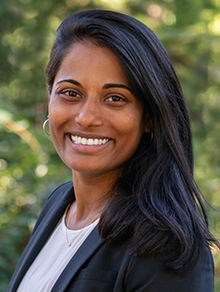
Katya Cherukumilli
· Assistant ProfessorVerifiedUniversity of Washington · Human Centered Design & Engineering
Active 2011–2023
About
Katya Cherukumilli is an Assistant Professor in the Department of Human Centered Design & Engineering at the University of Washington. Her research focuses on drinking water treatment, design for social good, environmental chemistry, and technology design and implementation. She is dedicated to advancing solutions that address social and environmental challenges through innovative design and engineering practices.
Research topics
- Computer Science
- Environmental engineering
- Environmental science
- Environmental planning
- Business
- Waste management
- Natural resource economics
- Engineering
- Environmental economics
- Geography
- Chemistry
Selected publications
Evaluating the hidden costs of drinking water treatment technologies
Nature Water · 2023-04-03 · 24 citations
articleOpen access1st authorEstimating the Global Target Market for Passive Chlorination
medRxiv · 2022-11-01 · 1 citations
preprintOpen access1st authorAbstract Deployment of passive (in-line) chlorinators, devices that disinfect water without electricity or daily user input, is one strategy to advance access to safely managed drinking water. Using the Joint Monitoring Programme (JMP) data, we first calculate the number of people in low- and middle-income countries (LMICs) using drinking water sources that are either compatible (piped water, kiosks) or potentially compatible (packaged/delivered water, rainwater, tubewells, boreholes, protected springs) with passive chlorinators. Leveraging water quality data from the Multiple Indicator Cluster Surveys (MICS), we estimate that 2.32 [95% CI: 2.19, 2.46] billion people in LMICs use microbially contaminated (with fecal indicator bacteria) drinking water sources that are compatible (1.51 [1.42, 1.60] billion) or potentially compatible (817 [776, 858] million) with passive chlorinators. The largest target market for passive chlorinators is in South Asia (551 [532, 571] million rural users and 401 [384, 417] million urban users), where over 77% of drinking water sources compatible with passive chlorinators are contaminated. However, self-reported household water treatment practices indicate that chlorination is more common in the African and Latin American regions, suggesting passive chlorination would have higher acceptance in these regions compared to Asia. Reaching the full target market will require establishing passive chlorinator compatibility with handpumps and protected springs and identifying financially viable implementation models. Abstract Figure
Estimating the Global Target Market for Passive Chlorination
Environmental Science & Technology Letters · 2022-12-26 · 5 citations
article1st authorDeploying passive (in-line) chlorinators is one strategy for improving access to microbially safe drinking water without requiring electricity or daily user input. Using Joint Monitoring Programme data, we calculate the population in low- and middle-income countries (n = 135 LMICs) using drinking water sources that are compatible (piped water and kiosks) or potentially compatible (packaged and/or delivered water, rainwater, boreholes and/or tube wells, and protected springs) with passive chlorinators. Leveraging water quality data from the Multiple Indicator Cluster Surveys (n = 37 LMICs), we estimate that 2.32 [95% confidence interval (CI): 2.19, 2.46] billion people use microbially contaminated water sources that are compatible [1.51 (1.42, 1.60) billion] or potentially compatible [817 (776, 858) million] with passive chlorinators. The largest target market for passive chlorinators is in South Asia [551 (532, 571) million rural users and 401 (384, 417) million urban users], where >77% of compatible drinking water sources are contaminated. However, self-reported household water treatment practices (n = 54 LMICs) indicate that chlorination is more common in the African and Latin American regions, suggesting passive chlorination would have higher acceptance in these regions than in Asia. Reaching the full potential of passive chlorinators will require establishing compatability of technologies with hand pump chlorination and identifying financially viable implementation models.
Passive In-Line Chlorination for Drinking Water Disinfection: A Critical Review
Environmental Science & Technology · 2022 · 84 citations
- Computer Science
- Business
- Environmental science
The world is not on track to meet Sustainable Development Goal 6.1 to provide universal access to safely managed drinking water by 2030. Removal of priority microbial contaminants by disinfection is one aspect of ensuring water is safely managed. Passive chlorination (also called in-line chlorination) represents one approach to disinfecting drinking water before or at the point of collection (POC), without requiring daily user input or electricity. In contrast to manual household chlorination methods typically implemented at the point of use (POU), passive chlorinators can reduce the user burden for chlorine dosing and enable treatment at scales ranging from communities to small municipalities. In this review, we synthesized evidence from 27 evaluations of passive chlorinators (in 19 articles, 3 NGO reports, and 5 theses) conducted across 16 countries in communities, schools, health care facilities, and refugee camps. Of the 27 passive chlorinators we identified, the majority (22/27) were solid tablet or granular chlorine dosers, and the remaining devices were liquid chlorine dosers. We identified the following research priorities to address existing barriers to scaled deployment of passive chlorinators: (i) strengthening local chlorine supply chains through decentralized liquid chlorine production, (ii) validating context-specific business models and financial sustainability, (iii) leveraging remote monitoring and sensing tools to monitor real-time chlorine levels and potential system failures, and (iv) designing handpump-compatible passive chlorinators to serve the many communities reliant on handpumps as a primary drinking water source. We also propose a set of reporting indicators for future studies to facilitate standardized evaluations of the technical performance and financial sustainability of passive chlorinators. In addition, we discuss the limitations of chlorine-based disinfection and recognize the importance of addressing chemical contamination in drinking water supplies. Passive chlorinators deployed and managed at-scale have the potential to elevate the quality of existing accessible and available water services to meet "safely managed" requirements.
Environmental Science Water Research & Technology · 2021-01-01 · 9 citations
article1st authorCorrespondingColumn filters can effectively adsorb fluoride using bauxite, an abundant natural mineral ore, instead of activated alumina, an expensive and industrially refined media.
Annual Review of Environment and Resources · 2020 · 66 citations
- Computer Science
- Environmental science
- Environmental planning
Chemical contamination of drinking water (including salinity) puts more than one billion people at risk of adverse health effects globally. Resource-constrained communities are the most affected and face unique challenges that require innovative safe water solutions. This review focuses on arsenic, fluoride, nitrates, lead, chromium, total dissolved solids, emerging organic contaminants, and, to a lesser extent, manganese, cadmium, selenium, and uranium. It covers contaminant prevalence, major health effects, and treatment technologies or avoidance strategies that have been proven effective in realistic water matrices and conditions. The review covers the levelized costs of water for pilot- and full-scale systems most relevant to resource-constrained communities, with a focus on component costs, including the costs of power systems, lifting water, waste management, and labor. These costs are not universally reported, but can be significant. The findingsare analyzed and discussed in the context of providing sustainable safe water solutions in resource-constrained settings.
Water Research · 2020 · 97 citations
- Environmental science
- Environmental planning
- Environmental engineering
Elsevier eBooks · 2019-01-01
book-chapterAddressing Groundwater Fluoride Contamination Using Inexpensively Processed Bauxite
Elsevier eBooks · 2019-01-01 · 3 citations
book-chapterOpen accessSenior authorAGU Fall Meeting Abstracts · 2019-12-01
article1st authorCorresponding
Frequent coauthors
- 16 shared
Ashok Gadgil
University of California, Berkeley
- 6 shared
Sanaullah Khan
- 4 shared
Heather L. Buckley
University of Victoria
- 4 shared
Lee E. Voth‐Gaeddert
- 4 shared
Yoshika S. Crider
Center for Global Development
- 4 shared
Adil Dhalla
Nanyang Technological University
- 4 shared
Amy J. Pickering
- 2 shared
Jasmina Markovski
Arizona State University
Education
- 2017
Ph.D., Civil and Environmental Engineering
University of California Berkeley
Awards & honors
- UW CoMotion Innovation Fund and Postdoctoral Fellowship (201…
- R&D Magazine Top 100 Inventions Award (2017)
- Bay Area Global Health Innovation Challenge Grand Prize (201…
- National Science Foundation Graduate Student Fellowship (NSF…
- Resume-aware match score
- Save to shortlist
- AI-drafted outreach
See your match with Katya Cherukumilli
PhdFit ranks faculty by your research interests, methods, and publications — grounded in their actual work, not templates.
- Free to start
- No credit card
- 30-second signup