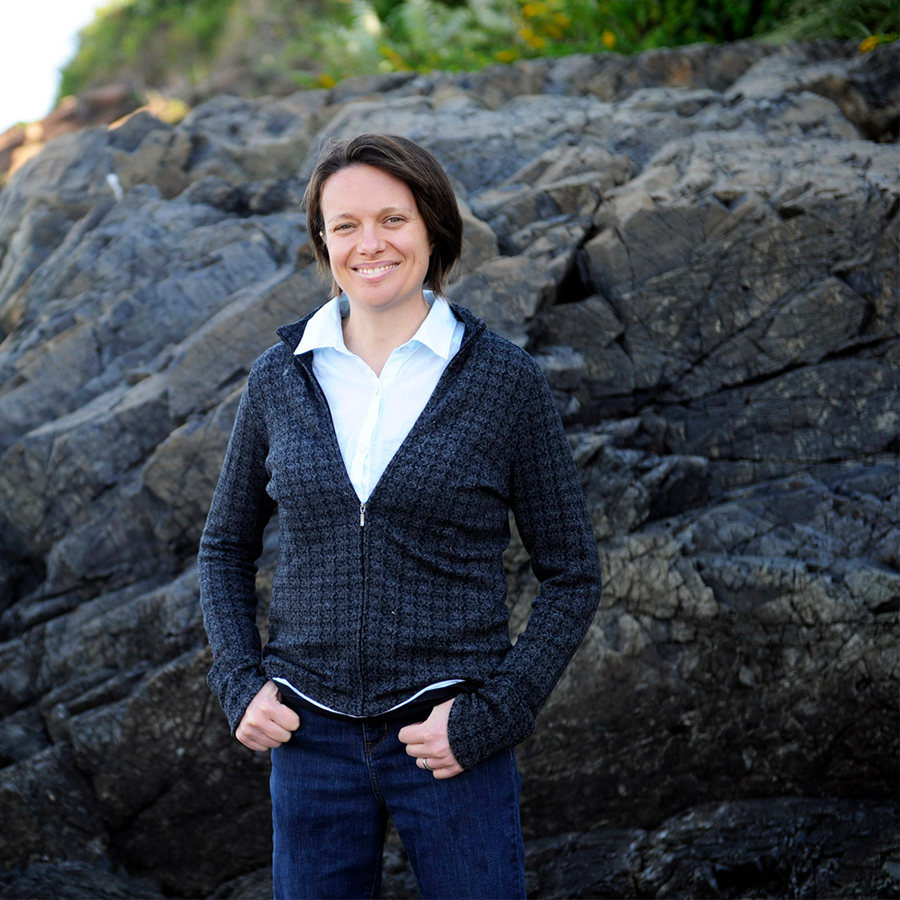
Katie Lotterhos
· Associate Professor, Marine and Environmental SciencesNortheastern University · Civil and Environmental Engineering
Active 2002–2024
About
Katie Lotterhos is an associate professor of marine and environmental sciences at Northeastern University, affiliated with the Coastal Sustainability Institute and the Marine Science Center. Her research employs eco-evolutionary genomics to understand how climate has historically shaped biodiversity and to predict how a rapidly changing climate will impact marine life in the future. Her work integrates theory and experimentation, developing novel statistical methodologies to analyze data across biological, spatial, and temporal scales. Current projects include studying the responses of marine invertebrates to ocean acidification and pollution, analyzing the population dynamics of fisheries with applications to management and marine reserve design, and advancing methods in statistical genomics. She has received notable recognition for her contributions, including a CAREER award from the National Science Foundation and a Fulbright scholarship. Dr. Lotterhos is actively involved in collaborative efforts, such as the Genomics Partnership at the Gloucester Marine Genomics Institute, and her research has been highlighted in various media outlets. Her work aims to inform conservation strategies and improve understanding of how climate change affects marine biodiversity, with a focus on practical applications like oyster enhancement and predicting species survival under changing ocean conditions.
Research topics
- Computer Science
- Biology
- Machine Learning
- Evolutionary biology
- Genetics
- Ecology
- Agroforestry
Selected publications
Philosophical Transactions of the Royal Society B Biological Sciences · 2022 · 80 citations
Senior authorCorresponding- Computer Science
- Machine Learning
- Biology
outliers, sometimes overlapping with other inversions) are consistent with a highly polygenic architecture, and inversions do not need to contain any large-effect genes to play an important role in local adaptation. By combining a population and quantitative genetic framework, our results give a deeper understanding of the specific conditions needed for inversions to be involved in adaptation when the genetic architecture is polygenic. This article is part of the theme issue 'Genomic architecture of supergenes: causes and evolutionary consequences'.
Seeing the forest for the trees: Assessing genetic offset predictions from gradient forest
Evolutionary Applications · 2022 · 87 citations
Senior authorCorresponding- Computer Science
- Biology
- Agroforestry
Gradient Forest (GF) is a machine learning algorithm designed to analyze spatial patterns of biodiversity as a function of environmental gradients. An offset measure between the GF-predicted environmental association of adapted alleles and a new environment (GF Offset) is increasingly being used to predict the loss of environmentally adapted alleles under rapid environmental change, but remains mostly untested for this purpose. Here, we explore the robustness of GF Offset to assumption violations, and its relationship to measures of fitness, using SLiM simulations with explicit genome architecture and a spatial metapopulation. We evaluate measures of GF Offset in: (1) a neutral model with no environmental adaptation; (2) a monogenic "population genetic" model with a single environmentally adapted locus; and (3) a polygenic "quantitative genetic" model with two adaptive traits, each adapting to a different environment. We found GF Offset to be broadly correlated with fitness offsets under both single locus and polygenic architectures. However, neutral demography, genomic architecture, and the nature of the adaptive environment can all confound relationships between GF Offset and fitness. GF Offset is a promising tool, but it is important to understand its limitations and underlying assumptions, especially when used in the context of predicting maladaptation.
The Importance of Genetic Redundancy in Evolution
Trends in Ecology & Evolution · 2020 · 189 citations
Senior authorCorresponding- Computer Science
- Evolutionary biology
- Computer Science
Recent grants
Testing the tests: a predictive framework to guide genome scans for locally adapted traits
NSF · $565k · 2017–2022
NSF · $715k · 2017–2020
RCN: Evolution in Changing Seas
NSF · $523k · 2018–2024
NSF · $1.5M · 2021–2026
Frequent coauthors
- 19 shared
Sara M. Schaal
NOAA National Marine Fisheries Service
- 14 shared
Sean Hoban
- 13 shared
Alan M. Downey‐Wall
Northeastern University
- 10 shared
Yaamini R. Venkataraman
Woods Hole Oceanographic Institution
- 10 shared
Steven Roberts
University of Washington
- 9 shared
Matthew P. Hare
Louisiana Department of Natural Resources
- 9 shared
Jonathan B. Puritz
University of Rhode Island
- 8 shared
Áki J. Láruson
Marine and Freshwater Research Institute
Labs
The Lotterhos Lab at Northeastern Marine Science CenterPI
Awards & honors
- NSF CAREER Award
- Fulbright scholarship
Similar researchers at Northeastern University
- Resume-aware match score
- Save to shortlist
- AI-drafted outreach
See your match with Katie Lotterhos
PhdFit ranks faculty by your research interests, methods, and publications — grounded in their actual work, not templates.
- Free to start
- No credit card
- 30-second signup