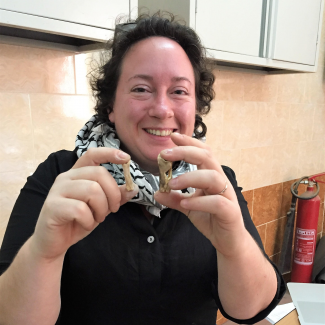
Kathryn Grossman
North Carolina State University · Anthropology
Active 1986–2025
About
Kathryn Grossman is an archaeologist and zooarchaeologist with expertise in the complex societies of Southwest Asia and the eastern Mediterranean. Her current research focuses on resistance to state-making, the biographies of early cities, and human/non-human animal relationships in early complex societies. She directs the Makounta-Voules Archaeological Project and has been a senior staff member on archaeological projects across Syria, Cyprus, Egypt, and Iraq. Grossman is also co-authoring the final report on excavations at Tell Qarqur, Syria, where she worked from 2006 to 2010. At NC State, she teaches courses in Introductory Archaeology, Mesopotamian Archaeology, Zooarchaeology, Egyptian Archaeology, and Archaeological Field Methods. Her previous teaching experience includes positions at MIT and Bradley University.
Research topics
- Political Science
- History
- Economy
- Economics
- Archaeology
- Sociology
- Ancient history
- Geography
- Economic history
- Medicine
- Law
- Political economy
Selected publications
Cities are different animals: A zooarchaeology of urbanism at Hamoukar, Syria, 5th–3rd millennia BC
Journal of Archaeological Science · 2025-11-14 · 2 citations
articleOpen access1st authorCorrespondingThe advent of urbanism marks a significant shift in human lifeways, and comparative study has shown that the world has seen many different forms of urbanism. We argue that animals were a fundamental part of what made cities different from other forms of settlement and different from one another. In this article, we provide the first long-term, diachronic analysis of a Mesopotamian city that foregrounds the evolving role of animals. We argue that the site of Hamoukar in northeastern Syria is best viewed as a succession of three cities, each distinctive in its own way and each dependent on animals in its own fashion. To make this argument, we summarize urban dynamics at Hamoukar from the late 5th through mid-late 3rd millennia BC, with a particular focus on faunal remains. We show that intensive and potentially long-distance caprine management was key to the first city; a more mixed animal economy, with caprines potentially harvested for wool, defined the second city; and pigs dominated the meat supply of the third city. Analysis of changing patterns in species composition, caprine survivorship, secondary products exploitation, and biometrics demonstrates that the three different cities were––both literally and metaphorically––different animals. • Cities are multispecies spaces and centers animals in urban economy. • A diachronic zooarchaeological analysis from an early Mesopotamian city. • Analyses of species composition, caprine survivorship, and biometrics. • Changes in animal economy define Hamoukar as three successive cities.
Levant · 2025-01-02
article1st authorCorrespondingIraq · 2025-11-25 · 1 citations
articleOpen access1st authorCorrespondingThis article presents the results of excavations in Early Bronze Age levels at the site of Hamoukar in northeastern Syria. During the 2008 and 2010 field seasons, excavations in the lower town at Hamoukar uncovered evidence for three distinct architectural phases dating to the second half of the third millennium B.C. Prior to these excavations, attention had been focused on the final phase of Early Bronze Age occupation in the lower town, when the settlement was violently destroyed and then abandoned. It is now possible, however, to provide a backstory for the settlement’s violent end and also a more complicated––if still preliminary––account of exactly how the urbanisation process played out at the site. This article presents a summary of the Early Bronze Age stratigraphic sequence in the lower town at Hamoukar and, at the same time, a description of new evidence for the evolution of social, economic, and ritual practice across three phases of urban development. A brief comparison with urban trajectories at two other contemporary sites highlights the heterogeneity of cities and urban dynamics in Early Bronze Age northern Mesopotamia.
Cities are Different Animals: A Zooarchaeology of Urbanism at Hamoukar, Syria, 5th–3rd Millennium Bc
SSRN Electronic Journal · 2025-01-01
preprintOpen access1st authorCorrespondingHAL (Le Centre pour la Communication Scientifique Directe) · 2023-11-15
article1st authorCorrespondingInternational audience
Exploring Ancient Cities: Archaeological Insights — Part 2
2022
1st authorCorresponding- Archaeology
- Geography
- History
Archaeology is a discipline that is well-positioned to study the 6000 years of urban living, and ancient cities can provide insight into some of the wicked problems of modern urbanism. In this (Part 2 of 2) Kathryn Grossman, Ph.D. discusses how archaeologists study ancient cities (it requires careful research design!). Youâll also learn how studying ancient cities reveals the diversity of forms cities have taken, and how they have sustained (or failed to sustain) themselves.
Exploring Ancient Cities: Archaeological Insights — Part 1
2022-01-15
preprintOpen access1st authorCorrespondingArchaeology is a discipline that is well-positioned to study the 6000 years of urban living, and ancient cities can provide insight into some of the wicked problems of modern urbanism. In this video (Part 1 of 2) Kathryn Grossman, Ph.D. discusses how archaeologists study ancient cities (it requires careful research design!). Youâll also learn how studying ancient cities reveals the diversity of forms cities have taken, and how they have sustained (or failed to sustain) themselves.
2022
Senior authorCorresponding- Political Science
- History
- Economic history
Archaeologists Tate Paulette, Ph.D. and Kathryn Grossman, Ph.D. describe the stories of the first settlements and cities and the circumstances that spawned many of the diseases we still battle today. Dr. Tate Pauletteâs research focuses on food, hygiene, and beer. Dr. Kate Grossmanâs research focuses on the domestic animals humans relied on.
Harrassowitz Verlag eBooks · 2020-01-01
book-chapter1st authorCorrespondingThe northern coast of Cyprus has long been of interest to archaeologists researching the Chalcolithic and Bronze Age on the island. However, no prehistoric sites have been excavated in the region around the Chrysochou Bay, along the island’s northwest coast. With easy access to rich mineral sources, to the sea, to resources in the upland forests, and to arable land, this region would certainly have been attractive to the prehistoric inhabitants of the island. In the summer of 2017, the Cypriot Department of Antiquities granted the authors a permit to conduct surface collection and geophysical survey at the site of Makounta-Voules- Mersinoudia, a large prehistoric site approximately 2.5 km from the coast of Chrysochou Bay, approximately 5 km of the town of Polis. The site of Makounta-Voules-Mersinoudia has been visited by archaeologists many times in recent decades but until now has not been subjected to systematic, intensive survey. In this paper, we present the results of our first season of work at Makounta-Voules-Mersinoudia, outline some of the implications of our results, and describe our plan for future work at the site. We also present the results of a rescue project that we conducted on behalf of the Department of Antiquities: surface survey and geophysical study at the site of Stroumpi-Pigi-Agios Andronikos, a small prehistoric site just outside the town of Stroumpi.
2017 Survey of Two Prehistoric Sites in Western Cyprus:
Harrassowitz Verlag eBooks · 2020-04-16
book-chapter1st authorCorresponding
Frequent coauthors
- 400 shared
Theodore J. Cachey
- 400 shared
Gerald Prince
California University of Pennsylvania
- 400 shared
Thomas Hale
University of Oxford
- 400 shared
Gwen Kirkpatrick
- 400 shared
Ronald W. Tobin
- 400 shared
John M. Lipski
Pennsylvania State University
- 400 shared
Joseph Τ. Snow
- 400 shared
Norris Lacy
University of California, Santa Barbara
- Resume-aware match score
- Save to shortlist
- AI-drafted outreach
See your match with Kathryn Grossman
PhdFit ranks faculty by your research interests, methods, and publications — grounded in their actual work, not templates.
- Free to start
- No credit card
- 30-second signup