Julie Zhu
· Associate Professor of MusicUniversity of Michigan · Department of Organ
Active 2004–2024
About
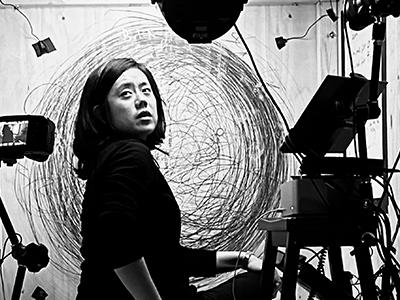
Julie Zhu is a composer, artist, and carillonist who is an Assistant Professor in the Department of Performing Arts Technology at the University of Michigan School of Music, Theatre & Dance. Her work often incorporates technology such as artificial intelligence, live sound processing, sensors, and virtual reality to reveal and amplify underlying mathematical structures and gentle noises through innovative intermedia instrumentation and diverse chamber experiences. Her music has been featured on Radio France’s Création Mondiale and performed at various institutions including GMEM Festival Propagations Marseille, IRCAM Paris, ICST Zürich, Sansusī Latvia, Tetramatyka Lviv, and Carnegie Hall. Her research focuses on music and AI, notably through her project Deep Drawing, which explores the machine’s ability to bring intricate noises of drawing and writing to visual life. Other long-term projects include Talking Pupils, a VR Opera centered on the experience of the visually impaired, and the Bell Resonator, a device designed to sustain the sound of a bell. As a carillonist, Zhu regularly performs on the Burton and Lurie Tower at the University of Michigan and has concertized in the summer. She was also the resident carillonneur at Saint Thomas Church Fifth Avenue in New York City during her time as a visual artist. Zhu holds multiple degrees, including a DMA in music composition from Stanford University, an MFA in combined media from Hunter College, and bachelor’s degrees in mathematics and art from Yale University. Her selected works include compositions for string quartet, electronics, and intermedia performances, with recent pieces commissioned by the French Ministry of Culture and GMEM.
Research topics
- Particle physics
- Physics
- Nuclear physics
- Computer Science
- Optics
- Quantum mechanics
- Geology
- Operating system
- Telecommunications
- Computational science
- Computer hardware
- Algorithm
- Engineering
- Astrophysics
- Statistics
- Mathematics
- Simulation
- Aerospace engineering
- Biology
- Real-time computing
Selected publications
arXiv (Cornell University) · 2023 · 1 citations
- Physics
- Particle physics
- Nuclear physics
Measurements of the substructure of top-quark jets are presented, using 140 fb$^{-1}$ of 13 TeV $pp$ collision data recorded with the ATLAS detector at the LHC. Top-quark jets reconstructed with the anti-$k_{t}$ algorithm with a radius parameter $R=1.0$ are selected in top-quark pair ($t\bar{t}$) events where one top quark decays semileptonically and the other hadronically, or where both top quarks decay hadronically. The top-quark jets are required to have transverse momentum $p_\mathrm{T} > 350$ GeV, yielding large samples of data events with jet $p_\mathrm{T}$ values between 350 and 600 GeV. One- and two-dimensional differential cross-sections for eight substructure variables, defined using only the charged components of the jets, are measured in a particle-level phase space by correcting for the smearing and acceptance effects induced by the detector. The differential cross-sections are compared with the predictions of several Monte Carlo simulations in which top-quark pair-production quantum chromodynamic matrix-element calculations at next-to-leading-order precision in the strong coupling constant $\alpha_\mathrm{S}$ are passed to leading-order parton shower and hadronization generators. The Monte Carlo predictions for measures of the broadness, and also the two-body structure, of the top-quark jets are found to be in good agreement with the measurements, while variables sensitive to the three-body structure of the top-quark jets exhibit some tension with the measured distributions.
AtlFast3: The Next Generation of Fast Simulation in ATLAS
Computing and Software for Big Science · 2022 · 106 citations
- Computer Science
- Computer Science
- Computational science
Abstract The ATLAS experiment at the Large Hadron Collider has a broad physics programme ranging from precision measurements to direct searches for new particles and new interactions, requiring ever larger and ever more accurate datasets of simulated Monte Carlo events. Detector simulation with Geant4 is accurate but requires significant CPU resources. Over the past decade, ATLAS has developed and utilized tools that replace the most CPU-intensive component of the simulation—the calorimeter shower simulation—with faster simulation methods. Here, AtlFast3, the next generation of high-accuracy fast simulation in ATLAS, is introduced. AtlFast3 combines parameterized approaches with machine-learning techniques and is deployed to meet current and future computing challenges, and simulation needs of the ATLAS experiment. With highly accurate performance and significantly improved modelling of substructure within jets, AtlFast3 can simulate large numbers of events for a wide range of physics processes.
arXiv : Search for exotic decays of the Higgs boson into long-lived particles in $pp$ collisions at $\sqrt{s} = 13$ TeV using displaced vertices in the ATLAS inner detector
2021 · 1 citations
- Physics
- Particle physics
- Nuclear physics
A novel search for exotic decays of the Higgs boson into pairs of long-lived neutral particles, each decaying into a bottom quark pair, is performed using 139 fb$^{-1}$ of $\sqrt{s} = 13$ TeV proton-proton collision data collected with the ATLAS detector at the LHC. Events consistent with the production of a Higgs boson in association with a leptonically decaying $Z$ boson are analysed. Long-lived particle (LLP) decays are reconstructed from inner-detector tracks as displaced vertices with high mass and track multiplicity relative to Standard Model processes. The analysis selection requires the presence of at least two displaced vertices, effectively suppressing Standard Model backgrounds. The residual background contribution is estimated using a data-driven technique. No excess over Standard Model predictions is observed, and upper limits are set on the branching ratio of the Higgs boson to LLPs. Branching ratios above 10% are excluded at 95% confidence level for LLP mean proper lifetimes $c\tau$ as small as 4 mm and as large as 100 mm. For LLP masses below 40 GeV, these results represent the most stringent constraint in this lifetime regime.
Search for new phenomena in three- or four-lepton events in $pp$ collisions at $\sqrt s$ =13 TeV with the ATLAS detector
2021 · 1 citations
- Physics
- Particle physics
- Nuclear physics
A search with minimal model dependence for physics beyond the Standard Model in events featuring three or four charged leptons (3ℓ and 4ℓ, ℓ=e,μ) is presented. The analysis aims to be sensitive to a wide range of potential new-physics theories simultaneously. This analysis uses data from pp collisions delivered by the Large Hadron Collider at a centre-of-mass energy of s=13 TeV and recorded with the ATLAS detector, corresponding to the full Run 2 dataset of 139 fb−1. The 3ℓ and 4ℓ phase space is divided into 22 event categories according to the number of leptons in the event, the missing transverse momentum, the invariant mass of the leptons, and the presence of leptons originating from a Z-boson candidate. These event categories are analysed independently for the presence of deviations from the Standard Model. No statistically significant deviations from the Standard Model predictions are observed. Upper limits for all signal regions are reported in terms of the visible cross-section.
Measurement of the $t\bar{t}t\bar{t}$ production cross section in $pp$ collisions at $\sqrt{s}$=13 TeV with the ATLAS detector
CERN Document Server (European Organization for Nuclear Research) · 2021 · 2 citations
- Physics
- Particle physics
- Nuclear physics
A measurement of four-top-quark production using proton-proton collision data at a centre-of-mass energy of 13 TeV collected by the ATLAS detector at the Large Hadron Collider corresponding to an integrated luminosity of 139 fb$^{-1}$ is presented. Events are selected if they contain a single lepton (electron or muon) or an opposite-sign lepton pair, in association with multiple jets. The events are categorised according to the number of jets and how likely these are to contain $b$-hadrons. A multivariate technique is then used to discriminate between signal and background events. The measured four-top-quark production cross section is found to be 26$^{+17}_{-15}$ fb, with a corresponding observed (expected) significance of 1.9 (1.0) standard deviations over the background-only hypothesis. The result is combined with the previous measurement performed by the ATLAS Collaboration in the multilepton final state. The combined four-top-quark production cross section is measured to be 24$^{+7}_{-6}$ fb, with a corresponding observed (expected) signal significance of 4.7 (2.6) standard deviations over the background-only predictions. It is consistent within 2.0 standard deviations with the Standard Model expectation of 12.0$\pm$2.4 fb.
Operation of the ATLAS trigger system in Run 2
Journal of Instrumentation · 2020 · 115 citations
- Computer Science
- Computer Science
- Physics
:
The European Physical Journal C · 2020 · 292 citations
- Physics
- Particle physics
- Nuclear physics
Abstract A search for the electroweak production of charginos and sleptons decaying into final states with two electrons or muons is presented. The analysis is based on 139 fb $$^{-1}$$ <mml:math xmlns:mml="http://www.w3.org/1998/Math/MathML"><mml:msup><mml:mrow/><mml:mrow><mml:mo>-</mml:mo><mml:mn>1</mml:mn></mml:mrow></mml:msup></mml:math> of proton–proton collisions recorded by the ATLAS detector at the Large Hadron Collider at $$\sqrt{s}=13$$ <mml:math xmlns:mml="http://www.w3.org/1998/Math/MathML"><mml:mrow><mml:msqrt><mml:mi>s</mml:mi></mml:msqrt><mml:mo>=</mml:mo><mml:mn>13</mml:mn></mml:mrow></mml:math> $$\text {TeV}$$ <mml:math xmlns:mml="http://www.w3.org/1998/Math/MathML"><mml:mtext>TeV</mml:mtext></mml:math> . Three R -parity-conserving scenarios where the lightest neutralino is the lightest supersymmetric particle are considered: the production of chargino pairs with decays via either W bosons or sleptons, and the direct production of slepton pairs. The analysis is optimised for the first of these scenarios, but the results are also interpreted in the others. No significant deviations from the Standard Model expectations are observed and limits at 95% confidence level are set on the masses of relevant supersymmetric particles in each of the scenarios. For a massless lightest neutralino, masses up to 420 $$\text {Ge}\text {V}$$ <mml:math xmlns:mml="http://www.w3.org/1998/Math/MathML"><mml:mrow><mml:mtext>Ge</mml:mtext><mml:mspace/></mml:mrow></mml:math> are excluded for the production of the lightest-chargino pairs assuming W -boson-mediated decays and up to 1 $$\text {TeV}$$ <mml:math xmlns:mml="http://www.w3.org/1998/Math/MathML"><mml:mtext>TeV</mml:mtext></mml:math> for slepton-mediated decays, whereas for slepton-pair production masses up to 700 $$\text {Ge}\text {V}$$ <mml:math xmlns:mml="http://www.w3.org/1998/Math/MathML"><mml:mrow><mml:mtext>Ge</mml:mtext><mml:mspace/></mml:mrow></mml:math> are excluded assuming three generations of mass-degenerate sleptons.
Observation of electroweak production of two jets and a $Z$-boson pair with the ATLAS detector at the LHC
HAL (Le Centre pour la Communication Scientifique Directe) · 2020 · 16 citations
- Physics
- Particle physics
- Nuclear physics
Electroweak symmetry breaking explains the origin of the masses of elementary particles through their interactions with the Higgs field. Besides the measurements of the Higgs boson properties, the study of the scattering of massive vector bosons with spin 1 allows the nature of electroweak symmetry breaking to be probed. Among all processes related to vector-boson scattering, the electroweak production of two jets and a Z-boson pair is a rare and important one. Here we report the observation of this process from proton–proton collision data corresponding to an integrated luminosity of 139 fb$^{−1}$ recorded at a centre-of-mass energy of 13 TeV with the ATLAS detector at the Large Hadron Collider. We consider two different final states originating from the decays of the Z-boson pair: one containing four charged leptons and another containing two charged leptons and two neutrinos. The hypothesis of no electroweak production is rejected with a statistical significance of 5.7σ, and the measured cross-section for electroweak production is consistent with the Standard Model prediction. In addition, we report cross-sections for inclusive production of a Z-boson pair and two jets for the two final states.
The European Physical Journal C · 2020 · 31 citations
- Computer Science
- Physics
- Nuclear physics
Abstract The jet energy scale, jet energy resolution, and their systematic uncertainties are measured for jets reconstructed with the ATLAS detector in 2012 using proton–proton data produced at a centre-of-mass energy of 8 TeV with an integrated luminosity of $$20 \, \hbox {fb}^{-1}$$ <mml:math xmlns:mml="http://www.w3.org/1998/Math/MathML"> <mml:mrow> <mml:mn>20</mml:mn> <mml:mspace/> <mml:msup> <mml:mtext>fb</mml:mtext> <mml:mrow> <mml:mo>-</mml:mo> <mml:mn>1</mml:mn> </mml:mrow> </mml:msup> </mml:mrow> </mml:math> . Jets are reconstructed from clusters of energy depositions in the ATLAS calorimeters using the anti- $$k_t$$ <mml:math xmlns:mml="http://www.w3.org/1998/Math/MathML"> <mml:msub> <mml:mi>k</mml:mi> <mml:mi>t</mml:mi> </mml:msub> </mml:math> algorithm. A jet calibration scheme is applied in multiple steps, each addressing specific effects including mitigation of contributions from additional proton–proton collisions, loss of energy in dead material, calorimeter non-compensation, angular biases and other global jet effects. The final calibration step uses several in situ techniques and corrects for residual effects not captured by the initial calibration. These analyses measure both the jet energy scale and resolution by exploiting the transverse momentum balance in $$\gamma $$ <mml:math xmlns:mml="http://www.w3.org/1998/Math/MathML"> <mml:mi>γ</mml:mi> </mml:math> + jet, Z + jet, dijet, and multijet events. A statistical combination of these measurements is performed. In the central detector region, the derived calibration has a precision better than 1% for jets with transverse momentum $$150 \, \hbox {GeV} < p_{{\mathrm {T}}}<$$ <mml:math xmlns:mml="http://www.w3.org/1998/Math/MathML"> <mml:mrow> <mml:mn>150</mml:mn> <mml:mspace/> <mml:mtext>GeV</mml:mtext> <mml:mo><</mml:mo> <mml:msub> <mml:mi>p</mml:mi> <mml:mi>T</mml:mi> </mml:msub> <mml:mo><</mml:mo> </mml:mrow> </mml:math> 1500 GeV, and the relative energy resolution is $$(8.4\pm 0.6)\%$$ <mml:math xmlns:mml="http://www.w3.org/1998/Math/MathML"> <mml:mrow> <mml:mo>(</mml:mo> <mml:mn>8.4</mml:mn> <mml:mo>±</mml:mo> <mml:mn>0.6</mml:mn> <mml:mo>)</mml:mo> <mml:mo>%</mml:mo> </mml:mrow> </mml:math> for $$p_{{\mathrm {T}}}= 100 \, \hbox {GeV}$$ <mml:math xmlns:mml="http://www.w3.org/1998/Math/MathML"> <mml:mrow> <mml:msub> <mml:mi>p</mml:mi> <mml:mi>T</mml:mi> </mml:msub> <mml:mo>=</mml:mo> <mml:mn>100</mml:mn> <mml:mspace/> <mml:mtext>GeV</mml:mtext> </mml:mrow> </mml:math> and $$(23\pm 2)\%$$ <mml:math xmlns:mml="http://www.w3.org/1998/Math/MathML"> <mml:mrow> <mml:mo>(</mml:mo> <mml:mn>23</mml:mn> <mml:mo>±</mml:mo> <mml:mn>2</mml:mn> <mml:mo>)</mml:mo> <mml:mo>%</mml:mo> </mml:mrow> </mml:math> for $$p_{{\mathrm {T}}}= 20 \, \hbox {GeV}$$ <mml:math xmlns:mml="http://www.w3.org/1998/Math/MathML"> <mml:mrow> <mml:msub> <mml:mi>p</mml:mi> <mml:mi>T</mml:mi> </mml:msub> <mml:mo>=</mml:mo> <mml:mn>20</mml:mn> <mml:mspace/> <mml:mtext>GeV</mml:mtext> </mml:mrow> </mml:math> . The calibration scheme for jets with radius parameter $$R=1.0$$ <mml:math xmlns:mml="http://www.w3.org/1998/Math/MathML"> <mml:mrow> <mml:mi>R</mml:mi> <mml:mo>=</mml:mo> <mml:mn>1.0</mml:mn> </mml:mrow> </mml:math> , for which jets receive a dedicated calibration of the jet mass, is also discussed.
A search for the dimuon decay of the Standard Model Higgs boson with the ATLAS detector
Physics Letters B · 2020 · 147 citations
- Physics
- Particle physics
- Nuclear physics
A search
Frequent coauthors
- 3079 shared
F. Déliot
CEA Paris-Saclay
- 3045 shared
T. Beau
Consejo Nacional de Investigaciones Científicas y Técnicas
- 2958 shared
J.-F. Grivaz
Laboratoire de Physique des 2 Infinis Irène Joliot-Curie
- 2831 shared
S. Trincaz-Duvoid
Laboratoire de Physique Nucléaire et de Hautes Énergies
- 2758 shared
B. Trocmé
Laboratoire AstroParticule et Cosmologie
- 2729 shared
L. Li
- 2601 shared
M. Ridel
Université Paris Cité
- 2595 shared
L. Roos
Laboratoire de Physique Nucléaire et de Hautes Énergies
Similar researchers at University of Michigan
- Resume-aware match score
- Save to shortlist
- AI-drafted outreach
See your match with Julie Zhu
PhdFit ranks faculty by your research interests, methods, and publications — grounded in their actual work, not templates.
- Free to start
- No credit card
- 30-second signup