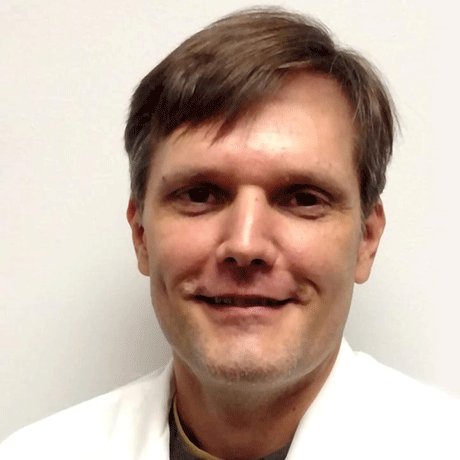
Jonathan P. Davis
· ProfessorOhio State University · Molecular, Cellular, and Integrative Physiology
Active 1982–2026
About
Jonathan Davis, PhD, is a Professor of Physiology and Cell Biology at The Ohio State University College of Medicine. His research focuses on elucidating the biochemical and physiological mechanisms that determine the kinetics and magnitude of cardiac, skeletal, and smooth muscle contraction and relaxation in health and disease through the engineering of proteins. His specific interests include understanding the cellular and molecular basis of muscle contraction and relaxation, and how calcium binding proteins and enzymes are kinetically tuned to respond to calcium transients both in vitro and in vivo. Dr. Davis's laboratory studies the behavior of engineered proteins from isolated systems to complex protein assemblies, muscle cells, and ultimately in vivo models, utilizing advanced virus and protein delivery techniques to study their effects in small and large animal systems.
Research topics
- Medicine
- Biochemistry
- Internal medicine
- Biology
- Chemistry
- Biophysics
- Cardiology
- Anatomy
- Crystallography
- Cell biology
Selected publications
Biophysical Journal · 2026-02-01
articleSenior authorDynamic-Structure Redesign of Calmodulin Reveals Mechanistic Constraints on Ryr2 Regulation
bioRxiv (Cold Spring Harbor Laboratory) · 2026-04-17
articleOpen accessSenior authorCorresponding2. ABSTRACT Calmodulin (CaM) is a highly conserved Ca 2+ sensor that regulates hundreds of cellular targets through Ca 2+ -dependent conformational dynamics. Despite its central role in Ca 2+ signaling and disease, its evolutionary conservation and structural flexibility have suggested that CaM is resistant to rational redesign. Here, using the cardiac Ca 2+ release channel Ryanodine receptor 2 (RyR2) as a model system, we tested whether incorporating conformational dynamics into computational protein design enables functional reengineering of CaM. We first applied a static structure–based redesign to increase CaM–RyR2 affinity. Although the resulting variant bound more tightly to both the RyR2 peptide and the intact channel in vitro, it distorted peptide geometry and worsened Ca 2+ leak in cardiomyocytes ex vivo. Guided by molecular dynamics simulations, we then developed a dynamic-structure redesign strategy that preserves conformational integrity while strengthening binding. The resulting CaM variant exhibited increased RyR2 affinity and reduced pathological Ca 2+ leak in a disease-relevant model. These findings show that improved binding affinity alone is insufficient to enhance physiological regulation and that successful CaM redesign requires preservation of conformational dynamics. More broadly, they demonstrate that integrating conformational dynamics into protein redesign can enable functionally predictive engineering of flexible regulatory protein–protein interactions.
BPS2026 – Troponin enhanceropathies: A novel role for the troponin genes
Biophysical Journal · 2026-02-01
articleSenior authorBiophysical Journal · 2026-02-01
articleSenior authorMolecular interactions of the NaV1.5 C-terminal domain: CaM sequestered the IQ motif from the CTD
Journal of Biological Chemistry · 2025-10-30 · 1 citations
articleOpen access<h2>Abstract</h2> Voltage-gated sodium channels (Na<sub>V</sub>) are important for life. Alterations to the synchronized timing of ion conduction can create life-threatening conditions. How Na<sub>V</sub> conduction responds to changes in intracellular Ca<sup>2+</sup> concentration has been the subject of extensive investigation. Crystal structures of the cardiac Na<sub>V</sub> (Na<sub>V</sub>1.5) cytosolic components were reported as trimeric complexes that are restructured in the presence of Ca<sup>2+</sup>. These results formed the basis for a gating model where two Na<sub>V</sub>1.5 molecules interact to alter function in response to Ca<sup>2+</sup> concentration. Here, we investigated the binding site surface of these trimeric interactions in solution. NMR demonstrated that these trimeric complexes do not form in solution. Analysis of the available structural data indicated that the Na<sub>V</sub>1.5 IQ motif can only accommodate interaction with one protein at a time. Our NMR data were consistent with the Na<sub>V</sub>1.5 C-terminal domain (CTD) and the Ca<sup>2+</sup>- sensing protein calmodulin (CaM) engaging the same binding site surface of the Na<sub>V</sub>1.5 IQ motif. Titrations of IQ motif peptide into a 1:1 mixture of <sup>15</sup>N CTD : CaM sample revealed the Na<sub>V</sub>1.5 channel is biophysically distinct from neuronal Na<sub>V</sub>1.2 as Ca<sup>2+</sup> enhanced CaM's ability to sequester the Na<sub>V</sub>1.5 IQ motif from the Na<sub>V</sub>1.5 CTD. Stopped-flow kinetic measurements quantified Ca<sup>2+</sup> release rates from the CaM-IQ and CaM-inactivation gate (IGATE) complexes to provide insight into complex lifetimes. Our work advanced understanding the molecular machinery that underlies Na<sub>V</sub>1.5 gating (CTD-IGATE and CTD-IQ motif interactions) and provided insight into the structural details of CaM-facilitated Na<sub>V</sub>1.5 modification (CaM-IQ motif and CaM-IGATE interactions).
Biophysical Journal · 2025-02-01
articleBiophysical Journal · 2025-02-01
articleBiophysical characterization of anion channels in mitochondrion-endoplasmic-reticulum contact sites
Biophysical Journal · 2025-04-06 · 2 citations
articleOpen accessTransforming Growth Factors in Venous Thrombus Formation and Resolution
Arteriosclerosis Thrombosis and Vascular Biology · 2025-03-20 · 3 citations
reviewOpen access1st authorCorrespondingDeep vein thrombosis (DVT) and pulmonary embolism are vascular occlusive disorders categorized under the term venous thromboembolism. Venous thromboembolism affects ≈900 000 people per year in the United States alone. Understanding of the multifaceted process of DVT has improved in recent years, and current DVT treatments reduce thrombus propagation, but they also increase bleeding risk and fail to accelerate natural venous thrombus resolution. Multiple inflammatory cytokines regulate the development and subsequent resolution of DVT. One family of cytokines involved in DVT and venous thrombus resolution is the TGF-β (transforming growth factor-β) family. A comprehensive understanding of the control of venous thrombus formation and resolution by the TGF-β family could lead to the development of novel treatments for DVT that target ≥1 of the TGF-β isoforms. The aim of this review is to describe studies of the roles of the TGF-β isoforms in venous thrombus formation and resolution and to highlight opportunities for future research. TGF-β isoforms include TGF-β1, TGF-β2, and TGF-β3. TGF-β1 has a well-characterized role in the positive regulation of venous thrombus formation and the negative regulation of venous thrombus resolution. Further research is necessary, however, to understand the potential roles of TGF-β2 and TGF-β3 in venous thrombus formation and resolution. Given that TGF-β1 expression increases during venous thrombosis and that inhibition or knockdown of TGF-β1 reduces thrombus burden, TGF-β1 represents a potential diagnostic marker for DVT and a putative target for therapies that aim to prevent or treat DVT.
Biophysical Journal · 2025-02-01
article
Recent grants
NIH · $424k · 2018
NIH · $379k · 2017
NIH · $1.5M · 2021
NIH · $1.9M · 2015
Regulation and Dysregulation of Cardiac EC coupling by Calmodulin
NIH · $6.1M · 2017–2027
Frequent coauthors
- 73 shared
Paul M.L. Janssen
The Ohio State University
- 72 shared
Svetlana B. Tikunova
The Ohio State University
- 56 shared
Gary H. Wikfors
Rogers (United States)
- 48 shared
Brandon J. Biesiadecki
The Ohio State University
- 42 shared
Mark T. Ziolo
The Ohio State University
- 41 shared
Sándor Györke
The Ohio State University
- 41 shared
Sean C. Little
Bristol-Myers Squibb (United States)
- 40 shared
James C. Widman
National Oceanic and Atmospheric Administration
- Resume-aware match score
- Save to shortlist
- AI-drafted outreach
See your match with Jonathan P. Davis
PhdFit ranks faculty by your research interests, methods, and publications — grounded in their actual work, not templates.
- Free to start
- No credit card
- 30-second signup