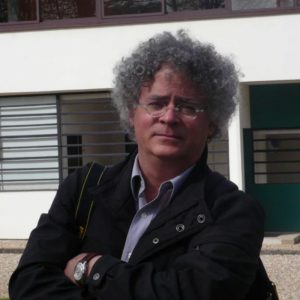
Jonathan M. Reynolds
· Professor (Barnard)Columbia University · East Asian Languages and Cultures
Active 1987–2019
About
Jonathan M. Reynolds is a Professor at Barnard College, with a PhD from Stanford University obtained in 1991. He teaches courses on Japanese Photography, Methods and Theories of Art History, and Japanese Architecture: Tokyo. His research focuses on the history of Japanese art and architecture, with particular emphasis on modern Japanese architecture and Japanese photography. Reynolds authored the book 'Allegories of Time and Space: Visualizing Japanese Cultural Identity through Architecture and Photography,' published by the University of Hawai'i Press in 2015, which explores the role of tradition in shaping cultural identity in Japanese architecture, photography, and popular culture from the 1940s to the 1990s.
Research topics
- Geology
- Geochemistry
- Oceanography
- Seismology
- Paleontology
Selected publications
Staff Nurse Perceptions: Exploring Management, Burnout and Patient Safety
Carolina Digital Repository (University of North Carolina at Chapel Hill) · 2019-08-21
articleOpen access1st authorCorrespondingNurse burnout is a problem affecting patient safety in all hospitals. Studies suggest that perception of management and teamwork are inversely related to level of burnout and can potentially be related to perception of patient safety. Therefore this study explored the relationships between perceptions of management, teamwork, burnout and patient safety. A secondary data analysis was completed on an AHRQ survey done in early 2015 that explored nurse perceptions of management, teamwork, burnout and patient safety. Responses from 595 nurses on 27 units were analyzed through One-Way ANOVAs and Tukey-Kramer Least Square Means comparisons to explore these perceptions. Relationships between perceived management support, burnout and patient safety as well as perceived teamwork, burnout and patient safety were observed at the hospital level. There were interactions found based on intensity of care (intensive care units: lower management, teamwork and patient safety; higher burnout) and patient populations (Children’s Hospital: lower management, teamwork and patient safety; higher burnout) compared to those within each groups. Results were as expected and comparable to other studies for perceptions based on hospital and intensity of care groupings. Patient population findings were not as expected with the Children’s Hospital having greater burnout and lower perceptions of management, teamwork and patient safety compared to adult populations. This study supports nurse leaders receiving training regarding better supporting staff and instilling teamwork to combat burnout and improve patient safety. Further research should be done on the relationship between management and teamwork.
2017-01-01 · 3 citations
articleOpen accessIce-sheet related landforms at the continental shelf edge, Albatross Bank, Alaska
Geological Society London Memoirs · 2016-01-01
articleAlbatross Bank is a flat glaciated bedrock bank (Fig. 1a) located on the distal edge of the Alaskan continental shelf south of Kodiak Island (Fig. 1b). The bank illustrates the glacial geomorphology from an active ice edge during Marine Isotopic Stage (MIS) 2 ( c. 22–19 ka) sea-level regression (Briner & Kaufman 2008). The multibeam echo-sounder (MBES) images presented here provide the first detailed morphological evidence that the furthest extent of glacial advance in the late Pleistocene reached the shelf edge of the Gulf of Alaska. Other disparate areas of MBES imagery from the distal edge of the SE Alaska shelf to the western part of the Gulf of Alaska show evidence of glacial advance to the shelf break and support earlier depictions of Wisconsinan glaciation (Kaufman & Manley 2004; Briner & Kaufman 2008). Fig. 1. Multibeam swath bathymetry and bathymetric profiles of glacial features on Albatross Bank, Alaskan continental shelf. ( a ) Sun-illuminated multibeam-bathymetric image showing a band of seafloor iceberg ploughmarks (red inset, box f), bedrock outcrops and subglacial meltwater channels (red inset, box c). Acquisition system Reason SeaBat 8111. Frequency 100 kHz. Grid-cell size c. 10 m. ( b ) Location of study …
Quaternary International · 2015-11-01
articleSenior authorHabitats and Demersal Fish Communities in the Vicinity of Albatross Bank, Gulf of Alaska
Elsevier eBooks · 2011-12-12 · 2 citations
book-chapter1st authorCorrespondingPsychology in the Schools · 2010-10-21 · 19 citations
articleAbstract This study was designed to investigate the validity of four different aloud reading comprehension assessment measures: Maze, comprehension questions, Maze accurate response rate (MARR), and reading comprehension rate (RCR). The criterion measures used in this study were the Woodcock–Johnson III Tests of Achievement (WJ‐III ACH) Broad Reading Cluster Score and words correct per minute (WCPM). Pearson Product Correlations and linear regression were used to investigate possible relationships between Maze comprehension level (accuracy), comprehension question level (accuracy), MARR, RCR, WCPM, and the Broad Reading Cluster Score of the WJ‐III ACH. Participants were sixth‐, seventh‐, and eighth‐grade students from a middle school located in the Southeastern United States. Significant correlations were found between each of the reading comprehension assessment variables (WCPM, MARR, RCR, Maze comprehension level, and comprehension question level) and the WJ‐III ACH Broad Reading Cluster Score. MARR and RCR represented the strongest correlations when compared to the other variables. Results from a linear regression analysis indicated that RCR was the best predictor of the criterion variable (WJ‐III). Implications for future research and applied practice are discussed. © 2010 Wiley Periodicals, Inc.
Psychology in the Schools · 2010-10-21 · 38 citations
articleAbstract Many reading comprehension measures require the student to read silently. When students read silently, important information (e.g., consistent reading errors) may not be identified. It may also be difficult to detect a student who is choosing not to read the passage. For this reason, investigating whether there is a significant difference in comprehension under silent and aloud reading conditions is important to determine under what conditions reading comprehension should be measured accurately. This study was designed to investigate possible differences between silent and aloud reading comprehension scores on Maze assessment probes. Pearson product correlations were used to investigate possible relationships between Maze comprehension scores (silent and aloud), WCPM, and the Broad Reading Cluster Score of the Woodcock–Johnson III Tests of Achievement (WJ‐III ACH). Participants were 89 first‐ and second‐grade students from an elementary school located in the Southeastern United States. Each student was exposed to four assessment conditions, which included WCPM, three tests from the WJ‐III ACH, and Maze reading comprehension passages. Significant correlations were found for WCPM, aloud and silent Maze, and the WJ‐III ACH Broad Reading Cluster Score. No significant difference was found between aloud and silent reading comprehension, which suggests that reading comprehension can be measured accurately under either reading condition. © 2010 Wiley Periodicals, Inc.
AGUFM · 2005-12-01
articleA submarine perspective of the Honolulu Volcanics, Oahu
Journal of Volcanology and Geothermal Research · 2005-12-28 · 31 citations
articleSenior authorAGU Fall Meeting Abstracts · 2004-12-01
article1st authorCorresponding
Frequent coauthors
- 7 shared
C. H. Langmuir
Planetary Science Institute
- 6 shared
Kim A. Kastens
- 6 shared
W. I. Ridley
- 4 shared
Kirn A. Kastens
Lamont-Doherty Earth Observatory
- 4 shared
John F. Bender
- 4 shared
Jonathan Heifetz
National Oceanic and Atmospheric Administration
- 4 shared
William B. F. Ryan
- 4 shared
David A. Clague
Education
- 1991
Ph.D.
Stanford University
- Resume-aware match score
- Save to shortlist
- AI-drafted outreach
See your match with Jonathan M. Reynolds
PhdFit ranks faculty by your research interests, methods, and publications — grounded in their actual work, not templates.
- Free to start
- No credit card
- 30-second signup