
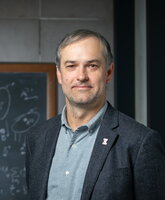
Joaquin Vieira
· ProfessorUniversity of Illinois Urbana-Champaign · Astronomy
Active 2004–2026
Academic metrics are sourced from OpenAlex and public funding records; values may differ from Google Scholar.
About
Joaquin Daniel Vieira is a professor at the University of Illinois with appointments in Astronomy, Physics, and the National Center for Supercomputing Applications (NCSA). He is an observational cosmologist whose research spans the electromagnetic spectrum. His scientific interests focus on galaxy evolution and structure formation at high redshift, the star formation history of the Universe, the epoch of reionization, and the cosmic microwave background. Professor Vieira builds experiments, conducts cosmological surveys, and performs follow-up observations of distant galaxies. He works with data from major observatories and instruments including the South Pole Telescope (SPT), Dark Energy Survey (DES), Herschel, Hubble, Spitzer, Chandra, and ALMA. Currently, he is involved in developing future millimeter and sub-millimeter facilities and studies the cosmic evolution of dust and ionized carbon. Professor Vieira earned his Ph.D. in Physics from The University of Chicago in 2009, following an M.S. in Physics from the same institution in 2005, and a B.S. in Astrophysics from The University of California, Los Angeles in 2002. His work has been recognized with several honors including the Antarctic Service Medal of the United States of America in 2011, fellowships at the Center for Advanced Studies and Beckman in 2015-16, a National Center for Supercomputing Applications Fellowship in 2015, and a Sloan Research Fellowship in 2017. He is also noted for his excellence in teaching…
Research topics
- Astrophysics
- Physics
- Astronomy
- Particle physics
- Quantum mechanics
- Optics
- Statistics
Selected publications
CMB-S4: Forecasting Constraints on Primordial Gravitational Waves
The Astrophysical Journal · 2022 · 256 citations
Abstract CMB-S4—the next-generation ground-based cosmic microwave background (CMB) experiment—is set to significantly advance the sensitivity of CMB measurements and enhance our understanding of the origin and evolution of the universe. Among the science cases pursued with CMB-S4, the quest for detecting primordial gravitational waves is a central driver of the experimental design. This work details the development of a forecasting framework that includes a power-spectrum-based semianalytic proj…
The SPTpol Extended Cluster Survey
The Astrophysical Journal Supplement Series · 2020 · 200 citations
Abstract We describe the observations and resultant galaxy cluster catalog from the 2770 deg 2 SPTpol Extended Cluster Survey (SPT-ECS). Clusters are identified via the Sunyaev–Zel’dovich (SZ) effect and confirmed with a combination of archival and targeted follow-up data, making particular use of data from the Dark Energy Survey (DES). With incomplete follow-up we have confirmed as clusters 244 of 266 candidates at a detection significance ξ ≥ 5 and an additional 204 systems at 4 < ξ < 5.…
The Astrophysical Journal · 2021 · 136 citations
We present the first results from the Mapping Obscuration to Reionization with ALMA (MORA) survey, the largest Atacama Large Millimeter/submillimeter Array (ALMA) blank-field contiguous survey to date (184 arcmin(2)) and the only at 2 mm to search for dusty star-forming galaxies (DSFGs). We use the 13 sources detected above 5 sigma to estimate the first ALMA galaxy number counts at this wavelength. These number counts are then combined with the state-of-the-art galaxy number counts at 1.2 and 3…
Constraints on Cosmological Parameters from the 500 deg<sup>2</sup> SPTPOL Lensing Power Spectrum
The Astrophysical Journal · 2020 · 87 citations
Abstract We present cosmological constraints based on the cosmic microwave background (CMB) lensing potential power spectrum measurement from the recent 500 deg 2 SPTpol survey, the most precise CMB lensing measurement from the ground to date. We fit a flat ΛCDM model to the reconstructed lensing power spectrum alone and in addition with other data sets: baryon acoustic oscillations (BAO), as well as primary CMB spectra from Planck and SPTpol . The cosmological constraints based on SPTpol and Pl…
The Astrophysical Journal · 2024-12-27 · 20 citations
articleOpen accessAbstract This paper gives an overview of Targeting Extremely Magnified Panchromatic Lensed Arcs and Their Extended Star formation (TEMPLATES), a JWST Early Release Science program that targeted four extremely bright, gravitationally lensed galaxies, two extremely dusty and two with low attenuation, as templates for galaxy evolution studies with JWST. TEMPLATES obtains a common set of spectral diagnostics for these 1.3 ≤ z ≤ 4.2 galaxies, in particular H α , Paschen α , and the rest-frame optical…
Recent grants
Frequent coauthors
- 358 shared
J. E. Carlstrom
- 341 shared
C. L. Chang
Argonne National Laboratory
- 336 shared
B. A. Benson
Netherlands Institute for Radio Astronomy
- 300 shared
K. K. Schaffer
University of Chicago
- 270 shared
S. S. Meyer
- 268 shared
L. E. Bleem
University of Chicago
- 262 shared
J. J. Mohr
- 243 shared
M. Dobbs
Canadian Institute for Advanced Research
Education
- 2009
PhD, Physics
The University of Chicago
Awards & honors
- Antarctic Service Medal of the United States of America (201…
- Center for Advanced Studies Fellow and Beckman Fellow (2015-…
- National Center for Supercomputing Applications (NCSA) Fello…
- Sloan Research Fellowship (2017)
Similar researchers at University of Illinois Urbana-Champaign
- Resume-aware match score
- Save to shortlist
- AI-drafted outreach
See your match with Joaquin Vieira
PhdFit ranks faculty by your research interests, methods, and publications — grounded in their actual work, not templates.
- Free to start
- No credit card
- 30-second signup