
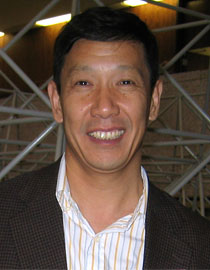
Jianer Chen
· Professor, Computer Science & EngineeringVerifiedTexas A&M University · Computer Science & Engineering
Active 1987–2024
About
Jianer Chen is a Professor in the Department of Computer Science & Engineering at Texas A&M University. His research interests include algorithms and complexity, computer graphics, bioinformatics, and computer networks. Dr. Chen has received numerous awards, including the AFS Distinguished Faculty Achievement Award at both the university and college levels, the E.D. Brockett Professorship Award, and the Eugene E. Webb '43 Faculty Fellow, among others. He holds a Ph.D. in Mathematics from Columbia University and a Ph.D. in Computer Science from New York University, along with multiple other degrees in Mathematics and Computer Science. His scholarly work involves developing algorithms and computational methods, contributing significantly to theoretical computer science and related fields.
Research topics
- Computer Security
- Computer Science
- Telecommunications
- Computer network
- Psychology
- Neuroscience
- Physics
- Distributed computing
- Medicine
- Physical medicine and rehabilitation
Selected publications
Journal of Stroke and Cerebrovascular Diseases · 2024-08-22 · 6 citations
articleSenior authorarXiv (Cornell University) · 2024-02-06
preprintOpen accessSenior authorOne of the theoretically intriguing problems in computer-aided geometric modeling comes from the stitching of the tensor product Bezier patches. When they share an extraordinary vertex, it is not possible to obtain continuity C1 or G1 along the edges emanating from that extraordinary vertex. Unfortunately, this stitching problem cannot be solved by using higher degree or rational polynomials. In this paper, we present a modified de Casteljau subdivision algorithm that can provide a solution to this problem. Our modified de Casteljau subdivision, when combined with topological modeling, provides a framework for interactive real-time modeling of piecewise smooth manifold meshes with arbitrary topology. The main advantage of the modified subdivision is that the continuity C1 on a given boundary edge does not depend on the positions of the control points on other boundary edges. The modified subdivision allows us to obtain the desired C1 continuity along the edges emanating from the extraordinary vertices along with the desired G1 continuity in the extraordinary vertices.
arXiv (Cornell University) · 2024-02-03
preprintOpen accessSenior authorOne of the key problems in dealing with color in rendering, shading, compositing, or image manipulation is that we do not have algebraic structures that support operations over colors. In this paper, we present an all-encompassing framework that can support a set of algebraic structures with associativity, commutativity, and inverse properties. To provide these three properties, we build our algebraic structures on an extension of projective space by allowing for negative and complex numbers. These properties are important for (1) manipulating colors as periodic functions, (2) solving inverse problems dealing with colors, and (3) being consistent with the wave representation of the color. Allowance of negative and complex numbers is not a problem for practical applications, since we can always convert the results into desired range for display purposes as we do in High Dynamic Range imaging. This set of algebraic structures can be considered as a generalization of the Minkowski norm Lp in projective space. These structures also provide a new version of the generalized Holder average with associativity property. Our structures provide inverses of any operation by allowing for negative and complex numbers. These structures provide all properties of the generalized Holder average by providing a continuous bridge between the classical weighted average, harmonic mean, maximum, and minimum operations using a single parameter p.
On optimal streaming kernelization algorithms
Science China Information Sciences · 2024-07-16 · 2 citations
articleSenior authorJournal of NeuroEngineering and Rehabilitation · 2024-09-18 · 16 citations
reviewOpen accessSenior authorINTRODUCTIN: Improper gait patterns, impaired balance and foot drop consistently plague stroke survivors, preventing them from walking independently and safely. Neuromuscular electrical stimulation (NMES) technology can help patients reactivate their muscles and regain motor coordination. This study aims to systematically review and summarize the evidence for the potential benefits of NMES on the improvement of gait patterns after stroke. EVIDENCE ACQUISITION: PubMed, Cochrane Library, Embase, Science Direct and Web of Science were systematically searched until April 2024, to identify randomized controlled trials with the following criteria: stroke survivors as participants; NMES as intervention; conventional rehabilitation as a comparator; and gait assessment, through scales or quantitative parameters, as outcome measures. EVIDENCE SYNTHESIS: 29 publications involving 1711 patients met the inclusion criteria. Meta-analysis showed no significant differences in Ten-meter walk test, Fugl-Meyer assessment lower extremity, Modified Ashworth Assessment and asymmetry between the NMES group and the control group. Besides, NMES was associated with changes in outcome indicators such as quantitative gait analysis speed [SMD = 0.53, 95% CI (0.20, 0.85), P = 0.001], cadence [SMD = 0.76, 95% CI (0.32, 1.20), P = 0.0008], affected side step length [SMD = 0.73, 95% CI (0.16, 1.31), P = 0.01], angle of ankle dorsiflexion [WMD = 1.57, 95% CI (0.80, 2.33), P < 0.0001], Six-Minute Walk Test [WMD = 14.83, 95% CI (13.55, 16.11), P<0.00001]. According to the PEDro scale, 21 (72.4%) studies were of high quality and 8 were of moderate quality (27.6%). CONCLUSIONS: Taken together, the review synthesis indicated that NMES might play a potential role in stroke-induced walking dysfunction. And NMES may be superior for survivors in the chronic phase than the acute and subacute phases, and the efficacy of short sessions received by patients was greater than that of those who participated in a longer session. Additionally, further comparisons of the effects of NMES with different types or stimulation frequencies may provide unexpected benefits.
Space limited linear-time graph algorithms on big data
Theoretical Computer Science · 2024-02-28 · 2 citations
article1st authorCorresponding2024-09-28
book-chapter1st authorCorrespondingEngineering Applications of Artificial Intelligence · 2024-07-13 · 9 citations
articleSenior authorNearly Time-Optimal Kernelization Algorithms for the Line-Cover Problem with Big Data
Algorithmica · 2024-05-09
article1st authorCorrespondingApplication Analysis of Multiple Neurons Connected with Fast Inhibitory Synapses
Journal of Bionic Engineering · 2024-05-14
articleSenior author
Recent grants
Studies on New Algorithmic Techniques for Parameterized Computation
NSF · $150k · 2008–2011
AF: Small: Topological Graph Theory Revisited: With Applications in Computer Graphics
NSF · $403k · 2009–2013
Computational Upper and Lower Bounds via Parameterized Complexity
NSF · $156k · 2004–2008
Frequent coauthors
- 175 shared
Jianxin Wang
Central South University
- 58 shared
Iyad Kanj
- 47 shared
Qilong Feng
- 38 shared
Minzhu Xie
Ministry of Education of the People's Republic of China
- 38 shared
Ergün Akleman
- 38 shared
Guojun Wang
Taizhou Vocational and Technical College
- 38 shared
Ge Xia
- 31 shared
Chen Song-qiao
Harbin Institute of Technology
Awards & honors
- AFS Distinguished Faculty Achievement Award (university leve…
- AFS Distinguished Faculty Achievement Award (college level),…
- E.D. Brockett Professorship Award, College of Engineering, T…
- Eugene E. Webb '43 Faculty Fellow, Texas A&M University (200…
- AFS Distinguished Faculty Achievement Award (college level),…
- Resume-aware match score
- Save to shortlist
- AI-drafted outreach
See your match with Jianer Chen
PhdFit ranks faculty by your research interests, methods, and publications — grounded in their actual work, not templates.
- Free to start
- No credit card
- 30-second signup