
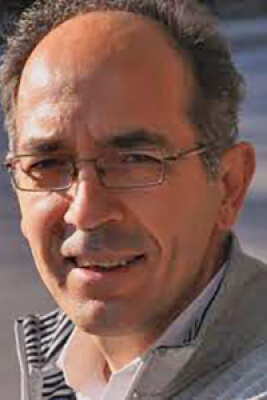
Jerry X. Mitrovica
· Frank B. Baird, Jr. Professor of Science; Affiliate in Environmental Science & EngineeringHarvard University · Environmental Science & Engineering
Active 1985–2026
Academic metrics are sourced from OpenAlex and public funding records; values may differ from Google Scholar.
About
Jerry X. Mitrovica is the Frank B. Baird, Jr. Professor of Science at Harvard University and an affiliate in Environmental Science & Engineering. His primary teaching areas include Environmental Science & Engineering, with research focusing on climate change, climate dynamics, geophysics, ice dynamics, sea level, and planetary sciences. Based at Harvard's John A. Paulson School of Engineering and Applied Sciences, he is involved in advancing understanding of Earth's physical processes related to climate and sea level changes.
Research topics
- Oceanography
- Geology
- Environmental science
- Paleontology
- Climatology
- Astronomy
- Geodesy
- Astrobiology
- Geography
- Physics
Selected publications
Understanding of Contemporary Regional Sea‐Level Change and the Implications for the Future
Reviews of Geophysics · 2020 · 171 citations
Global sea level provides an important indicator of the state of the warming climate, but changes in regional sea level are most relevant for coastal communities around the world. With improvements to the sea-level observing system, the knowledge of regional sea-level change has advanced dramatically in recent years. Satellite measurements coupled with in situ observations have allowed for comprehensive study and improved understanding of the diverse set of drivers that lead to variations in sea…
Oceanic forcing of penultimate deglacial and last interglacial sea-level rise
Nature · 2020 · 131 citations
Science Advances · 2020 · 59 citations
During the Last Glacial Maximum, expansive continental ice sheets lowered globally averaged sea level ~130 m, exposing a land bridge at the Bering Strait. During the subsequent deglaciation, sea level rose rapidly and ultimately flooded the Bering Strait, linking the Arctic and Pacific Oceans. Observational records of the Bering Strait flooding have suggested two apparently contradictory scenarios for the timing of the reconnection. We reconcile these enigmatic datasets using gravitationally sel…
Long‐Term Earth‐Moon Evolution With High‐Level Orbit and Ocean Tide Models
Journal of Geophysical Research Planets · 2021 · 58 citations
, evolution of inclination and eccentricity is dominated by tidal and core-mantle boundary dissipation within the Moon, which yield high lunar orbit inclinations in the early Earth-Moon system. A drawback for our results is that the semi-major axis does not collapse to near-zero values at 4.5 Ga, as indicated by most lunar formation models. Additional processes, missing from our current efforts, are discussed as topics for future investigation.
Probabilistic reconstruction of sea-level changes and their causes since 1900
Earth system science data · 2024-07-31 · 25 citations
articleOpen accessCorrespondingAbstract. Coastal communities around the world are increasingly exposed to extreme events that have been exacerbated by rising sea levels. Sustainable adaptation strategies to cope with the associated threats require a comprehensive understanding of past and possible future changes. Yet, many coastlines lack accurate long-term sea-level observations. Here, we introduce a novel probabilistic near-global reconstruction of relative sea-level changes and their causes over the period from 1900 to 202…
Recent grants
NSF · $68k · 2017–2019
NSF · $89k · 2015–2018
NSF · $96k · 2012–2015
Frequent coauthors
- 233 shared
Konstantin Latychev
- 183 shared
Jacqueline Austermann
- 121 shared
Carling C. Hay
Boston College
- 114 shared
Natalya Gomez
- 107 shared
Mark Hoggard
Australian National University
- 102 shared
Evelyn Powell
- 85 shared
A. M. Forte
University of Florida
- 83 shared
Tamara Pico
Similar researchers at Harvard University
- Resume-aware match score
- Save to shortlist
- AI-drafted outreach
See your match with Jerry X. Mitrovica
PhdFit ranks faculty by your research interests, methods, and publications — grounded in their actual work, not templates.
- Free to start
- No credit card
- 30-second signup