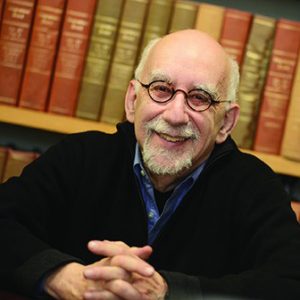
Ira I. Katznelson
Columbia University · History
Active 1968–2025
About
Professor Ira I. Katznelson is the Ruggles Professor of Political Science and History at Columbia University and serves as the Interim Provost. His career and publications are detailed on the Department of Political Science website. He is involved in academic leadership and research within the fields of political science and history. For further information about his work and contributions, contact details include his office at 411 Fayerweather Hall, phone number (212) 854-4646, and email address history@columbia.edu.
Research topics
- Sociology
- Computer Science
- Political Science
- Law
- Philosophy
- Social Science
- Humanities
- Artificial Intelligence
- Economics
- Aesthetics
- Law and economics
- Art history
- Epistemology
- Art
- Neoclassical economics
- Political economy
Selected publications
Congressional Substance and Significance: Lawmaking and National Security After 9/11
Congress & the Presidency · 2025-05-04
articleSenior authorStanford University Press eBooks · 2023
- Computer Science
- Computer Science
discussed the place of Burma in South Asian history over the course of a semesterlong works-in-progress group
Cambridge University Press eBooks · 2023-11-09 · 1 citations
book-chapterOpen access1st authorCorrespondingThis essay probes two questions about popular sovereignty's status as a philosophical and governing creed in early America. How did an unprecedented collective 'people' – a people of citizens who actively participated in governing and who constituted an abstract legitimating power – get fashioned notwithstanding the remarkable national, cultural, religious, and racial heterogeneity of Britain's North American colonies and the early United States? Why did this remarkable achievement not last, culminating in rivers of blood? I argue that the constellation of ideas and institutions that had fashioned America's civic people out of raw materials provided by Hobbes, Locke, and Madison was brought to crisis by how President Andrew Jackson and Vice President John C. Calhoun elaborated extensions to the scope of popular sovereignty in the name of democracy – Jackson regarding the movement of free white people westward; Calhoun concerning slavery and its expansion.
History in the Humanities and Social Sciences
Cambridge University Press eBooks · 2022 · 13 citations
- Social Science
- Sociology
- Social Science
This interdisciplinary volume explores the relationship between history and a range of disciplines in the humanities and social sciences: economics, political science, political theory, international relations, sociology, philosophy, law, literature and anthropology. The relevance of historical approaches within these disciplines has shifted over the centuries. Many of them, like law and economics, originally depended on self-consciously historical procedures. These included the marshalling of evidence from past experience, philological techniques and source criticism. Between the late nineteenth and the middle of the twentieth century, the influence of new methods of research, many indebted to models favoured by the natural sciences, such as statistical, analytical or empirical approaches, secured an expanding intellectual authority while the hegemony of historical methods declined in relative terms. In the aftermath of this change, the essays collected in History in the Humanities and Social Sciences reflect from a variety of angles on the relevance of historical concerns to representative disciplines as they are configured today.
On (Lost and Found) Analytical History in Political Science
Cambridge University Press eBooks · 2022-12-08 · 2 citations
book-chapter1st authorCorrespondingI argue that feminism develops a historicist critique of philosophy from within philosophy. Feminist thinkers bring to bear both history and historicist sensibilities to reveal concepts as constructs of power rather than given in nature, and reason as fractured, weaponised, and thickly situated in political structures. They thereby take aim at both philosophy and – relatedly – patriarchy. But feminists are not immune from the lure of conceptual analysis, from wanting to fix, to get right, the terms of their campaign – nor indeed from wanting themselves to claim a transcendent vantage point of truth. This chapter is about the gulf between history and philosophy, and the feminist bridge between them.
The MIT Press eBooks · 2021-01-01
paratextOpen accessforeclosure crisis and, 4 gentrification and, 6
From the Street to the Lecture Hall:
Princeton University Press eBooks · 2021-03-09
book-chapter1st authorCorrespondingPrinceton University Press eBooks · 2021 · 13 citations
1st authorCorresponding- Computer Science
- Computer Science
- Artificial Intelligence
SPQ volume 21 issue 3 Cover and Back matter
State Politics & Policy Quarterly · 2021-08-23
paratextOpen accessAt a fraught moment for democracies worldwide, this series brings together renowned scholars to probe the sources of current apprehensions about democracy and explore how democratic regimes might thrive.
Measuring Liberalism, Confronting Evil: A Retrospective
Annual Review of Political Science · 2021-05-11 · 3 citations
articleOpen access1st authorCorrespondingTaking liberalism's measure as an indispensable yet inherently fragile design grounded in the rule of law, government by consent, individual and public rights, and political representation, my work at the intersection of ideas, institutions, and methods to appraise behavior has focused on origins and transitions, membership boundaries and domination, and an unsteady bonding with the older regime model of democracy. Shaped by early and later life experiences and guided by the good fortune of stimulating networks and enabling institutions, my analytical histories of thought and events, primarily in the American experience, have asked when and why liberal democracies become normatively appealing (less closed and more tolerant) and more effective (less vulnerable and more secure). As a political scientist trained in history, I have been keen to advance a discipline that refuses to be enclosed or too crisply divided into subfields, or, indeed, to choose between quests for causality and understanding.
Frequent coauthors
- 20 shared
John S. Lapinski
University of Pennsylvania
- 16 shared
János Kornai
Harvard University
- 16 shared
Pacify Divide
Collegium Budapest
- 16 shared
Pablo González-Álvarez
Hospital Universitari Germans Trias i Pujol
- 16 shared
Els Compernolle
Central European University
- 16 shared
Iván Gál
Central European University
- 16 shared
Jürgen De Wispelaere
Central European University
- 16 shared
David Levi-Faur
Seoul National University
Education
- 1972
Ph.D., Political Science
Yale University
- 1967
B.A., Political Science
University of California, Berkeley
- Resume-aware match score
- Save to shortlist
- AI-drafted outreach
See your match with Ira I. Katznelson
PhdFit ranks faculty by your research interests, methods, and publications — grounded in their actual work, not templates.
- Free to start
- No credit card
- 30-second signup