
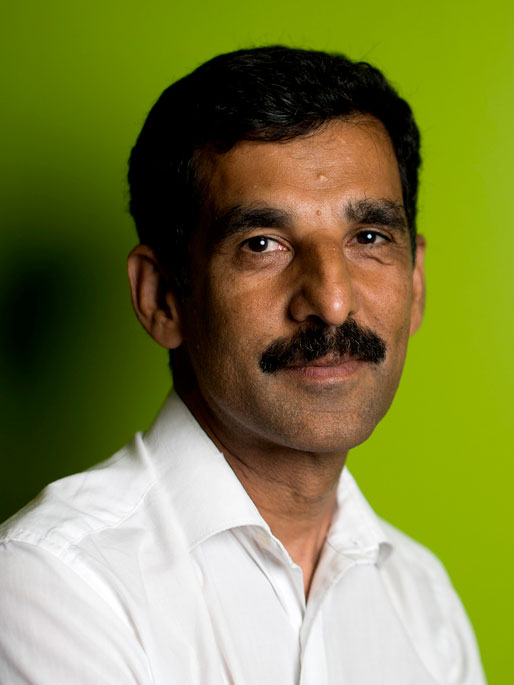
Hanumant Singh
Northeastern University · Engineering Management and Systems Engineering
Active 1972–2026
Academic metrics are sourced from OpenAlex and public funding records; values may differ from Google Scholar.
About
Hanumant Singh is a Professor at Northeastern University in the College of Engineering, with a joint appointment in the Mechanical and Industrial Engineering Program. He received his Ph.D. from the MIT-Woods Hole Oceanographic Institution Joint Program in 1995 and worked on the staff at Woods Hole Oceanographic Institution until 2016, when he joined Northeastern University. His research interests focus on field robotics, emphasizing SLAM (Simultaneous Localization and Mapping), imaging, and mapping in marine, polar, and aerial environments. Singh's group has designed and built autonomous vehicles such as the Seabed AUV and the Jetyak Autonomous Surface Vehicle, which are used globally for scientific and academic research. He has participated in 60 expeditions across all of the world’s oceans supporting diverse fields including Marine Geology, Marine Biology, Deep Water Archaeology, Chemical Oceanography, Polar Studies, and Coral Reef Ecology. Singh has received several awards, including the IEEE Oceanic Engineering Society Lifetime Achievement Award and the IEEE Distinguished Faculty Award. His work involves developing geometric and machine learning-based methods for deploying unmanned aerial, marine, and ground vehicles in extreme environments, and he leads the Field Robotics Lab at Northeastern University.
Research topics
- Computer Science
- Artificial Intelligence
- Geography
- Human–computer interaction
- Remote sensing
- Oceanography
- Multimedia
- Simulation
- Operating system
- Environmental science
Selected publications
Emerging Technologies and Approaches for In Situ, Autonomous Observing in the Arctic
Oceanography · 2022 · 25 citations
Understanding and predicting Arctic change and its impacts on global climate requires broad, sustained observations of the atmosphere-ice-ocean system, yet technological and logistical challenges severely restrict the temporal and spatial scope of observing efforts. Satellite remote sensing provides unprecedented, pan-Arctic measurements of the surface, but complementary in situ observations are required to complete the picture. Over the past few decades, a diverse range of autonomous platforms…
Towards Robot Avatars: Systems and Methods for Teleinteraction at Avatar XPRIZE Semi-Finals
2021 IEEE/RSJ International Conference on Intelligent Robots and Systems (IROS) · 2022 · 20 citations
There has been a drastic shift to remote interaction for professional, industrial and personal interactions. Improving the overall quality of these interactions by removing any sense of distance between the users is the ultimate goal. Video conferencing has been widely adopted as an improvement to audio-only interactions. Having added visuals to audio communication, the next frontier is to add physical interaction to this remote communication. In this paper, we present an avatar system with the…
Design and Evaluation of a Generic Visual SLAM Framework for Multi Camera Systems
IEEE Robotics and Automation Letters · 2023-09-18 · 19 citations
articleSenior authorMulti-camera systems have been shown to improve the accuracy and robustness of SLAM estimates, yet state-of-the-art SLAM systems predominantly support monocular or stereo setups. This paper presents a generic sparse visual SLAM framework capable of running on any number of cameras and in any arrangement. Our SLAM system uses the generalized camera model, which allows us to represent an arbitrary multi-camera system as a single imaging device. Additionally, it takes advantage of the overlapping f…
Bridging the Domain Gap between Synthetic and Real-World Data for Autonomous Driving
ACM Journal on Autonomous Transportation Systems · 2023-11-23 · 14 citations
articleOpen accessModern autonomous systems require extensive testing to ensure reliability and build trust in ground vehicles. However, testing these systems in the real-world is challenging due to the lack of large and diverse datasets, especially in edge cases. Therefore, simulations are necessary for their development and evaluation. However, existing open-source simulators often exhibit a significant gap between synthetic and real-world domains, leading to deteriorated mobility performance and reduced platfo…
NeuFlow: Real-time, High-accuracy Optical Flow Estimation on Robots Using Edge Devices
2024-10-14 · 12 citations
articleSenior authorReal-time high-accuracy optical flow estimation is a crucial component in various applications, including localization and mapping in robotics, object tracking, and activity recognition in computer vision. While recent learning-based optical flow methods have achieved high accuracy, they often come with heavy computation costs. In this paper, we propose a highly efficient optical flow architecture, called NeuFlow, that addresses both high accuracy and computational cost concerns. The architectur…
Recent grants
Collaborative Research: Improved Vehicle Autonomy in Geophysical Flows
NSF · $75k · 2016–2018
MRI: Development of AUV Technologies for Long-Range Under-Ice Transects
NSF · $488k · 2010–2013
NSF · $43k · 2017–2020
Frequent coauthors
- 81 shared
Craig Lee
- 81 shared
Victoria Hill
Old Dominion University
- 81 shared
J. Wilkinson
- 81 shared
John D. Guthrie
- 49 shared
Ryan M. Eustice
- 25 shared
Pushyami Kaveti
Northeastern University
- 24 shared
Oscar Pizarro
- 20 shared
Christopher Roman
Labs
Field Robotics LabPI
Education
- 1995
Ph.D., Ocean Engineering
Massachusetts Institute of Technology
Awards & honors
- IEEE Oceanic Engineering Society Lifetime Achievement Award…
- IEEE Fellow
Similar researchers at Northeastern University
- Resume-aware match score
- Save to shortlist
- AI-drafted outreach
See your match with Hanumant Singh
PhdFit ranks faculty by your research interests, methods, and publications — grounded in their actual work, not templates.
- Free to start
- No credit card
- 30-second signup