
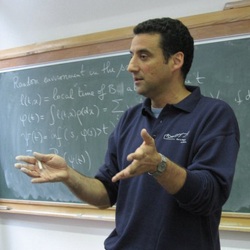
Gérard Ben Arous
· Silver Professor of Mathematics; Director, Courant InstituteNew York University · Computer Science and Engineering
Active 1983–2026
Academic metrics are sourced from OpenAlex and public funding records; values may differ from Google Scholar.
About
Gérard Ben Arous is a Professor of Mathematics at the Courant Institute of Mathematical Sciences, New York University, where he arrived in 2002. He also serves as the Director of the Courant Institute and Vice Provost for Science and Engineering Development. A native of France, Professor Ben Arous studied Mathematics at École Normale Supérieure and earned his PhD from the University of Paris VII in 1981. His academic career includes positions at the University of Paris-Sud (Orsay), École Normale Supérieure, and the Swiss Federal Institute of Technology in Lausanne, where he held the Chair of Stochastic Modeling. He has also headed departments of Mathematics and Computer Science and founded the Bernoulli Center, a Mathematics research institute in Lausanne. He is the managing editor of the journal Probability Theory and Related Fields, alongside Amir Dembo of Stanford. His research focuses on probability theory and its applications, including stochastic analysis, large deviations, random media, and random matrices, as well as their connections to partial differential equations, dynamical systems, and physics, particularly statistical mechanics of disordered media. His main interests involve the time evolution of complex systems, the universal aspects of their long-term behavior, and the mechanisms of aging related to complexity and disorder. Recognized for his contributions, he is a Fellow of the Institute of Mathematical Statistics, an elected member of the International…
Research topics
- Computer Science
- Artificial Intelligence
- Mathematics
- Physics
- Statistical physics
- Mathematical analysis
- Geometry
- Algorithm
- Quantum mechanics
- Thermodynamics
Selected publications
Algorithmic thresholds for tensor PCA
The Annals of Probability · 2020 · 59 citations
1st authorCorrespondingWe study the algorithmic thresholds for principal component analysis of Gaussian $k$-tensors with a planted rank-one spike, via Langevin dynamics and gradient descent. In order to efficiently recover the spike from natural initializations, the signal-to-noise ratio must diverge in the dimension. Our proof shows that the mechanism for the success/failure of recovery is the strength of the “curvature” of the spike on the maximum entropy region of the initial data. To demonstrate this, we study the…
Counting equilibria of large complex systems by instability index
Proceedings of the National Academy of Sciences · 2021 · 42 citations
1st authorCorrespondingWe consider a nonlinear autonomous system of [Formula: see text] degrees of freedom randomly coupled by both relaxational (“gradient”) and nonrelaxational (“solenoidal”) random interactions. We show that with increased interaction strength, such systems generically undergo an abrupt transition from a trivial phase portrait with a single stable equilibrium into a topologically nontrivial regime of “absolute instability” where equilibria are on average exponentially abundant, but typically, all of…
High‐dimensional limit theorems for SGD: Effective dynamics and critical scaling
Communications on Pure and Applied Mathematics · 2023-10-04 · 17 citations
articleOpen access1st authorAbstract We study the scaling limits of stochastic gradient descent (SGD) with constant step‐size in the high‐dimensional regime. We prove limit theorems for the trajectories of summary statistics (i.e., finite‐dimensional functions) of SGD as the dimension goes to infinity. Our approach allows one to choose the summary statistics that are tracked, the initialization, and the step‐size. It yields both ballistic (ODE) and diffusive (SDE) limits, with the limit depending dramatically on the former…
Landscape complexity beyond invariance and the elastic manifold
Communications on Pure and Applied Mathematics · 2023-09-14 · 16 citations
article1st authorAbstract This paper characterizes the annealed, topological complexity (both of total critical points and of local minima) of the elastic manifold. This classical model of a disordered elastic system captures point configurations with self‐interactions in a random medium. We establish the simple versus glassy phase diagram in the model parameters, with these phases separated by a physical boundary known as the Larkin mass, confirming formulas of Fyodorov and Le Doussal. One essential, dynamical,…
Shattering versus metastability in spin glasses
Communications on Pure and Applied Mathematics · 2023-07-25 · 10 citations
articleOpen access1st authorCorrespondingAbstract Our goal in this work is to better understand the relationship between replica symmetry breaking, shattering, and metastability. To this end, we study the static and dynamic behaviour of spherical pure p ‐spin glasses above the replica symmetry breaking temperature . In this regime, we find that there are at least two distinct temperatures related to non‐trivial behaviour. First we prove that there is a regime of temperatures in which the spherical p ‐spin model exhibits a shattering ph…
Recent grants
NSF · $300k · 2008–2012
Random Matrices, Complexity and Slow Dynamics in Random Media
NSF · $420k · 2012–2016
Frequent coauthors
- 32 shared
Alice Guionnet
Unité de Mathématiques Pures et Appliquées
- 32 shared
Alexander Fribergh
Université de Montréal
- 24 shared
Paul Bourgade
- 21 shared
Jǐŕı Černý
- 20 shared
Alan Hammond
- 19 shared
Aukosh Jagannath
University of Waterloo
- 18 shared
Reza Gheissari
- 17 shared
Nina Gantert
Labs
NYU Courant Mathematics DepartmentPI
Education
- 1981
Ph.D.
University of Paris VII
Other
École Normale Supérieure
Other
University of Paris-Sud (Orsay)
Other, Chair of Stochastic Modeling
Swiss Federal Institute of Technology in Lausanne
Awards & honors
- Senior Lady Davis Fellowship (Israel)
- Rollo Davison Prize (Imperial College, London)
- Montyon Prize (French Academy of Sciences)
Similar researchers at New York University
- Resume-aware match score
- Save to shortlist
- AI-drafted outreach
See your match with Gérard Ben Arous
PhdFit ranks faculty by your research interests, methods, and publications — grounded in their actual work, not templates.
- Free to start
- No credit card
- 30-second signup