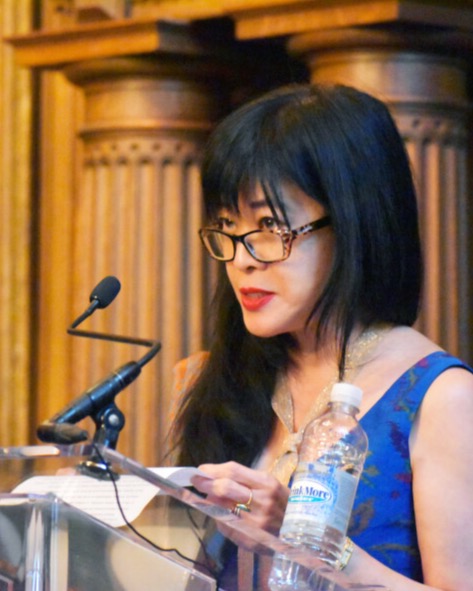
About
Geraldine Heng is a faculty member in the English department at The University of Texas at Austin. Her scholarly work focuses on literary, cultural, and social encounters between worlds, emphasizing webs of exchange and negotiation between communities and cultures. She particularly investigates these interactions through the lenses of gender, race, sexuality, and religion. Heng has a special interest in early globalism and Europe's discoveries and rediscoveries of Asia and Africa. In recognition of her contributions, she was elected to the American Academy of Arts & Sciences in 2023. Her research includes significant contributions to the understanding of medieval literature and race. Her first book, Empire of Magic (2003), explores the development of European romance literature, especially the King Arthur legend, in response to the crusades and Europe's encounters with the East. Her second book, The Invention of Race in the European Middle Ages (2018), conceptualizes medieval race and examines the treatment of Jews, Muslims, Africans and blackness, Native Americans, Mongols, and the Romani. This work won multiple awards, including the 2019 PROSE Prize in World History, the 2019 American Academy of Religion prize in Historical Studies, the 2019 Robert W. Hamilton grand prize, and the Medieval Institute's 2020 Otto Gründler prize. Heng also authored England and the Jews: How Religion and Violence Created the First Racial State in the West (2018) and has published works on teaching early global literatures and cultures. In addition to her research, Heng is deeply involved in teaching and organizational work. She teaches courses on early global literatures, premodern race, race theory, the literatures and political cultures of the Crusades, medieval romance, medieval England, Chaucer, medieval biography, transcultural travel narratives, feminist theory, and transnational feminisms. She co-founded The Global Middle Ages Project (G-MAP) and has been instrumental in developing digital humanities projects related to global medieval studies. Heng currently holds the Mildred Hayek Vacek and John Roman Vacek Chair at the University of Texas, Austin.
Research topics
- History
- Political Science
- Sociology
- Ancient history
- Art
- Geography
- Art history
- Engineering
- Archaeology
- Classics
- Literature
- Philosophy
- Aesthetics
Selected publications
Thinking about a World in Motion
Cambridge University Press eBooks · 2025-10-02
book-chapter1st authorCorrespondingWhy Do We Need a Long History of Race?
PMLA/Publications of the Modern Language Association of America · 2025-10-01
articleOpen access1st authorCorrespondingWhen The Invention of Race in the European Middle Ages was published in 2018-and, before that, when I published a two-part article of the same title in Literature Compass in 2011-race theorists and premodernists had to be actively persuaded that phenomena and practices identified today as race and racialization were palpable in the European Middle Ages, long before the modern eras.To begin the conversation, I offered a simple, stripped-down working hypothesis: that race is one of the primary names we have-a name we retain for the epistemological, ethical, and political commitments it recognizes-for a repeating tendency, of the gravest import, to demarcate human beings through differences among humans that are selectively essentialized as absolute and fundamental, in order to distribute positions and powers differentially to human groups.Racial formation thus occurs as specific historical occasions where strategic essentialisms are posited and assigned, through a variety of practices and pressures, so as to construct a hierarchy of peoples for differential treatment.
Teaching Early Global Literatures and Cultures
Cambridge University Press eBooks · 2025-05-05 · 5 citations
book1st authorCorrespondingTeaching Early Global Literatures and Cultures is a guide to the terra incognita of the global literature classroom. It begins with a framing rationale for why it is valuable to teach early global literatures today; critically surveys the issues involved in such teaching; supplies details of some two dozen texts from which to build a possible syllabus; adds a comprehensive bibliography, and suggestions for student research and student involvement in co-creating course content; and furnishes detailed guidelines for how to teach some 10 texts. It should be possible for faculty and graduate instructors to take this Element and begin teaching its sample syllabus right away.
Review: The Medieval Postcolonial Jew, In and Out of Time, Miriam Ara Krummel
Jewish historical studies · 2024-01-01
articleOpen access1st authorCorrespondingDecolonizing the Medieval Literary Curriculum
Cambridge University Press eBooks · 2023-11-02 · 2 citations
book-chapterOpen access1st authorCorrespondingNot a single tea plantation exists within the United Kingdom. [Tea] is the symbolization of British identity -I mean, what does anybody in the world know about an English person except that they cannot get through the day without a cup of tea? Where does it come from? Ceylon/Sri Lanka, India. That is the outside history that is
Balthazar · 2023-04-04
book-chapterOpen access1st authorCorrespondingIntroduction to Race in the European Middle Ages
2023-01-01 · 2 citations
other1st authorCorrespondingIntroduction For a long time, race in the European Middle Ages was a difficult subject to treat. This was because for generations, the modernists who dominated race scholarship in the academy tended to dismiss any possibility that race and its attendant consequences had any meaning at all for premod
The Cambridge Journal of Postcolonial Literary Inquiry · 2022-01-01 · 9 citations
articleOpen access1st authorCorrespondingThe aim of this book is to sketch paradigms and models for thinking critically about medieval race that call attention to tendencies and patterns, inventions, and strategies in race-making and identify crucibles and dynamics that conduce to the production of racial form and raced behavior. Dorothy Kim's response to my 2018 book, The Invention of Race in the European Middle Ages, opens with the quotation above, taken from the book itself. In requoting, I've emphasized the words thinking critically because most of the articles in this forum see that Invention of Race is scholarship that emerges out of the varied genealogical traditions of critical race theories, even as the book works to remain faithful to the premodern archives with which it transacts-so as to confront head-on, as Amrita Dhar puts it, the "charges of presentism and anachronism" that are invariably visited upon critical scholarship on premodernity. 1 Before Invention of Race, euromedievalist work on race largely produced descriptive or taxonomic scholarship (e.g., scholarship that asked who belonged to the "Germanic races" or "Celtic races"), or focused on scrutinizing Muslim, Jewish, or Black characters in literary texts-often, texts of recreational/fantasy literature. Accordingly,
2022-01-01 · 1 citations
other1st authorCorresponding2021 · 37 citations
1st authorCorresponding- Political Science
- Geography
- History
The Global Middle Ages: An Introduction discusses how, when, and why a 'global Middle Ages' was conceptualized; explains and considers the terms that are deployed in studying, teaching, and researching a Global Middle Ages; and critically reflects on the issues that arise in the establishment of this relatively new field of academic endeavor. An Introduction surveys the considerable gains to be had in developing a critical early global studies, and introduces the collaborative work of the Cambridge Elements series in the Global Middle Ages.
Frequent coauthors
- 1 shared
Lynn T. Ramey
- 1 shared
Michael Widner
- 1 shared
Evelyn Blackwood
Purdue University System
- 1 shared
Peter Nazareth
- 1 shared
Jane Margold
Wesleyan University
- 1 shared
Suzanne Brenner
University of California, San Diego
- Resume-aware match score
- Save to shortlist
- AI-drafted outreach
See your match with Geraldine Heng
PhdFit ranks faculty by your research interests, methods, and publications — grounded in their actual work, not templates.
- Free to start
- No credit card
- 30-second signup