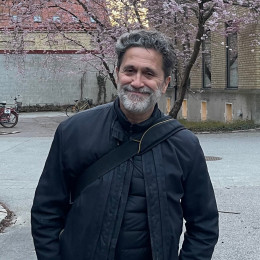
Gil Anidjar
· Professor of Religion, Department of ReligionVerifiedColumbia University · Religion
Active 2002–2026
Research topics
- Sociology
- Philosophy
- Political Science
- History
- Psychology
- Law
- Linguistics
- Epistemology
- Internal medicine
- Criminology
- Medicine
- Psychoanalysis
- Aesthetics
Selected publications
Sikh Research Journal · 2026-05-22
articleOpen access1st authorCorrespondingI am my mother’s child. Still and always. Like everyone, like every individual in history or outside of it, I have been mothered. We have all been mothered. More or less well. More or less by our own mothers. You could say that, from that unavoidable universal, there emerged the reasons for my interest in dependence, I mean, in difference—that old word—and particularly in the difference mothers make or constitute. For the most part, though, and since writing On the Sovereignty of Mothers, I have continued to try to articulate something, well, different, something like maternal difference (a phrase that, incidentally, seems as rare and unused, Naomi Morgenstern (2020) can no doubt confirm, as “maternal sovereignty” or “maternal contract"). It is, at any rate, and to be more precise, maternal differences that have struck me as unavoidable. The French have this word, incontournable, which signifies the impossibility of going around, uncircumventable. Which means, of course, that such avoidance is not only eminently possible (recall Apollo’s denial of the very parenthood of the mother in Aeschylus’ Oresteia and its tricky inheritors), but might, in fact, be governing our thought and conduct, our communities and polities. Still, even in the denial, ignorance, or violent effacement they might be said to generate or engender, I would argue that mothers remain symptomatically unavoidable—and this as soon as mothers come to mind; as soon as one encounters, which is to say, reflects and remembers, but also effaces and erases, goes around and loses mothers (we have all been mothered); as soon as mothers and the maternal become an explicit (or, again, denied) matter of concern, a question or a series of questions to be confronted or avoided, if otherwise, I would insist, than as particular or personal, local or regional, questions. Mothers, I shall try to reiterate here, do much more than reproduce the family (that protean “unit,” if there is one, that so consistently occludes what takes place “outside” of it); they reproduce the polity.
Filozofija i drustvo · 2024-01-01
articleOpen access1st authorCorrespondingDeath, Derrida suggests in Politics of Friendship, is a question of numbers. Yet, death is also always ?mine,? which is why Heidegger can say that ?the dying of Others is not something which we experience in a genuine sense; at most we are always just ?there alongside?.? Between my death and the death of everyone, between the one and the infinitely many, I have found myself wondering about a different measure, a more limited and distinct grammatical - or arithmetic - register, in which is raised the question of our death. The death, not of humanity, nor quite the death of all others, but the death of the people, the death of we who count and count for and on each other (or imagine we do). This is where Derrida?s calculability or incalculability of death intervenes at its most opaque, it seems to me. Somewhere between the one and the very many, the universal many of humanity, between what Heidegger calls ?mineness? (which, when it comes to death, remains a possibility) and the death of (all) others, there would be found the death of we, the people.
Derrida Today · 2023-05-01 · 1 citations
article1st authorCorrespondingWas Derrida a mama’s boy? Was he not hiding or indeed manifesting, ostensibly displaying even, mommy issues? Let us posit that Derrida had a substantial, perhaps an inordinate amount of things to say about mothers in general, about surrogate mothers too, and about his own mother in particular. Derrida did confess having taken the side of his mother. Yet, what I really want to ask is whether, from Plato to Nancy and, more obviously, from Rousseau to Freud and beyond, mothers can, in fact, be confined to bounded registers of life, of Derrida’s life and, more formally, to the biographical and autobiographical (as ‘Circumfession’ and before it Spurs and The Ear of the Other might suggest). Or even to the psychoanalytical (as The Post Card and, in it, the famous fort/da scene would certainly indicate). A concern — shall I already call it a solicitude — for mothers, on Derrida’s part, might raise a distinct set of questions.
Angelaki · 2023-01-02 · 1 citations
article1st authorCorrespondingI teach with water. It’s nothing very remarkable and I myself do not remember how I settled upon water as a most convenient introduction to what I have to teach, which is to say, to learn. Did not everything begin with water? My own beginnings, in any case, would border on the banal, if they did not signify so much about where I live (race and class) and how I teach (tradition, institution, location), the liberties I can responsibly take, or the sheer length to which one might have to go to register and partake of a sense of wonder – and of outrage – on the impossible path toward a collective experience of learning. In this particular instalment, learning with water is very much about recalling what we know, knowing what we do with the knowledge that we have. I teach with water. I start my class by quietly, if ostensibly, depositing in front of the class, or at the center of the seminar table, a bottle of “spring water.” I then invite the students to attend to this classroom instance of the proverbial elephant, though not necessarily true to the desperate manner of the three blind men.
The rights of whites (in search of a majority)
Interventions · 2023-12-11
article1st authorCorrespondingLike every concept, perhaps, the concept of minority can only function differentially. It is differential with regard to majority, of course, and with regard to other categories of groups, communities, or collectives, identified as minorities. The polysemy, and even vagueness, of the concept of minority, along with its distribution across a range of discursive fields, adds to its differential dimension as the word “minority” must relate to or carry a modifier. And modifiers of minority do run the full spectrum of minorities, beginning with number, of course, but also race, class, sex and gender, nationality, ethnicity, or religion, legal, social and political. And let us not forget age. Its ambiguities notwithstanding, minority always involved yet another differential, namely, measurement, though it was one that had to do with a certain quality (size, maturity), rather than with quantity per se. Is there such a thing as a minority, then? Is it not always already vanishing? What this essay describes as the destruction of minority seems crucial to recognize. It alerts us to a barely discernible condition in the age of minorities, to the possibility of there being no such thing as a majority, or else only under the figure of that minority which is not one, a minority that would appear as majority, effacing the minority that it itself is, while destroying “minorities.”
Critical Times · 2023 · 3 citations
1st authorCorresponding- Sociology
- Political Science
- Psychoanalysis
Abstract Were one to trust the experts of “the risk society,” and the countless volumes that take risk as their object, one might conclude that we have lost sight of danger. How secure is the distinction? This essay registers the discursive proliferation that has surrounded risk, as opposed to the poverty of theorizations of danger. Since Mary Douglas's famous 1966 contribution, it is as if the two terms were synonymous. Yet linguistic usage, along with other counterexamples, signal that we might learn from attending to danger in its specificity. The essay then turns to Sigmund Freud, that little-recognized thinker of danger. It was Freud who located loss—and the mother—at the center of what he strikingly called the “danger-situation.”
Mal de Sionisme (Zionist Fever)
Fordham University Press eBooks · 2022 · 2 citations
1st authorCorresponding- Medicine
- Internal medicine
Edinburgh University Press eBooks · 2022-11-24
book-chapter1st authorCorrespondingEdinburgh University Press eBooks · 2022-11-29
book-chapter1st authorCorrespondingThe word Muselmänner has been recorded, inscribed and translated, disseminated, sometimes even read, though not without problems, of course. It is a word that we will come to understand as both ordinary and literary, at once a rigid, or petrified, designator and a floating signifier; a word that signals and carries a certain history and a definite enumeration as well, that has multiplied and proliferated, acquired a strange ubiquity, and a persistent illegibility. It has done so in a vast but specific archive — Holocaust literature — and beyond it too On my way to Islam in World Literature, I shall experiment with that word, an ordinary word, or rather, a word that is at once more ordinary and more literary that has otherwise appeared. I shall proceed without assurance that I stand on the same enumerative or rhetorical ground I otherwise attend to, or indeed that I read from a demonstrably different grid or frame (Economy, Science, Politics, Religion — and the rest is Literature). Just one word, then: the word Muselmänner, which can certainly be, and has in fact been, read and translated — Muslims.
2022-10-24
book-chapter1st authorCorrespondingFor a building that never made it past destruction, the tower of Babel has cast a surprisingly long shadow. It has been a creative shadow, no doubt, and it has accordingly occasioned much growth and proliferation – of words, and other multifarious constructions. The shadow of the tower has also been an oppressive and constricting one, and a strange illustration too of what Yasmin Yildiz calls ‘the postmonolingual condition.’ After all, as Jacques Derrida asks, ‘in what tongue was the tower of Babel constructed and deconstructed?’ In what tongue and in what translation indeed? According to what ‘theology of translation’ and in what religion? Whereas the translation of religion, of the word ‘religion’ has come to be seen as a somewhat troubling, if persistently successful, enterprise, Derrida offers a different reading, and a different practice – or practices. Derrida challenges us to translate translation, to translate religion, and to ask, simultaneously, about the religion of translation.
Frequent coauthors
- 4 shared
Mamadou Diouf
Columbia University
- 4 shared
Katherine Pratt Ewing
Columbia University
- 4 shared
Jamal Malik
University of Erfurt
- 4 shared
Karen Barkey
University of California, Berkeley
- 4 shared
Thomas Gugler
Life University
- 4 shared
Leonardo Thanks
Columbia University
- 4 shared
Ilona Gerbakher
- 4 shared
Zehra Mehdi
- Resume-aware match score
- Save to shortlist
- AI-drafted outreach
See your match with Gil Anidjar
PhdFit ranks faculty by your research interests, methods, and publications — grounded in their actual work, not templates.
- Free to start
- No credit card
- 30-second signup