
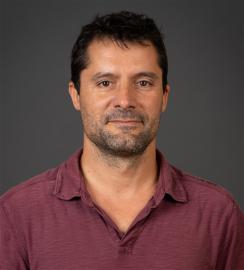
Ery Arias-Castro
· ProfessorUniversity of California, San Diego · Mathematics
Active 1970–2025
Academic metrics are sourced from OpenAlex and public funding records; values may differ from Google Scholar.
About
Ery Arias-Castro received his Ph.D. in Statistics from Stanford University in 2004. Following his doctoral studies, he held postdoctoral positions at the Institute for Pure and Applied Mathematics (IPAM), where he participated in the program on Multiscale Geometry and Analysis in High Dimensions, and at the Mathematical Sciences Research Institute (MSRI), where he engaged in the program on Mathematical, Computational and Statistical Aspects of Image Analysis. He joined the faculty of the Department of Mathematics at UCSD in 2005. His research interests encompass high-dimensional statistics, machine learning, spatial statistics, image processing, and applied probability.
Research topics
- Computer Science
- Mathematics
- Artificial Intelligence
- Statistics
- Mathematical analysis
- Combinatorics
- Data science
- Discrete mathematics
- Algorithm
- Theoretical computer science
Selected publications
On the estimation of latent distances using graph distances
Electronic Journal of Statistics · 2021 · 9 citations
1st authorCorrespondingWe are given the adjacency matrix of a geometric graph and the task of recovering the latent positions. We study one of the most popular approaches which consists in using the graph distances and derive error bounds under various assumptions on the link function. In the simplest case where the link function is proportional to an indicator function, the bound matches an information lower bound that we derive.
Principles of Statistical Analysis
2022 · 5 citations
1st authorCorrespondingThis compact course is written for the mathematically literate reader who wants to learn to analyze data in a principled fashion. The language of mathematics enables clear exposition that can go quite deep, quite quickly, and naturally supports an axiomatic and inductive approach to data analysis. Starting with a good grounding in probability, the reader moves to statistical inference via topics of great practical importance – simulation and sampling, as well as experimental design and data coll…
A unifying view of modal clustering
Information and Inference A Journal of the IMA · 2022-12-01 · 4 citations
article1st authorAbstract Two important non-parametric approaches to clustering emerged in the 1970s: clustering by level sets or cluster tree as proposed by Hartigan, and clustering by gradient lines or gradient flow as proposed by Fukunaga and Hostetler. In a recent paper, we draw a connection between these two approaches, in particular, by showing that the gradient flow provides a way to move along the cluster tree. Here, we argue the case that these two approaches are fundamentally the same. We do so by prop…
Information and Inference A Journal of the IMA · 2023-09-18 · 3 citations
article1st authorCorrespondingAbstract We start by considering the problem of estimating intrinsic distances on a smooth submanifold. We show that minimax optimality can be obtained via a reconstruction of the surface, and discuss the use of a particular mesh construction—the tangential Delaunay complex—for that purpose. We then turn to manifold learning and argue that a variant of Isomap where the distances are instead computed on a reconstructed surface is minimax optimal for the isometric variant of the problem.
Anomaly Detection for a Large Number of Streams: A Permutation-Based Higher Criticism Approach
Journal of the American Statistical Association · 2022-09-22 · 3 citations
articleOpen accessAnomaly detection when observing a large number of data streams is essential in a variety of applications, ranging from epidemiological studies to monitoring of complex systems. High-dimensional scenarios are usually tackled with scan-statistics and related methods, requiring stringent modeling assumptions for proper calibration. In this work we take a nonparametric stance, and propose a permutation-based variant of the higher criticism statistic not requiring knowledge of the null distribution.…
Recent grants
Stable and Robust Graph Embedding, and Related Problems
NSF · $140k · 2019–2022
Theory and practice of nonparametric detection
NSF · $120k · 2006–2011
ATD: Detection of Clusters in Spatial Data and Images
NSF · $885k · 2012–2017
Frequent coauthors
- 37 shared
Emmanuel J. Candès
- 23 shared
Bruno Pelletier
Institut de recherche mathématique de Rennes
- 20 shared
David L. Donoho
Stanford University
- 19 shared
Nicolas Verzélen
Mathématiques, Informatique et Statistique pour l'Environnement et l'Agronomie
- 17 shared
Gábor Lugosi
- 16 shared
Arnaud Durand
Institut de Mathématiques de Jussieu-Paris Rive Gauche
- 15 shared
Xiaoming Huo
- 14 shared
Clément Berenfeld
Awards & honors
- Hellman Fellowship
Similar researchers at University of California, San Diego
- Resume-aware match score
- Save to shortlist
- AI-drafted outreach
See your match with Ery Arias-Castro
PhdFit ranks faculty by your research interests, methods, and publications — grounded in their actual work, not templates.
- Free to start
- No credit card
- 30-second signup