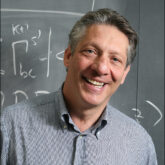
Edward Farhi
· Cecil & Ida Green Professor of Physics, EmeritusMassachusetts Institute of Technology · Physics
Active 1976–2024
Research topics
- Computer Science
- Quantum mechanics
- Physics
- Mathematics
- Combinatorics
- Discrete mathematics
- Mathematical optimization
- Theoretical physics
- Theoretical computer science
- Algorithm
- Library science
- Data science
- History
Selected publications
Non-Abelian braiding of graph vertices in a superconducting processor
Nature · 2023 · 110 citations
- Physics
- Theoretical physics
- Quantum mechanics
to create and braid them. This allows us to experimentally verify the fusion rules of the anyons and braid them to realize their statistics. We then study the prospect of using the anyons for quantum computation and use braiding to create an entangled state of anyons encoding three logical qubits. Our work provides new insights about non-Abelian braiding and, through the future inclusion of error correction to achieve topological protection, could open a path towards fault-tolerant quantum computing.
Quantum Computer Systems for Scientific Discovery
PRX Quantum · 2021 · 261 citations
- Computer Science
- Computer Science
- Data science
The great promise of quantum computers comes with the dual challenges of building them and finding their useful applications. We argue that these two challenges should be considered together, by codesigning full-stack quantum computer systems along with their applications in order to hasten their development and potential for scientific \ndiscovery. In this context, we identify scientific and community needs, opportunities, a sampling of a few use case \nstudies, and significant challenges for the development of quantum computers for science over the next 2–10 years.
The Quantum Approximate Optimization Algorithm Needs to See the Whole Graph: Worst Case Examples
arXiv (Cornell University) · 2020 · 55 citations
1st authorCorresponding- Computer Science
- Mathematics
- Combinatorics
The Quantum Approximate Optimization Algorithm can be applied to search problems on graphs with a cost function that is a sum of terms corresponding to the edges. When conjugating an edge term, the QAOA unitary at depth p produces an operator that depends only on the subgraph consisting of edges that are at most p away from the edge in question. On random d-regular graphs, with d fixed and with p a small constant time log n, these neighborhoods are almost all trees and so the performance of the QAOA is determined only by how it acts on an edge in the middle of tree. Both bipartite random d-regular graphs and general random d-regular graphs locally are trees so the QAOA's performance is the same on these two ensembles. Using this we can show that the QAOA with $(d-1)^{2p} < n^A$ for any $A<1$, can only achieve an approximation ratio of 1/2 for Max-Cut on bipartite random d-regular graphs for d large. For Maximum Independent Set, in the same setting, the best approximation ratio is a d-dependent constant that goes to 0 as d gets big.
The Quantum Approximate Optimization Algorithm Needs to See the Whole Graph: A Typical Case
arXiv (Cornell University) · 2020 · 89 citations
1st authorCorresponding- Computer Science
- Computer Science
- Algorithm
The Quantum Approximate Optimization Algorithm can naturally be applied to combinatorial search problems on graphs. The quantum circuit has p applications of a unitary operator that respects the locality of the graph. On a graph with bounded degree, with p small enough, measurements of distant qubits in the state output by the QAOA give uncorrelated results. We focus on finding big independent sets in random graphs with dn/2 edges keeping d fixed and n large. Using the Overlap Gap Property of almost optimal independent sets in random graphs, and the locality of the QAOA, we are able to show that if p is less than a d-dependent constant times log n, the QAOA cannot do better than finding an independent set of size .854 times the optimal for d large. Because the logarithm is slowly growing, even at one million qubits we can only show that the algorithm is blocked if p is in single digits. At higher p the algorithm "sees" the whole graph and we have no indication that performance is limited.
Frequent coauthors
- 50 shared
Joseph C. Bardin
Amherst College
- 50 shared
Sam Gutmann
- 44 shared
Hartmut Neven
Google (United States)
- 42 shared
Sergio Boixo
- 42 shared
Brian Burkett
- 42 shared
Brooks Foxen
- 42 shared
Kevin J. Satzinger
Google (United States)
- 42 shared
Roberto Collins
Google (United States)
Similar researchers at Massachusetts Institute of Technology
- Resume-aware match score
- Save to shortlist
- AI-drafted outreach
See your match with Edward Farhi
PhdFit ranks faculty by your research interests, methods, and publications — grounded in their actual work, not templates.
- Free to start
- No credit card
- 30-second signup