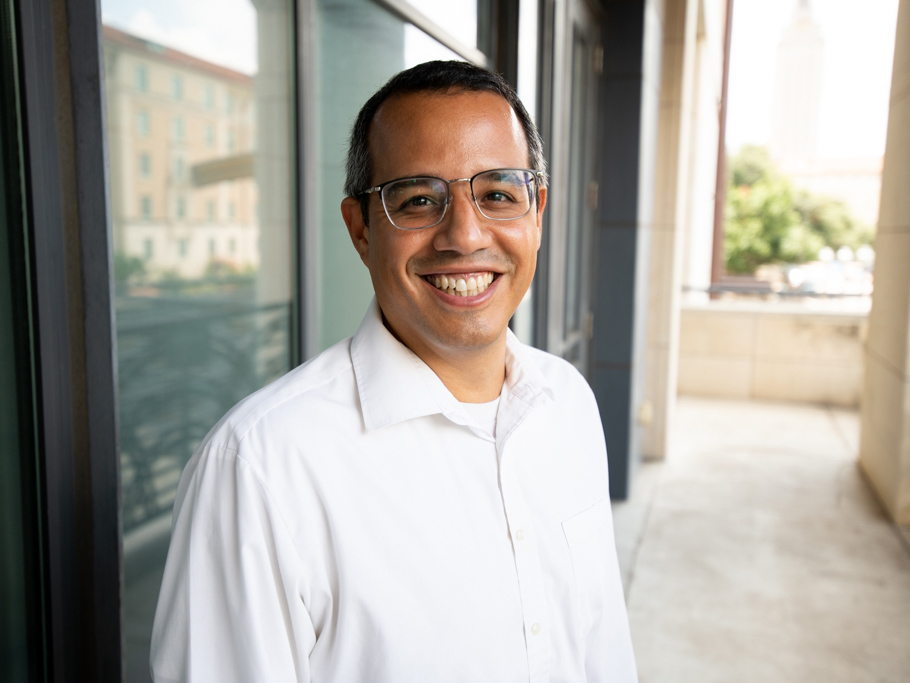
Edward Castillo
· Associate Professor & Associate Chair of Graduate Education Biomedical EngineeringUniversity of Texas at Austin · Biomedical Engineering
Active 1990–2024
About
Professor Edward Castillo is an Associate Professor and Associate Chair for Graduate Education in the Department of Biomedical Engineering at the University of Texas at Austin. He is the Principal Investigator of the Dynamic Medical Image and Computing Lab (DMIC Lab). His research focuses on medical image processing, functional imaging, and clinical applications related to biomedical engineering. Dr. Castillo's work involves advancing techniques in medical imaging to improve diagnostic and therapeutic outcomes, contributing to the field through innovative research and leadership in graduate education.
Research topics
- Medicine
- Internal medicine
- Anatomy
- Nuclear medicine
- Dentistry
- Virology
- Radiology
- Surgery
Selected publications
Radiotherapy and Oncology · 2021 · 12 citations
- Medicine
- Nuclear medicine
- Radiology
Electric scooter craniofacial trauma
Laryngoscope Investigative Otolaryngology · 2020 · 57 citations
- Medicine
- Surgery
- Dentistry
OBJECTIVE: The use of standing electronic scooters associated with micromobility applications (e-scooters) has risen nationally. The aim of this study was to obtain a detailed view of soft tissue and bony craniofacial injury associated with e-scooter-related trauma. METHODS: Single-institution retrospective case series of patients presenting to a level 1 trauma center emergency department or trauma unit with documented e-scooter-related craniofacial injury. RESULTS: Of 203 included patients, 188 (92.6%) patients sustained craniofacial injury. One hundred thirty-one (64.5%) had exclusively soft tissue injury, 3 (1.5%) exclusively bony injury, 51 (25.1%) both soft and bony injuries, and twenty-five (12.3%) patients sustained dental injury. Aesthetic units most frequently sustaining acute soft tissue injury were the forehead (n = 106, 34.6%), scalp (n = 36, 11.8%), chin (n = 34, 11.1%), upper lip (n = 32, 10.5%), and cheek (n = 31, 10.1%). Aesthetic subunits most often sustaining acute soft tissue injury included the brow (42, 13.7%), central forehead (39, 12.7%), lateral forehead (n = 25, 8.2%), and upper lip vermillion (n = 23, 7.5%). Craniofacial osseous fracture most often occurred in the orbit (n = 42, 24.6%) and maxilla (n = 40, 23.4%). Individual osseous segments most frequently sustaining acute fracture included the anterior maxillary sinus wall (n = 22, 12.9%), nasal bone (n = 20, 11.7%), lateral orbital wall (n = 16, 9.4%), orbital floor (n = 15, 8.8%), and zygomatic bone (13, 7.6%). CONCLUSIONS: Our analysis demonstrates that most patients presenting to our center with craniofacial trauma sustained acute bony fracture, most often to the midface. Our data of common injuries associated with e-scooter trauma could inform implementation in the form of facial safety equipment or safety skills training for e-scooter riders. LEVEL OF EVIDENCE: 4.
European Journal Of Haematology · 2020 · 103 citations
- Medicine
- Internal medicine
- Virology
BACKGROUND: Hypercoagulability may contribute to COVID-19 pathogenicity. The role of anticoagulation (AC) at therapeutic (tAC) or prophylactic doses (pAC) is unclear. OBJECTIVES: We evaluated the impact on survival of different AC doses in COVID-19 patients. METHODS: Retrospective, multi-center cohort study of consecutive COVID-19 patients hospitalized between March 13 and May 5, 2020. RESULTS: A total of 3480 patients were included (mean age, 64.5 years [17.0]; 51.5% female; 52.1% black and 40.6% white). 18.5% (n = 642) required intensive care unit (ICU) stay. 60.9% received pAC (n = 2121), 28.7% received ≥3 days of tAC (n = 998), and 10.4% (n = 361) received no AC. Propensity score (PS) weighted Kaplan-Meier plot demonstrated different 25-day survival probability in the tAC and pAC groups (57.5% vs 50.7%). In a PS-weighted multivariate proportional hazards model, AC was associated with reduced risk of death at prophylactic (hazard ratio [HR] 0.35 [95% confidence interval {CI} 0.22-0.54]) and therapeutic doses (HR 0.14 [95% CI 0.05-0.23]) compared to no AC. Major bleeding occurred more frequently in tAC patients (81 [8.1%]) compared to no AC (20 [5.5%]) or pAC (46 [2.2%]) subjects. CONCLUSIONS: Higher doses of AC were associated with lower mortality in hospitalized COVID-19 patients. Prospective evaluation of efficacy and risk of AC in COVID-19 is warranted.
Recent grants
Frequent coauthors
- 215 shared
Gary M. Vilke
- 177 shared
Thomas Guerrero
University of California, San Diego
- 138 shared
Richard Castillo
Emory University
- 133 shared
Theodore C. Chan
University of California, San Diego
- 93 shared
Jesse J. Brennan
University of California, San Diego
- 81 shared
J.P. Killeen
University of California, San Diego
- 73 shared
Yevgeniy Vinogradskiy
- 53 shared
Leslie C. Oyama
University of California, San Diego
Labs
Education
- 2009
Postdoctoral Scholar and Lecturer, Mathematics
University of California, Irvine
- 2008
Ph.D., Computational and Applied Mathematics
Rice University
- 2004
M.A., Computational and Applied Mathematics
Rice University
Awards & honors
- William J. Murray, Jr. Fellowship in Engineering
Similar researchers at University of Texas at Austin
- Resume-aware match score
- Save to shortlist
- AI-drafted outreach
See your match with Edward Castillo
PhdFit ranks faculty by your research interests, methods, and publications — grounded in their actual work, not templates.
- Free to start
- No credit card
- 30-second signup