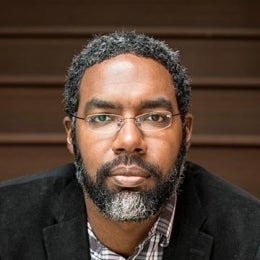
Deen Freelon
· Presidential ProfessorVerifiedUniversity of Pennsylvania · Annenberg School for Communication
Active 2009–2026
About
Deen Freelon, Ph.D., is a Presidential Professor at the Annenberg School for Communication at the University of Pennsylvania. He is an expert in digital politics and computational research methods, with a particular focus on the politics of race, gender, ideology, and other identity dimensions in social media. Freelon is widely recognized as an authority on digital politics and computational social science, having authored or coauthored over 60 book chapters, funded reports, and articles in prominent journals such as Nature, Science, and the Proceedings of the National Academy of Sciences. He was one of the first communication researchers to apply computational methods to social media data and has developed eight open-source research software packages, including ReCal, a free online intercoder reliability service used by researchers worldwide since 2008. Freelon has received over $6 million in research funding from organizations such as the Knight Foundation, the Hewlett Foundation, the Spencer Foundation, and the US Institute for Peace. He is a founding member and Senior Researcher at the Center for Information, Technology, and Public Life at the University of North Carolina at Chapel Hill, which is part of the Knight Research Network. Freelon’s research and commentary have been featured in numerous media outlets, including the Washington Post, NPR, The Atlantic, Buzzfeed, Vox, USA Today, the BBC, PBS NewsHour, CBS News, and NBC News. His work centers questions of identity and power, with particular attention to race, gender, and ideology. He holds a B.A. with honors from Stanford University, and an M.A. and Ph.D. from the University of Washington. Prior to his current position, he held tenured roles at American University and the University of North Carolina at Chapel Hill. His endowed chair is named after his great-grandfather, Allan Randall Freelon Sr., an acclaimed Philadelphia artist and educator who graduated from Penn.
Research topics
- Political Science
- Computer Science
- Sociology
- Law
- Media studies
- Internet privacy
- Data science
- World Wide Web
- Psychology
- Social psychology
- Advertising
- Business
- Information Retrieval
- Social Science
- Computer Security
- Management science
- Engineering
- Art history
- Mathematics
- Multimedia
- Communication
- Demography
- Political economy
- Economics
Selected publications
A systematic review of social science studies analyzing social media data, 2010-2024
SocArXiv (OSF Preprints) · 2026-04-20
preprintOpen accessSocial media platforms have long served as important data sources for social scientists. Policies around academic access to platform data, however, have seen substantial changes in recent years. These shifts have introduced profound uncertainty for scholarship relying on social media data. We evaluate the potential research impact of such changes by conducting a systematic analysis of scholarship published between 2010 and 2024 in 59 journals, representing five social science disciplines as well as leading interdisciplinary journals. Using a multi-method design that includes human-in-the-loop AI annotation, we find that 0.78% of papers in our corpus (3.15% when focusing exclusively on social science journals) use social media data for empirical research, with substantial variance across disciplines—ranging from less than 1% in Economics to approximately 13% in Communication. Twitter/X and Facebook are, respectively, the first and second most popular data sources across all disciplines, throughout the 15 years of our study. Further, the percentage of papers using social media data has dramatically increased over this period, tripling its share of social science publications, although this share has plateaued and even declined in the last few years. This recent decline has been driven by Twitter/X and Facebook in particular, and suggests that the empirical study of social media may be on the cusp of significant changes. These changes might affect the study of real-time events and phenomena with widespread sociopolitical ramifications, such as the COVID-19 pandemic and misleading information surrounding the 2016 U.S. presidential election, which we observe to be some of the major topics studied by social scientists using social media data.
Code for "The Effect of Deactivating Facebook and Instagram on Users’ Emotional State"
ICPSR Data Holdings · 2026-03-31
datasetOpen accessWe estimate the effect of social media deactivation on users’ emotional state in two large randomized experiments before the 2020 U.S. election. People who deactivated Facebook for the six weeks before the election reported a 0.060 standard deviation improvement in an index of happiness, depression, and anxiety, relative to controls who deactivated for just the first of those six weeks. People who deactivated Instagram for those six weeks reported a 0.041 standard deviation improvement relative to controls. Exploratory analysis suggests the Facebook effect is driven by people over 35, while the Instagram effect is driven by women under 25.<br>
How deceptive online networks reached millions in the US 2020 elections
Nature Human Behaviour · 2026-04-06
articleA systematic review of social science studies analyzing social media data, 2010-2024
2026-04-20
articleOpen accessSenior authorSocial media platforms have long served as important data sources for social scientists. Policies around academic access to platform data, however, have seen substantial changes in recent years. These shifts have introduced profound uncertainty for scholarship relying on social media data. We evaluate the potential research impact of such changes by conducting a systematic analysis of scholarship published between 2010 and 2024 in 59 journals, representing five social science disciplines as well as leading interdisciplinary journals. Using a multi-method design that includes human-in-the-loop AI annotation, we find that 0.78% of papers in our corpus (3.15% when focusing exclusively on social science journals) use social media data for empirical research, with substantial variance across disciplines—ranging from less than 1% in Economics to approximately 13% in Communication. Twitter/X and Facebook are, respectively, the first and second most popular data sources across all disciplines, throughout the 15 years of our study. Further, the percentage of papers using social media data has dramatically increased over this period, tripling its share of social science publications, although this share has plateaued and even declined in the last few years. This recent decline has been driven by Twitter/X and Facebook in particular, and suggests that the empirical study of social media may be on the cusp of significant changes. These changes might affect the study of real-time events and phenomena with widespread sociopolitical ramifications, such as the COVID-19 pandemic and misleading information surrounding the 2016 U.S. presidential election, which we observe to be some of the major topics studied by social scientists using social media data.
Code for "The Effect of Deactivating Facebook and Instagram on Users’ Emotional State"
ICPSR Data Holdings · 2026-03-31
datasetOpen accessWe estimate the effect of social media deactivation on users’ emotional state in two large randomized experiments before the 2020 U.S. election. People who deactivated Facebook for the six weeks before the election reported a 0.060 standard deviation improvement in an index of happiness, depression, and anxiety, relative to controls who deactivated for just the first of those six weeks. People who deactivated Instagram for those six weeks reported a 0.041 standard deviation improvement relative to controls. Exploratory analysis suggests the Facebook effect is driven by people over 35, while the Instagram effect is driven by women under 25.<br>
Reshares on social media amplify political news but do not detectably affect beliefs or opinions
UNC Libraries · 2025-03-19
articleOpen accessWe studied the effects of exposure to reshared content on Facebook during the 2020 US election by assigning a random set of consenting, US-based users to feeds that did not contain any reshares over a 3-month period. We find that removing reshared content substantially decreases the amount of political news, including content from untrustworthy sources, to which users are exposed; decreases overall clicks and reactions; and reduces partisan news clicks. Further, we observe that removing reshared content produces clear decreases in news knowledge within the sample, although there is some uncertainty about how this would generalize to all users. Contrary to expectations, the treatment does not significantly affect political polarization or any measure of individual-level political attitudes.
The Effect of Deactivating Facebook and Instagram on Users’ Emotional State
National Bureau of Economic Research · 2025-04-01 · 5 citations
reportOpen accessWe estimate the effect of social media deactivation on users' emotional state in two large randomized experiments before the 2020 U.S. election.People who deactivated Facebook for the six weeks before the election reported a 0.060 standard deviation improvement in an index of happiness, depression, and anxiety, relative to controls who deactivated for just the first of those six weeks.People who deactivated Instagram for those six weeks reported a 0.041 standard deviation improvement relative to controls.Exploratory analysis suggests the Facebook effect is driven by people over 35, while the Instagram effect is driven by women under 25.
American Psychologist · 2025-10-20 · 26 citations
articleOpen accessThere is widespread concern that misinformation poses dangerous risks to health, well-being, and civic life. Despite a growing body of research on the topic, significant questions remain about the psychological factors that render people susceptible to misinformation, the extent to which it affects real-world behavior, how it spreads online and offline, and intervention strategies that counter and correct misinformation effectively. This report reviews the best available psychological science research to reach consensus on each of these crucial questions, particularly as they pertain to health-related misinformation. In addition, the report offers eight specific recommendations for scientists, policymakers, and health professionals who seek to recognize and respond to misinformation in healthcare and beyond. (PsycInfo Database Record (c) 2025 APA, all rights reserved).
How do social media feed algorithms affect attitudes and behavior in an election campaign?
UNC Libraries · 2025-03-19 · 10 citations
articleOpen accessWe investigated the effects of Facebook's and Instagram's feed algorithms during the 2020 US election. We assigned a sample of consenting users to reverse-chronologically-ordered feeds instead of the default algorithms. Moving users out of algorithmic feeds substantially decreased the time they spent on the platforms and their activity. The chronological feed also affected exposure to content: The amount of political and untrustworthy content they saw increased on both platforms, the amount of content classified as uncivil or containing slur words they saw decreased on Facebook, and the amount of content from moderate friends and sources with ideologically mixed audiences they saw increased on Facebook. Despite these substantial changes in users' on-platform experience, the chronological feed did not significantly alter levels of issue polarization, affective polarization, political knowledge, or other key attitudes during the 3-month study period.
Inequities of race, place, and gender among the communication citation elite, 2000–2019
UNC Libraries · 2025-04-04
articleOpen accessA recent wave of studies has focused on the identities of communication scholars, quantifying the degree to which Whites, men, and Americans dominate the discipline.This study analyzes the communication citation elite (CCE)—a group of 1,675 highly cited scholars in communication research—in terms of race, gender, and country of employment over 20 years. Applying computational methods and content analysis, we find that 91.5% of first-author CCE members are White, 74.3% are men, and 78.6% work in the United States. Longitudinal analyses of each identity category reveal only minor shifts, most prominently slight gains for women and non-U.S. scholars. White representation among first authors decreased less than 4 percentage points over the study period (from 95.1% to 91.2%), with Black representation ending lower than it began (0.61% to 0.54%). Data from the International Communication Association indicate that the CCE is substantially more American and male than the organization’s full membership as of 2021.
Frequent coauthors
- 20 shared
Daniel Malmer
- 19 shared
Meredith D. Clark
Northeastern University
- 18 shared
Lisa K. Fazio
Vanderbilt University
- 16 shared
Dolores Albarracín
- 16 shared
Briony Swire‐Thompson
Northeastern University
- 16 shared
Jon Roozenbeek
University of Cambridge
- 16 shared
Lori Kido Lopez
University of Wisconsin–Madison
- 16 shared
Jay Joseph Van Bavel
Norwegian School of Economics
Awards & honors
- Annenberg Scholars Awarded Information and Democracy Researc…
- Resume-aware match score
- Save to shortlist
- AI-drafted outreach
See your match with Deen Freelon
PhdFit ranks faculty by your research interests, methods, and publications — grounded in their actual work, not templates.
- Free to start
- No credit card
- 30-second signup