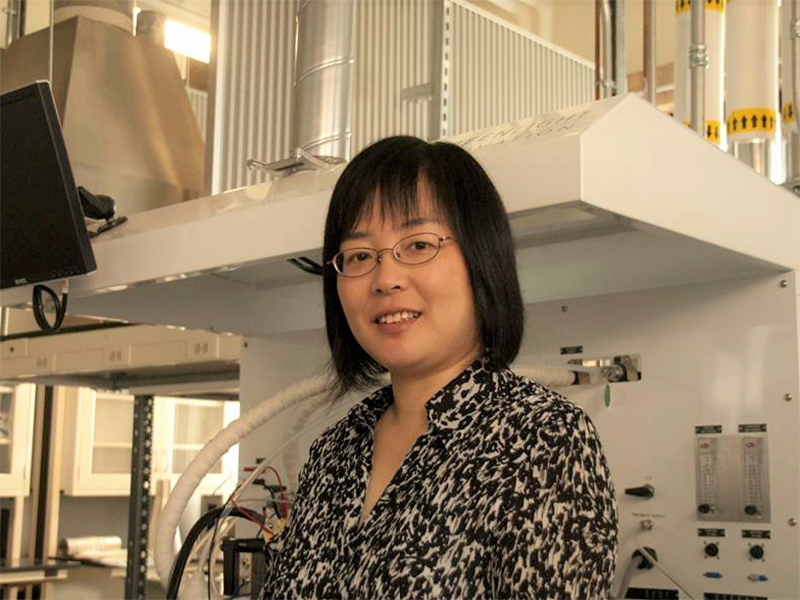
Dongmei "Maggie" Chen
· ProfessorVerifiedUniversity of Texas at Austin · Mechanical Engineering
Active 2004–2026
About
Dr. Dongmei "Maggie" Chen joined The University of Texas at Austin in January 2009. She holds the J. Mike Walker Professorship in Mechanical Engineering and is part of the Department of Mechanical Engineering. Her educational background includes a Ph.D. in Mechanical Engineering from The University of Michigan, obtained in 2006, and a B.S. in precision instruments and mechanology from Tsinghua University in Beijing, China. Prior to her academic appointment, she was a Senior Control Algorithms Engineer at General Motors Fuel Cell Activities Center. Her teaching and research interests are centered on automatic control and dynamic systems, with a focus on theories of optimal control, switching control, non-minimum phase systems and control, and reduced order modeling. Her research applies these theories to various fields including autonomous ground vehicles, energy systems such as wind turbines, fuel cells, rechargeable batteries, energy storage flywheels, smart microgrids, and automatic drilling systems. Dr. Chen has received several awards, including a 2011 NSF CAREER award, a Best Paper in Session award at the 2012 ASME Dynamic Systems and Control Conference, and IEEE PES Prize Paper Awards in 2016. Her industry experience includes recognition for technical excellence at General Motors and a nomination for the Customer Driven Quality Award at Ford Motor Company.
Research topics
- Computer Science
- Materials science
- Petroleum engineering
- Geology
- Nanotechnology
- Electrical engineering
- Engineering
- Optoelectronics
Selected publications
IEEE/ASME Transactions on Mechatronics · 2026-01-01
articleOpen accessSenior authorAn almost periodic piecewise linear system (APPLS) is a type of piecewise linear system where the system cyclically switches between different modes, each with an uncertain but bounded dwell-time. Process regulation, especially disturbance rejection, is critical to the performance of these advanced systems. However, a method to guarantee disturbance rejection has not been developed. The objective of this study is to develop an <inline-formula xmlns:mml="http://www.w3.org/1998/Math/MathML" xmlns:xlink="http://www.w3.org/1999/xlink"><tex-math notation="LaTeX">${{\mathcal{{H}}}_{\infty} }$</tex-math></inline-formula> performance analysis method for APPLSs, building on which an algorithm to synthesize practical <inline-formula xmlns:mml="http://www.w3.org/1998/Math/MathML" xmlns:xlink="http://www.w3.org/1999/xlink"><tex-math notation="LaTeX">${{\mathcal{{H}}}_{\infty} }$</tex-math></inline-formula> controllers is proposed. As an application, the developed methods are demonstrated with an advanced manufacturing system—roll-to-roll dry transfer of two-dimensional materials and printed flexible electronics. Experimental results show that the proposed method enables a less conservative and much better performing <inline-formula xmlns:mml="http://www.w3.org/1998/Math/MathML" xmlns:xlink="http://www.w3.org/1999/xlink"><tex-math notation="LaTeX">${{\mathcal{{H}}}_{\infty} }$</tex-math></inline-formula> controller compared with a baseline <inline-formula xmlns:mml="http://www.w3.org/1998/Math/MathML" xmlns:xlink="http://www.w3.org/1999/xlink"><tex-math notation="LaTeX">${{\mathcal{{H}}}_{\infty} }$</tex-math></inline-formula> controller that does not account for the uncertain system switching structure.
Existence and Uniqueness of Solution for Linear Complementarity Problem in Contact Mechanics
ArXiv.org · 2025-08-07
preprintOpen accessSenior authorAlthough a unique solution is guaranteed in the Linear complementarity problem (LCP) when the matrix $\mathbf{M}$ is positive definite, practical applications often involve cases where $\mathbf{M}$ is only positive semi-definite, leading to multiple possible solutions. However, empirical observations suggest that uniqueness can still emerge under certain structural conditions on the matrix $\mathbf{M}$ and vector $\mathbf{q}$. Motivated by an unresolved problem in nonlinear modeling for beam contact in directional drilling, this paper systematically investigates conditions under which a unique solution exists for LCPs with certain positive semi-definite matrices $\mathbf{M}$. We provide a rigorous proof demonstrating the existence and uniqueness of the solution for this specific case and extend our findings to establish a generalized framework applicable to broader classes of LCPs. This framework enhances the understanding of LCP uniqueness conditions and provides theoretical guarantees for solving real-world problems where positive semi-definite matrices $\mathbf{M}$ arise.
Journal of Process Control · 2025-10-28 · 2 citations
articleSenior authorDM-MPPI: Datamodel for Efficient and Safe Model Path Integral Control
arXiv (Cornell University) · 2025-11-30
preprintOpen accessSenior authorWe extend the Datamodels framework from supervised learning to Model Predictive Path Integral (MPPI) control. Whereas Datamodels estimate sample influence via regression on a fixed dataset, we instead learn to predict influence directly from sample cost features, enabling real-time estimation for newly generated samples without online regression. Our influence predictor is trained offline using influence coefficients computed via the Datamodel framework across diverse MPPI instances, and is then deployed online for efficient sample pruning and adaptive constraint handling. A single learned model simultaneously addresses efficiency and safety: low-influence samples are pruned to reduce computational cost, while monitoring the influence of constraint-violating samples enables adaptive penalty tuning. Experiments on path-tracking with obstacle avoidance demonstrate up to a $5\times$ reduction in the number of samples while maintaining control performance and improving constraint satisfaction.
SPE/IADC International Drilling Conference and Exhibition · 2025-02-25
articleAbstract Coupled tri-axial drillstring vibrations are widely recognized as major causes of compromised drilling efficiency and safety. Excessive and self-sustaining drillstring oscillations, occurring at different frequencies, can result in premature drilling system failures, bit wear/damage, compromised hole quality, reduced rate-of-penetration (ROP), and non-productive time (NPT). In this study, a novel distributed in-bottom-hole-assembly (in-BHA) drilling vibration control system is proposed to robustly and efficiently suppress coupled drilling vibrations once they are detected. Multi-input-multi-output (MIMO) in-BHA controllers with local state-/output-feedback were designed following robust and optimal control theories. Lower drillstring dynamics and downhole drilling parameters are utilized to simultaneously control the at-bit weight-on-bit (WOB) and rotation speed (RPM). Ideally, the proposed control system requires no communication with surface once deployed, which significantly accelerates system control response action and expands the control bandwidth. Comprehensive simulations are performed to illustrate that the proposed controllers outperform existing drilling vibration mitigation technologies in terms of robustness, stabilization time, energy consumption, and actuation requirements.
High-Temperature Cyclic Particle Storage Bin Testing
2025-03-01
reportSenior authorDrill Pipe Damage Tracking and Analysis System to Reduce Drillstring Failure
SPE/IADC International Drilling Conference and Exhibition · 2025-02-25
articleAbstract Drill pipe (DP) damages, caused by excessive loads and suboptimal drilling operations, can lead to undesired drilling dysfunctions, extra non-productive time, and increasing pipe repair expenses. Identifying the root causes of DP damages and their correlation to the drilling programs can help optimize the well/drillstring design as well as the drilling operation and ultimately reduce the risk of severe drillstring failure. In this study, over 300 DP inspection reports (over 170,000 joints of 5" and 5.5" DPs) and drilling data from over 1,000 wells are investigated to summarize the average connection damage rates and DP thickness loss. Damage decomposition among thread, seal, hardband, reface, damage beyond repair (DBR), and thickness loss are concluded for different pipe sizes, formations, and contractors. Furthermore, operation envelope, mud type, vertical/lateral footage, lithology, drillstring structure, and other well designs are selected as essential features for the damage-operation correlation analysis. Cases of severely damaged strings are investigated as well. Based on the analysis results, a comprehensive understanding of DP damage rates and mechanisms has been achieved to practically optimize drilling jobs, reduce drillstring failure risks, and cut drilling expenses. A DP analysis automation pipeline is also built to make the analysis results evergreen.
Rice Stubble Provides Overwintering Microhabitats for Spiders in Winter-Fallowed Rice Fields
Agriculture · 2025-02-11
articleOpen accessSpiders are among the predominant predatory arthropods in rice field ecosystems. Although the potential of spiders for controlling pests during the growth stages of rice is well known, few studies have focused on the overwintering habits of spiders after rice harvesting. In the present study, we aimed to evaluate the potential of rice stubble as an overwintering microhabitat for spiders in winter-fallowed rice fields. To this end, we investigated the arthropod community composition and analyzed the prey spectra of common predators in rice stubble in winter-fallowed rice fields in Nanchong City, Sichuan Province, China. The results showed that abundant predatory arthropods, particularly spiders, were present in the rice stubble, followed by other arthropods and pests. Dietary analysis via DNA metabarcoding revealed the prey availability and/or predation frequency of spiders is low in winter rice fields. Nevertheless, pests and other arthropods (particularly collembolans) within rice stubble serve as food resources for predators, particularly spiders, in winter-fallowed rice fields. Our results confirm that rice stubble provides overwintering microhabitats for spiders in winter-fallowed fields. Therefore, it is particularly important to properly manage rice stubble in winter-fallowed rice fields to enhance the biological pest control services of predators (including spiders). In addition, our findings highlight the potential of rice stubble as a habitat for the artificial reproduction of spiders for pest control in rice fields.
FPGA-based Mb2DKDNet for field disease and pest diagnosis
Smart Agricultural Technology · 2025-10-10 · 1 citations
articleOpen access1st author• Proposed Mb2DKDNet model for intelligent diagnosis of rice pests and diseases in the field. • Constructed MIRD dataset covering diverse regions and rice growth stages. • Deployed on FPGA to enable efficient real-time diagnosis in agricultural machinery. • Achieved 98.07 % accuracy, supporting precise pest control and reduced pesticide use. Accurate and efficient identification of rice diseases and pests is crucial for ensuring stable crop yields and sustainable agricultural development. It is necessary for crop protection to realize the in-time identification in the relatively short control window for some plant diseases and pests. In this study, we propose Mb2DKDNet, a lightweight convolutional neural network (CNN) optimized through Decoupled Knowledge Distillation (DKD) to enhance classification performance while maintaining computational efficiency. To further improve real-time inference capability, we implement a field-programmable gate array (FPGA)-based acceleration scheme, incorporating matrix blocking and pipelined vector multiplication techniques to optimize computational efficiency. As an essential part of this study, we collected and constructed a high-quality dataset, named Multi-scale Image Dataset for Rice Disease and Pest Diagnosis (MIRD), which spans multiple regions and time periods. Experimental results demonstrate that Mb2DKDNet achieves a classification accuracy of 98.07 %, representing a 1.25 % improvement over the baseline model, with only 2.23 M parameters. The FPGA implementation attains a computational throughput of 21.3 GFLOPs and an inference speed of 79 milliseconds per frame, ensuring efficient real-time processing in resource-constrained environments. The proposed method provides a promising solution for intelligent pest and disease monitoring in precision agriculture, contributing to improved crop protection and reduced reliance on chemical pesticides.
2025-06-22 · 1 citations
articleAbstract In drilling, the coupling between drillstring dynamics and drilling fluid hydraulics is instrumental to the excitation of vibrations in the drilling system and the applicable boundary conditions for such excitation. However, most of the existing drillstring models fail to capture the dynamic-hydraulic interactions and their impact on drilling performance. To address these challenges, comprehensive computational fluid dynamics (CFD) simulations were conducted with the finite volume method (FVM) to estimate the hydraulic forces on drillstrings under diverse conditions. Coupled lateral-torsional movements of a drill pipe were reconstructed and approximated as the moving boundaries of the CFD model. With the hybrid/dynamic mesh, the proposed CFD model can effectively calculate the real-time annulus fluid velocity field and hydraulic forces with improved accuracy. The simulations span a wide range of drilling scenarios, exploring different drillstring whirling and rotational frequencies, with varying flow rates of Newtonian and non-Newtonian fluids in 2D and 3D domains. The analysis results provide a detailed view of how the drillstring dynamics can affect the drilling fluid hydraulics and can be utilized to guide and improve drilling operations in the field.
Recent grants
CAREER: Control of Integrated Wind Turbine and Rechargeable Battery Systems
NSF · $410k · 2011–2017
NSF · $200k · 2013–2017
NSF · $463k · 2021–2025
NSF · $370k · 2012–2016
Frequent coauthors
- 33 shared
Eric van Oort
The University of Texas at Austin
- 30 shared
Pradeepkumar Ashok
The University of Texas at Austin
- 23 shared
Wei Li
- 20 shared
Qishen Zhao
Cytoskeleton (United States)
- 19 shared
Tianheng Feng
- 18 shared
Zheren Ma
- 16 shared
Nan Hong
The University of Texas at Austin
- 14 shared
Qifan Gu
The University of Texas at Austin
Education
- 2006
Ph.D., Mechanical Engineering
The University of Michigan
B.S., precision instruments and mechanology
Tsinghua University, Beijing, China
Awards & honors
- 2011 National Science Foundation (NSF) CAREER award
- Best Paper in Session award at the 2012 ASME Dynamic Systems…
- IEEE PES Prize Paper Award (2016)
- Powertrain Achievement Award in the Quest for Technical Exce…
- company-wide nomination for Customer Driven Quality Award fr…
- Resume-aware match score
- Save to shortlist
- AI-drafted outreach
See your match with Dongmei "Maggie" Chen
PhdFit ranks faculty by your research interests, methods, and publications — grounded in their actual work, not templates.
- Free to start
- No credit card
- 30-second signup