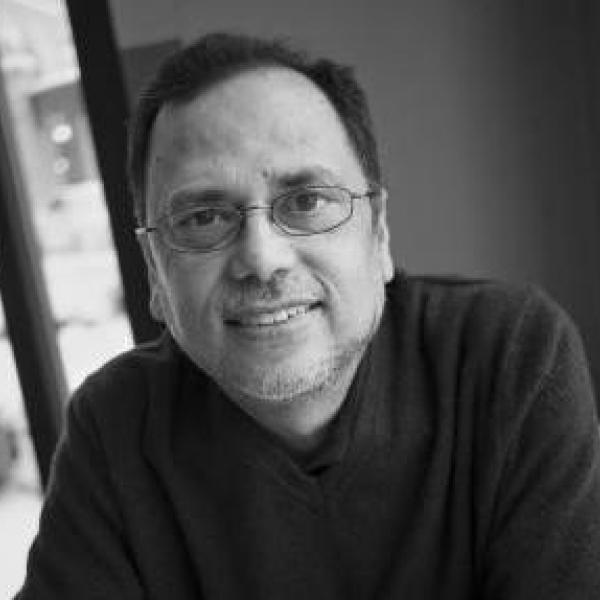
Dipesh Chakrabarty
· Lawrence A. Kimpton Distinguished Service ProfessorUniversity of Chicago · South Asian Languages and Civilizations
Active 1935–2026
About
Dipesh Chakrabarty is the Lawrence A. Kimpton Distinguished Service Professor in History, South Asian Languages and Civilizations, and the College at The University of Chicago. He holds a BSc (physics honors) from Presidency College, University of Calcutta, a postgraduate Diploma in management from the Indian Institute of Management, Calcutta, and a PhD in history from the Australian National University. Chakrabarty is a faculty fellow of the Chicago Center for Contemporary Theory and a courtesy faculty member in the Law School. He is a founding member of the editorial collective of Subaltern Studies, a consulting editor of Critical Inquiry, and a founding editor of Postcolonial Studies. His scholarly work focuses on postcolonial thought, global and planetary histories, and the intersections of climate change and human history. He has received numerous honors and awards, including the European Essay Prize for his work on climate history, honorary doctorates from the University of London, University of Antwerp, and École Normale Supérieure, and fellowships at prestigious institutions such as the Max Planck Institute, the Australian Academy of the Humanities, and the British Academy. Chakrabarty's research supervision encompasses topics like modern Indian history, South Asian cultures, and environmental history, with recent publications exploring climate change, planetary humanities, and postcolonial theory.
Research topics
- History
- Political Science
- Sociology
- Geography
- Law
- Astrobiology
- Geology
- Gender studies
- Physics
- Climatology
Selected publications
Cambridge University Press eBooks · 2026-03-15
bookSenior authorWith a focus on the Hindu/Presidency College, this book offers new ways of doing histories of education in colonial and postcolonial historical settings. Each essay utilizes new archival materials to present “liberal arts” education as an arena of competition, conversation, the rise of new disciplines, and politics. The everyday life of the College comes alive in a set of interdisciplinary essays that analyse different aspects of the institution's existence from student publications to the challenges of under-funding. Together, they shed new light on the daily labour and strife as well as the work of the imagination that shaped a centre of excellence. Excellence, however, was also premised upon social, cultural, and financial exclusions that cannot be ignored as we write new global histories of education and intellectual life in postcolonial India. The volume offers vital historical insight into the survival and challenges faced by an educational institution that is salutary as higher education, globally, faces unprecedented challenges.
Critique and Criticism, in Times of Crisis
Foucault Studies · 2026-03-01
articleOpen access1st authorCorrespondingThe Meanings of Climate Change in advance
Philosophy Today · 2026-01-01
article1st authorCorrespondingA leading historian and theorist of climate change, Dipesh Chakrabarty speaks with the philosopher and poet Travis Holloway about a range of issues, including: Chakrabarty’s concepts of the planetary and a planetary age; Chakrabarty’s engagement with philosophical debates concerning history; the turn in Chakrabarty’s work towards climate change and the geological; the relationship between his work on capitalism and postcolonialism and his work on climate change and geological histories; Chakrabarty’s response to the Anthropocene debate; and the meaning of climate change. Dipesh Chakrabarty is Distinguished Professor of History at the University of Chicago and author of The Climate of History in a Planetary Age, Provincializing Europe, and other works. Travis Holloway is a philosopher, a translator, and a poet and former Goldwater Fellow in Poetry at New York University. His most recent book is How to Live at the End of the World: Theory, Art, and Politics for the Anthropocene.
Some Ironies and Anomalies in the History of Subaltern Studies
2025-04-24 · 1 citations
book-chapter1st authorCorrespondingThis chapter reminisces about the historical period and the fervent, debates and political processes that gave shape to Subaltern Studies in the early 1980s. It comments on the significance acquired by peasants in 1970s, particularly among Left ideologues and intellectuals. Here, peasants were rendered as an identifiable social group whose political potential was expected to occasion revolutions leading non-capitalist futures, and links it with the choice of the peasant as the paradigmatic subaltern. Chakrabarty reflects on the transition in Subaltern Studies from an important intervention in colonial and national(ist) history and historiography into global, postcolonial-global “studies” (instead of “discipline”) from the 1990s in tune with changing socio-political circumstances and academic imperatives.
Žmogaus būklė antropoceno epochoje. 1-2 paskaitos
Athena filosofijos studijos · 2025-12-30
articleOpen access1st authorCorrespondingJau kur laik siekiu apmstyti klausim, kaip globalizacijos -didjanio pasaulio susietumo -ir globalinio atilimo susikertanios temos formuoja ms gyvena-
História e políticas de reconhecimento
LA Referencia (Red Federada de Repositorios Institucionales de Publicaciones Científicas) · 2025-02-05
articleOpen access1st authorCorrespondingNesse ensaio, Dipesh Chakrabarty reflete sobre a “política de reconhecimento” abordando o que ela significa para a escrita da história contemporânea, sobretudo, quando se consideram as convenções tradicionais relativas à objetividade e à distância histórica. Publicado em 2007, o manifesto problematiza essas questões e considera a relação entre identidade, direito e história a partir da posição única de Chakrabarty como historiador indiano formado em uma universidade australiana, atento tanto à experiência dos dalits, quanto às reivindicações dos aborígenes por terras na Austrália. As demandas por história e por direitos desses grupos considerados “subalternos” levam à emergência de uma “mistura particular entre história e memória” que desafia as formas correntes de pesquisa e escrita da história. Essa combinação coloca em evidência uma comodificação da experiência e inaugura, assim, uma nova relação com o passado, mediado agora mais pela mídia do que pelo aparato científico e disciplinar da história. Diante disso, a “política de reconhecimento” demanda dos historiadores a expansão não só do seu horizonte ético de atuação, quanto uma autoanálise crítica sobre o seu papel na luta por direitos.
Kapitalizm, praca i podstawa dla historii planetarnych
Klio - Czasopismo Poświęcone Dziejom Polski i Powszechnym · 2024-05-20
articleOpen access1st authorCorrespondingTranslation of the opnening lecture during XXIII International Congress of Historical Sciences (CAPITALISM, WORK, AND THE GROUND FOR PLANETARY HISTORIES)
2024-01-11
book-chapter1st authorCorrespondingThis chapter accentuates the conversation between India and the world, with an emphasis on the second half of the 19th century to the present day. Dipesh Chakrabarty explores notions of civilization and ethics, drawing in particular from four representative Indian voices: Swami Vivekananda, Rabindranath Tagore, Mahatma Gandhi and Jawaharlal Nehru. The chapter examines their influence on India in terms of postcolonialism, modernization, globalization and how their views and approaches shaped India's relationship with the Western world. Looking forwards to issues such as climate change, Chakrabarty argues that Tagore and Gandhi's civilizational critique has renewed new relevance in the world today.
Gallimard eBooks · 2024-04-25
book-chapter1st authorCorrespondingHumanities in the anthropocene
Jagiellonian University Repository (Jagiellonian University) · 2023-01-01
bookOpen access1st authorCorrespondingTom Humanistyka w czasach antropocenu zbiera najważniejsze teksty Dipesha Chakrabarty’ego, jednego z najwybitniejszych w świecie przedstawicieli studiów postkolonialnych i zaangażowanego w dyskusje na temat zmian klimatycznych historyka. Interesując się relacjami między Zachodem a światem niezachodnim, Chakrabarty krytycznie podchodzi do eurocentrycznych wizji przeszłości, realizując projekt "prowincjonalizowania Europy". W niezwykle ciekawy sposób łączy przy tym badania postkolonialne z analizami procesów globalizacji, krytyką kapitalizmu, przepisywaniem historii i rozważaniami na temat antropogenicznych zmian środowiska. Angażująca lektura jego tekstów wprowadza w tematy szeroko dziś dyskutowanych w humanistyce światowej relacji między kryzysem środowiskowym a globalnym kapitalizmem oraz między sprawiedliwością społeczną, środowiskową a epistemiczną. Humanistyka w czasach antropocenu pokazuje ponadto inspirowane dyskusjami na temat tytułowej epoki wyłanianie się humanistyki planetarnej, która podchodząc krytycznie do studiów nad antropocenem, proponuje inne niż tradycyjne paradygmaty ujęcie czasu i rozumienia człowieka, rozpatrywanego w ścisłym związku z bytami innymi niż ludzie.
Frequent coauthors
- 26 shared
Jean Comaroff
- 25 shared
Maria Martínez
University of California, Irvine
- 25 shared
Andrew Apter
Biblioteca Nacional de España
- 25 shared
Paul Ross
Biblioteca Nacional de España
- 25 shared
Ulrike Strasser
- 25 shared
Robin Derby
Biblioteca Nacional de España
- 25 shared
Kurt Macmillan
University of California, Irvine
- 25 shared
Joshua M. Kaplan
Awards & honors
- Prix Européen de l’Essai or the European Essay Prize for Apr…
- DLitt. (Honoris Causa), University of London (2010)
- Honorary doctorate, University of Antwerp, Belgium (2011)
- Honorary doctorate, École Normale Supérieure (2021)
- Toynbee Foundation Prize, for contributions to global histor…
- Resume-aware match score
- Save to shortlist
- AI-drafted outreach
See your match with Dipesh Chakrabarty
PhdFit ranks faculty by your research interests, methods, and publications — grounded in their actual work, not templates.
- Free to start
- No credit card
- 30-second signup