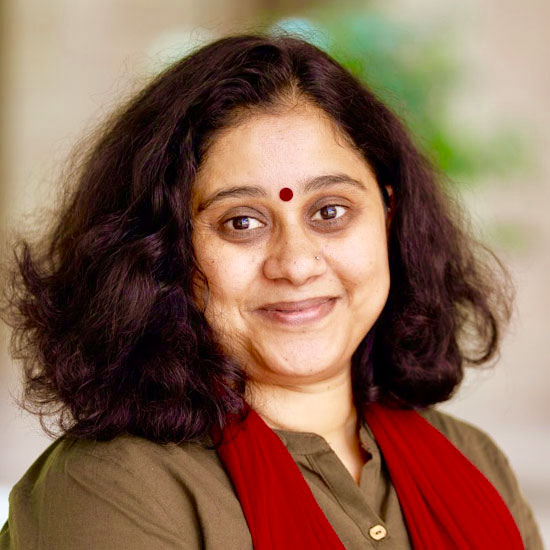
Deepa Nair
· Assistant Professor of HistoryCarnegie Mellon University · History
Active 2009–2025
About
Deepa Nair is an assistant teaching professor of history at Carnegie Mellon University. She is involved in redesigning courses to incorporate diverse perspectives, with a focus on enhancing inclusion, equity, and diversity in education. During her fellowship, she is redesigning the course Gender in South Asia, where she will explore strategies to enable student participation, remove barriers, and consider a variety of learning needs and preferences.
Research topics
- Sociology
- Philosophy
- Political Science
- Religious studies
- History
- Anthropology
- Art
- Art history
- Law
- Gender studies
- Media studies
Selected publications
Navigating Marginality: The Complex Realities of Muslim Minorities in India
IntechOpen eBooks · 2025-04-22 · 1 citations
book-chapterOpen access1st authorCorrespondingThis paper examines the contemporary multifaceted experiences of Muslims as a minority group in India. With over 200 million Muslims, India is home to one of the largest Muslim populations in the world. Yet, their position in the nation’s political and social landscape remains fraught with complexities. This paper delves into historical and contemporary challenges faced by Muslims, including communal violence and the rise of majoritarian nationalism. Through case studies, media analysis, and policy reviews, this research provides a comprehensive understanding of the precariousness of Muslim identity in India’s democracy and the struggles for equality, security, and representation in the face of growing religious polarization.
SOUTH ASIA - State, Society and Politics
AYBU AVESIS · 2023-01-01
bookJournal of Educational Media Memory and Society · 2021 · 5 citations
1st authorCorresponding- Political Science
- Sociology
- Political Science
In 2014, the National Democratic Alliance, led by the Bharatiya Janata Party (BJP), won the general election with the highest number of seats won by any party since 1984 and went on to win a second term victory in 2019. Since the rise of the BJP, Hindu nationalist interventions into education have increased. Their agenda has been to “indigenise, nationalise and spiritualise” education in India. To this end, textbooks were written to promote a Hindu majoritarian idea of India that sees Hindus as the primary citizens of India and categorizes Muslims as the “other”. This article outlines the political context in which Hindu nationalists have recently attempted to rewrite Indian history by focusing on the period of Muslim rule in India. It looks at textbooks published by the National Council of Educational Research and Training (NCERT) and media reports about regional history rewriting in India.
Hinduism in America: A Convergence of Worlds
Ethnic and Racial Studies · 2021 · 3 citations
1st authorCorresponding- Sociology
- Sociology
- Religious studies
This book is as much a personal journey for Long whose first encounter with Hinduism was through George Harrison’s song, My Sweet Lord, as it is an exploration of a story of two worlds, one of Hind...
Textbook Conflicts in South Asia
Journal of Educational Media Memory and Society · 2010-09-01 · 19 citations
article1st authorCorrespondingThe aftermath of World War II saw the emergence of many new nation-states on the Asian geopolitical map and a simultaneous attempt by these states to claim the agency of nationhood and to create an aura of a homogenous national identity. Textbooks have been the most potent tools used by nations to inject an idea of a national memory - in many instances with utter disregard for fundamental contradictions within the socio-political milieu. In South Asia, political sensitivity towards transmission of the past is reflected in the attempts of these states to revise or rewrite versions which are most consonant with the ideology of dominant players (political parties, religious organizations, ministries of education, publishing houses, NGOs, etc.) concerning the nature of the state and the identity of its citizens. This paper highlights the fundamental fault lines in the project of nation-building in states in South Asia by locating instances of the revision or rewriting of dominant interpretations of the past. By providing an overview of various revisionist exercises in South Asia, an attempt will be made to highlight important issues that are fundamental to the construction of identities in this diverse continent.
Contending "Historical" Identities in India
Journal of Educational Media Memory and Society · 2009-03-01 · 3 citations
article1st authorCorrespondingThe controversy over rewriting history textbooks in India in 2000 not only revealed the divergent renditions of collective memory but also evoked decades of contention over self-representation and cultural identity. This article explores these "multiple" renderings of a "singular" past and contends the formation of "historical identities" by arguing that divergent use of reason and interpretation leads to a layered and uid Indian identity leaving it open for contestation. By situating the case of the Mughal ruler Aurangzeb within the milieu from which textbook controversies emanate, the article suggests an alternative dimension for looking at the controversy—instead of the usual binary concept of "secular" versus "communal" history. At the root of the controversy is not merely politicization but also divergent perspectives of looking at the past and the resultant rethinking and reworking of dominant notions of it.
Frequent coauthors
- 1 shared
David Kloos
Royal Netherlands Institute of Southeast Asian and Caribbean Studies
- 1 shared
Prasenjit Duara
- 1 shared
Annemarie Samuels
- 1 shared
Julius Bautista
- 1 shared
Philip Fountain
Victoria University of Wellington
- 1 shared
Jeremy J. Kingsley
- 1 shared
Arif Jamal
National University of Singapore
- 1 shared
Dina Afrianty
Labs
Department of History - Carnegie Mellon UniversityPI
Awards & honors
- Provost's Inclusive Teaching Fellowship (2021-22)
- Resume-aware match score
- Save to shortlist
- AI-drafted outreach
See your match with Deepa Nair
PhdFit ranks faculty by your research interests, methods, and publications — grounded in their actual work, not templates.
- Free to start
- No credit card
- 30-second signup