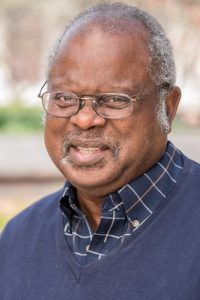
Darryl Thomas
· Associate Professor of African American StudiesPennsylvania State University · African American Studies
Active 1987–2024
About
Darryl C. Thomas is an associate professor of African American and diaspora studies. He received his bachelor of arts degree in African American history and U.S. history from Florida A&M University and his master of arts and doctoral degrees in political science at the University of Michigan. Professor Thomas has served as the chair of Binghamton University’s Africana Studies Department from 1997 to August 2003. His research and teaching focus on Africana studies, African studies, world politics, comparative politics, Black politics, urban politics, and political theory. He has published widely on topics including the international politics of the third world, African and Africana studies, globalization, democratization, and global Africa resistance to globalization, including U.S. hegemony and empire.
Research topics
- Political science
- Development economics
- Sociology
- Political economy
- Gender studies
Selected publications
International Review of Social History · 2024-12-01
articleOpen access1st authorCorrespondingAtticus Bagby-Williams and Nsambu Za Suekama. Black Anarchism and the Black Radical Tradition. Moving Beyond Racial Capitalism. Ed. by Shannon Fauwkes and Howard Waitzkin. Daraja Press, Cantley 2022. vi, 54 pp. Ill. 5.00.)
2023-11-01
book-chapter1st authorCorrespondingThis chapter examines the impact of climate change, the extractive industries being a major contributory factor, on the Caribbean region with a focus on Puerto Rico, Cuba, and Haiti. The goal of this chapter is to analyze the impact of climate change in the Caribbean with special focus on Puerto Rico, Cuba, and Haiti against the backdrop of the extractive industries and labour. Climate tipping points have swept through the Caribbean over the past decade, leaving a trail of destruction and despair as disastrous hurricanes, tropical storms, and earthquakes wreak havoc on the people of the region. The Intergovernmental Panel on Climate Change (2021) has issued a preliminary report highlighting how current climate catastrophes, including forest fires in Europe and the United States, spikes in temperature reaching triple digits, and melting glaciers (raising sea levels) suggest that the planet Earth has reached beyond the point of no return. In addition, this chapter will spotlight these three Caribbean states’ superfluous labourers who no longer take part in a meaningful way in the global economy. These communities are part of the redundant or marginal population, like their counterparts in urban America, whose services are no longer needed in the new economy. The pandemic (COVID-19) has disproportionately left them out of the decision-making circles on many fronts.
Choreographing increased understanding and positive attitudes towards coding by integrating dance
International Journal of Computer Science Education in Schools · 2021-02-15 · 6 citations
articleOpen accessSenior authorIncreasing the inclusion of underrepresented individuals in coding is an intractable problem, with a variety of initiatives trying to improve the situation. Many of these initiatives involve STEAM education, which combines the arts with traditional STEM disciplines. Evidence is emerging that this approach is making headway on this complex problem. We present one such initiative, iLumiDance Coding, which attempts to pique the interest and increase confidence of students in coding, by combining it with a fun and physical activity: dance. The connections between dance and coding, while not immediately obvious, are authentic, and we hypothesize that this approach will increase student comfort level with coding. We used student surveys of attitudes toward coding and a variety of statistical approaches to analyze our initiative. Each analysis showed a positive effect on student comfort level with coding. These results are useful for both educators and researchers since they contribute to a deeper understanding of how to increase interest in coding, which we hope will lead to an increase in representation.
2020-08-13
book-chapterSenior authorIs the Asian experience more relevant for African renaissance than it is generally assumed? We mean the lessons that could be drawn from a close examination of the transformation that had occurred in the 20th century in Japan and China, and particularly in Indonesia, Malaysia, and Vietnam. The answer, we argue, must be definitely yes. In each of these countries, positive economic change was preceded by a sustained and successful effort to raise the productivity and income of the majority of the population: the rural poor. In Africa, too, the vast majority of people live in the countryside. And yet, agriculture has been a relatively neglected sector in Africa's overall developmental strategy. When the sector received some attention, the specific policies in many African countries seemed to have been generally misguided. We argue that both of these trends should be corrected. What this also means is that the key for Africa's economic modernization is to a large extent in the hands of Africa's leaders. Ultimately, in other words, the improvement of the African condition hinges on the intent of Africans, particularly its leaders.
More Rivers to Cross: The Status of African American Professors at Penn State University (UP) Part 1
ScholarSphere (Penn State Libraries) · 2020-01-01
articleSenior authorThis report covers a 15 year period between 2004-2018 documenting institutional racism in the hiring and retention of African American and black professors at the main campus of Penn State University. The report explicitly details the comparative patterns of hiring and retaining black faculty at the university and each college over a 15 year period. It also includes a literature review of the racial biases entailed in the use of student teaching evaluation forms. A subsequent report (Part 2) will be published presenting the results of a survey of black professors about their experiences with interpersonal and systemic racism and academic climate at University Park and the 24 Commonwealth campuses.
Policing Black/Brown Communities inside/outside the United States:
Michigan State University Press eBooks · 2019-12-01
book-chapter1st authorCorrespondingProgress on Southeast Asia’s Flora projects
Gardens’ Bulletin Singapore · 2019-12-16 · 75 citations
articleOpen accessRethinking Black Radical Politics & Movements
SSRN Electronic Journal · 2018-11-27
articleOpen accessPANEL PROPOSAL: RETHINKING BLACK RADICAL POLITICS & MOVEMENTS (POLITICAL THEORY; AFRICA AND DIASPORA) NCOBPS 2019 PRESENTER 1: Onyekachi J. Ekeogu, Arizona State University TITLE: Black women’s Activism across Generations of Movements ABSTRACT: This paper is about black women’s activism. Specifically, its purpose is to examine how contemporary black women activists arrive at tactical choices in social movements. It aims to take on Jacqueline Benn-John’s 2016 call for more research on black women’s expertise on resistance and add the growing literature on black women’s activism by examining, what Treva Lindsey phrases as, “the realities of multiple jeopardy” that are faced by black women activists over generations. As the method, I employed content analysis to Barbra Ransby’s book called Ella Baker and The Black Freedom Movement, Paul Gibson’s 2012 YouTube video of the Temple University celebration of Pam Africa in “Pam Africa: Our Revolutionary Daughter of the Dust” and Patrisse Cullors’ 2018 memoir entitled When They Call You a Terrorist to examine the life and work of black women activists Ella Baker, Pam Africa, and Patrisse Cullors. I found that contemporary black women activists arrive at transformative tactical choices in social movements by way of their standpoint, a spirit of resourcefulness, and an understanding that norms can be change. I also found that black women activists highlight the beneficial nature of everyday items as protest resources. This paper ends with suggestions for future research on black women’s activism. PRESENTER 2: Darryl C. Thomas, Penn State University TITLE: Footprints in the Past/Envisioning the Future: Policing, Black Radicalism & Black Politics ABSTRACT: This paper will employ a comparative analysis using the work of Michael Dawson, Cedric J. Robinson, Nikhil Pal Singh, Charles W. Mills, and Naomi Zack among others to interrogate the relationship between American Liberalism in its domestic and international manifestations. It draws attention the America’s “inter” and “outer” war against Blacks and others. It also draws attention role of political theory as a key dimension of NCOBPS legacy. PRESENTER 3: H. L. T. Quan, Arizona State University TITLE: “Your Silence Will Not Protect You:” Black Abolitionist Feminism and the Contemporary Struggles Against American Fascism ABSTRACT: The Black feminist poet, Audre Lorde warned against a politics of silence when she admonished that “your silence will not protect you,” as she drew attention to the power of speaking out against injustices and unfreedom – a practice long held by Black feminists throughout history. Indeed, Black feminists (activists and scholars) have consistently and vocally delineated an anti-fascist praxis that which is conscious of itself as anti-fascist; yet, their contributions to a larger critique of democratic capitalism as a home grown fascist formation have largely been ignored. To counter this conspiracy of silence, this paper takes up contemporary Black abolitionist feminism as an example of Black feminist anti-fascist politics and consciousness. PRESENTER 4: Tiffany Willoughby-Herard, University of California, Irvine TITLE: The Relevance of the Pan African Congress in Contemporary South Africa ABSTRACT: Since 1994 the Pan African Congress has maintained a singular yet under-utilized repository for knowledge production about and disciplined reflection on South Africa’s domestic politics and role in the region and globe. As largely youth-led and often populist political parties and social movements flourish that are prioritizing economic justice and land rights there seems to be a manufactured disconnect between these concerns and their earlier champions in the Pan African Congress. What forces and phenomenon have pre-empted and interrupted an intergenerational dialogue about Pan Africanism’s philosophies about economic justice and land with a generation that has made a decisive commitment to return to these concerns? How has Pan-Africanism been historicized and presented in the new national history of a post-1994 South Africa? What does Pan-Africanism have to say to movements focused on the questions of gender and sexuality that have also demanded voice as indexes of economic justice and land rights?
2017-10-30
articleSenior author2017-10-30 · 1 citations
book-chapterSenior authorThis chapter examines four generations of developing solidarity among Third World states comprising the global South, with a greater emphasis on the coalition between global Africa and global Asia, in the twenty-first century. It juxtaposes the Bandung Conference of 1955 against the Berlin Conference of 1884–1885. The chapter also recounts the recurrent and changing themes of the Bandung Spirit which, going back to the Korean War in 1953, might even pre-date the Bandung Conference itself. It examines the relationship between Japan, China, and Africa in the wider context of global power transitions before it zooms in on one aspect of China's policy in Africa: the principle of non-intervention. The chapter analyzes not only what the Bandung Spirit means today but also whether we are entering the era of what may be called the BRICS (the association of five major emerging national economies: Brazil, Russia, India, China, and South Africa) Spirit.
Frequent coauthors
- 11 shared
John E. Tyworth
- 9 shared
David F. Pyke
University of San Diego
- 9 shared
Edward A. Silver
University of Michigan–Ann Arbor
- 7 shared
Christopher W. Craighead
University of Tennessee at Knoxville
- 6 shared
Michael Freimer
- 6 shared
Vidya Mani
University of Virginia
- 6 shared
Stephen E. Maiden
- 5 shared
Mirko Kremer
- Resume-aware match score
- Save to shortlist
- AI-drafted outreach
See your match with Darryl Thomas
PhdFit ranks faculty by your research interests, methods, and publications — grounded in their actual work, not templates.
- Free to start
- No credit card
- 30-second signup