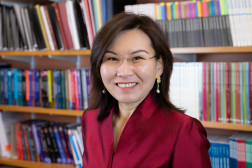
Manduhai Buyandelger
· Professor of Anthropology Director of Women's and Gender StudiesMassachusetts Institute of Technology · Sociology
Active 2012–2023
About
Manduhai Buyandelger is an anthropologist specializing in religion, gender, and politics with regional expertise in Mongolia. Her early research focused on cultural memory and religious practices among ethnic Buryats, particularly examining the proliferation of shamanic practices during the first decade of postsocialism and how these practices contested Soviet and Enlightenment-based values of secularism and rationality. Her first book, 'Tragic Spirits: Shamanism, Gender, and Memory in Contemporary Mongolia,' published by the University of Chicago Press in 2013, received notable awards including the Francis L.K. Hsu book prize and was recognized as a top social science book on Asia. Her second book, 'A Thousand Steps to the Parliament,' published in 2022, explores electoral politics in Mongolia, focusing on the experiences and political ambitions of women running for parliamentary office, and has garnered awards such as the Mongolian Anthropology Association Best Book Prize and the Golden Quill Pen award for addressing human rights issues. Her current research projects extend into multispecies ethnography, examining relations between humans and domesticated animals like cats and dogs, and exploring the politics of care and neglect within urban infrastructures in Mongolia and the US. She is also engaged in innovative interdisciplinary work, including the study of virtual realities and immersive technologies, as well as an anthro-engineering project with MIT Nuclear Engineering to develop alternative heating systems in Mongolia. Throughout her career, Buyandelger has contributed to anthropological discussions on religion, state, subjectivities, and gender, especially from a post-socialist perspective, and her work bridges cultural, technological, and environmental themes.
Research topics
- Sociology
- Political Science
- History
- Law
- Computer Science
- Art
- Aesthetics
- Economic history
- Philosophy
- Ancient history
- Literature
- Political economy
Selected publications
Economic volatilities, gold mining, and subjective transformations in Mongolia
Journal of the Royal Anthropological Institute · 2023-12-23
articleOpen access1st authorCorrespondingA Thousand Steps to Parliament
2022 · 8 citations
1st authorCorresponding- Political Science
- Computer Science
- Political Science
Indonesia · 2020
1st authorCorresponding- Sociology
- Aesthetics
- Sociology
This essay is one of more than a dozen in this volume to honor the late Mary Margaret Steedly. The paper’s theme is “spirits,” and reflects on how Steedly wove stories of encounters with spirits and mediums into an intricate matrix, thus revealing a space of a particular narrative experience. Each encounter pushes someone out of a comfort zone, thereby destabilizing a recognized identity, revealing the fragility of a boundary (“border between two worlds”), or undermining confidence in one’s understanding of something. While Steedly’s projects on spirit mediums and Indonesian supernaturalism are different and separated by twenty years, they complement each other. Attention to the supernatural offered her an unusual lens on the twists and turns of Indonesia’s historical transformation from a modernizing postcolonial nation to the mass-media-saturated, post-New Order era.
The Journal of Asian Studies · 2020
1st authorCorresponding- Sociology
- Political Science
- History
Mongolia Remade: Post-socialist National Culture, Political Economy, and Cosmopolitics. By David Sneath. Amsterdam: Amsterdam University Press, 2018. 226 pp. ISBN: 9789462989566 (cloth). - Volume 79 Issue 2
eCommons (Cornell University) · 2020-04-01
article1st authorCorrespondingPage range: 85-90
Asocial memories, ‘poisonous knowledge’, and haunting in Mongolia
Journal of the Royal Anthropological Institute · 2018-12-18 · 20 citations
articleOpen access1st authorCorrespondingAbstract This article argues that memories that come from contexts that are adversarial, and that are not always based on communication and sociality, should be better integrated within the existing theories of social memory. Shamans in postsocialist Mongolia claim that previously suppressed origin spirits demand that their descendants become initiated as shamans in exchange for ceasing to harass them for forgetting and abandonment. Some clients refuse to become initiated as shamans and thus choose to sever their relationship with their past. In this article I explore one such refusal, which led to a disintegration of existing social ties, while also yielding unexpected memories. These memories are different from the shared memories that emerge in the context of organized shamanic rituals. Circulated through rumour and supposition instead of positive sociality and sharing, these ‘asocial’ memories also act as a particular kind of ‘poisonous knowledge’, prompting each individual to withdraw from the network as a way of avoiding the alleged harm from unattended spirits. Owing to divergent subject positioning, where one person's remembering is another's forgetting, the haunting by unwanted memories continues, as resolution through unifying communal ritual is not possible.
The Journal of Asian Studies · 2017-07-31
article1st authorCorrespondingThe Lama Question: Violence, Sovereignty, and Exception in Early Socialist Mongolia. By Christopher Kaplonski . Honolulu: University of Hawai‘i Press, 2014. 280 pp. ISBN: 9780824838560 (cloth). - Volume 76 Issue 3
Mongolia's Self-Styled Female Parliamentary Candidates
Anthropology News · 2016-12-01 · 1 citations
article1st authorCorrespondingAmerican Anthropologist · 2014-09-22 · 11 citations
articleOpen accessThe suddenness with which Massive Open Online Courses, or MOOCs, sprang upon us left many within the academy grasping for interpretations. Early proponents touted them as revolutionary tools that could enhance on-campus learning while also making high-quality education accessible to a vast global population, reforming a malfunctioning university system, and producing new kinds of data on how people learn. Critics countered that behind this latest techno-utopian fad lurked an all-too-familiar conservative agenda to downsize the university; the global ambitions of a few elite, resource-rich schools; Silicon Valley corporate interests; and the disciplinary priorities of science, technology, engineering, and mathematics (the STEM fields). With some critical distance, the eight scholars in this Vital Topics Forum draw upon their experiences as anthropologists involved in MOOCs and anthropologists doing studies of MOOCs to propel us beyond such facile responses. Doing what anthropologists do best, they employ contextually rich analysis to upend received wisdom about what MOOCs mean, provide processual accounts of how they are made, and offer first-hand observations of how students are using them on the ground.
2013-01-01
book-chapter1st authorCorrespondingAbstract Chapter 5 concerns the dilemmas that female shamans face in their quest for power. By exploring the rise and fall of Chimeg, a female shaman, the chapter unpacks the discrepancy between egalitarian rules and hierarchical practice and asks why female shamans' skills as shamanic practitioners do not translate into political and material empowerment. The author explores how multiple gender systems in domestic, local, national, and state contexts impede female shamans' ascent to power both during socialism and a market economy. Female shamans are betwixt and between: they need to be married and maintain households in order to fit the moral standards of womanhood, but their marriages and homes become obstacles to their advancement. If female shamans leave their households in order to pursue their shamanic practices, their lack of kinship and household support also impede their empowerment. They encounter a glass ceiling in either case, and so many tend to resort to unconventional sexual unions and creative strategies to maintain their audiences. Most broadly, the author argues that shamanism might give women a temporary escape from the tyranny of household patriarchy, but at the price of making them victims of patriarchy in the public sphere.
Frequent coauthors
- 1 shared
Tom Looser
New York University
- 1 shared
Rachel Flamenbaum
University of California, Los Angeles
- 1 shared
Carolyn Moxley Rouse
Princeton University
- 1 shared
Shreeharsh Kelkar
University of California, Berkeley
- 1 shared
Catalina Laserna
Massachusetts Institute of Technology
- 1 shared
Orin Starn
Duke University
- 1 shared
Greg Downey
Macquarie University
Labs
Awards & honors
- 2023 Mongolian Writers Association 2023 Golden Quill Pen awa…
- 2023 The Onon Prize 2022 For contribution to Inner Asian Stu…
- 2022 Mongolian Anthropology Association 2022 Best Book Prize…
- 2022 MIT Climate and Sustainability Consortium Seed Awards 2…
- 2015 Shortlists ICAS Book Prize 2015, International Conventi…
- Resume-aware match score
- Save to shortlist
- AI-drafted outreach
See your match with Manduhai Buyandelger
PhdFit ranks faculty by your research interests, methods, and publications — grounded in their actual work, not templates.
- Free to start
- No credit card
- 30-second signup