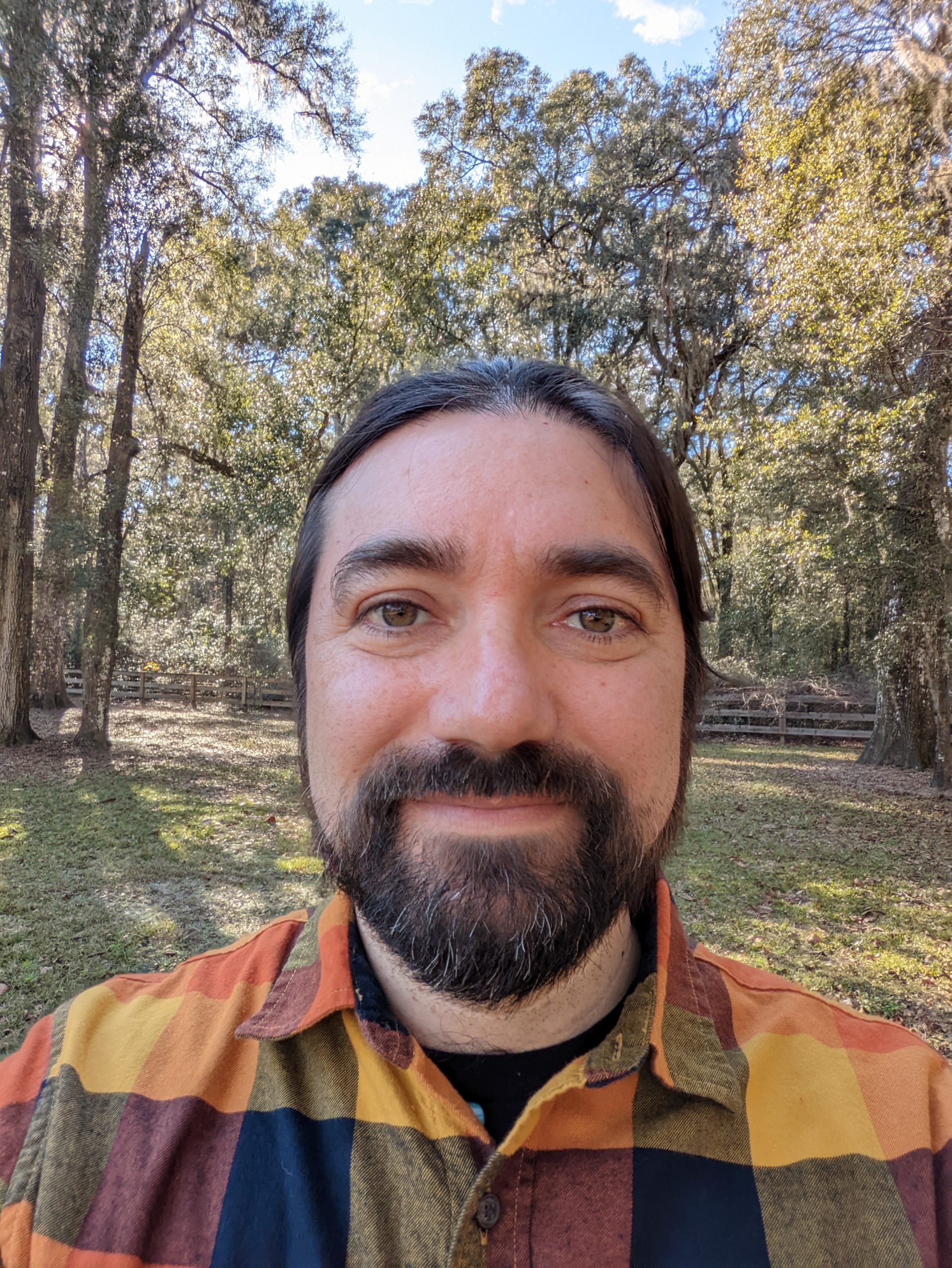
Jorge Valdés Kroff
· Associate Professor of Spanish and LinguisticsVerifiedUniversity of Florida · Romance Languages and Literatures
Active 2010–2026
About
Jorge Valdés Kroff is an Associate Professor of Spanish and Linguistics at the College of Liberal Arts and Sciences. His areas of interest and research include psycholinguistics, especially sentence processing in bilingual and second language speakers, Spanish-English code-switching, and Spanish heritage speakers. He holds a Ph.D. in Hispanic Linguistics and Language Science from Penn State University, where he also earned his M.A. in Hispanic Linguistics. Additionally, he completed his B.A. in Linguistics and International Studies at the University of North Carolina–Chapel Hill. His academic and research profile is supported by his Google Scholar, Research Gate, and LinkedIn profiles. He can be contacted via email at jvaldeskroff@ufl.edu or by phone at (352) 273-3744. His office is located at 246 Dauer, and his office hours for 2025-2026 are Wednesdays from 2:00 to 3:30 pm, Thursdays from 1:00 to 2:30 pm, and by appointment.
Research topics
- Computer Science
- Artificial Intelligence
- Natural Language Processing
- Psychology
- Linguistics
- Programming language
- Cognitive science
- Cognitive psychology
- Speech recognition
Selected publications
Sensitivity to codeswitching asymmetries in second language processing
Zenodo (CERN European Organization for Nuclear Research) · 2026-03-03
book-chapterOpen access1st authorCorrespondingSome Spanish-English bilingual communities in the US and Puerto Rico show apreference for codeswitched verb compounds involving the progressive auxiliary,estar. These switches are produced before or after the auxiliary with similar levels of frequency and acceptability. In contrast, verb phrases involving the perfectauxiliary, haber, show a clear dispreference for switches that occur within the verbcompound. This same asymmetry is found in real-time sentence processing in earlySpanish-English bilinguals and late second language (L2) speakers of English. Wetest 61 late L2 speakers of Spanish immersed in a region where Spanish-Englishbilingual speech is present to determine whether they exhibit online sensitivity tothis asymmetry during online reading. Results indicate that L2 Spanish speakersdemonstrate a sustained asymmetric pattern of sensitivity in later stages of reading, but only if they engaged in a session where they answered comprehensionquestions. Another L2 Spanish group that completed forced-choice grammaticalityjudgments while reading the same sentence constructions did not show sensitivityto the same asymmetry. We interpret our findings to point towards an importantrole for experience with exposure to community-based code-switching patterns tosuccessfully acquire and deploy during online sentence processing.
Sensitivity to codeswitching asymmetries in second language processing
Zenodo (CERN European Organization for Nuclear Research) · 2026-03-03
book-chapterOpen access1st authorCorrespondingSome Spanish-English bilingual communities in the US and Puerto Rico show apreference for codeswitched verb compounds involving the progressive auxiliary,estar. These switches are produced before or after the auxiliary with similar levels of frequency and acceptability. In contrast, verb phrases involving the perfectauxiliary, haber, show a clear dispreference for switches that occur within the verbcompound. This same asymmetry is found in real-time sentence processing in earlySpanish-English bilinguals and late second language (L2) speakers of English. Wetest 61 late L2 speakers of Spanish immersed in a region where Spanish-Englishbilingual speech is present to determine whether they exhibit online sensitivity tothis asymmetry during online reading. Results indicate that L2 Spanish speakersdemonstrate a sustained asymmetric pattern of sensitivity in later stages of reading, but only if they engaged in a session where they answered comprehensionquestions. Another L2 Spanish group that completed forced-choice grammaticalityjudgments while reading the same sentence constructions did not show sensitivityto the same asymmetry. We interpret our findings to point towards an importantrole for experience with exposure to community-based code-switching patterns tosuccessfully acquire and deploy during online sentence processing.
¿Sabes si viene un code-switch? Bilinguals can predict upcoming code-switches given enough context
Memory & Cognition · 2026-03-30
articleOpen accessLanguage comprehension involves prediction, but what exactly can comprehenders predict? We ask if bilinguals can consciously predict upcoming code-switches between languages. If predictions focus on a sentence's message, then listeners should not predict code-switches, which alter the language used but not necessarily the meaning. Alternatively, if listeners predict at many levels-including language-then they may predict code-switches. Here, we selected sentences from a corpus of spontaneous bilingual conversations that started in Spanish and removed the final word that would have continued in Spanish or code-switched to English. In two preregistered experiments, Spanish-English bilinguals heard these sentence fragments and predicted the language of the omitted final word. They successfully predicted upcoming code-switches when given 30 seconds of context prior to their predictions (Experiment 1; N = 94), but not when only hearing the sentence fragment (Experiment 2, N = 115). This shows that bilinguals can predict upcoming code-switches when sufficient conversational cues are available.
Investigating the effects of code-switch types on cognitive control.
Journal of Experimental Psychology Learning Memory and Cognition · 2025-07-21
articleOpen accessCode switching, here defined as the use of two languages within a single sentence, has been hypothesized to engage cognitive control such as inhibition and conflict monitoring. The current project investigates whether structurally distinct types of code switching engage cognitive control differently. We tested this in a conflict adaptation paradigm. Early Spanish-English bilinguals in the United States listened to (Experiments 1, 2, 4) or read (Experiment 3) unilingual Spanish sentences and sentences with dense or insertional switches to English. After each sentence, participants saw a Flanker trial and indicated the direction of the center arrow while ignoring the flanking arrows. If processing code switches increases engagement with cognitive control, then subsequent incongruent Flanker trials should demonstrate a reduced Flanker conflict effect. Across four experiments, we found either no effect of code switching on Flanker performance (Experiment 1) or found that the Flanker conflict effect was larger after code switched than after unilingual sentences (Experiments 2-4). We found no evidence that there was a difference between insertional and dense code switching on the Flanker conflict effect or a difference between modalities. We therefore have no evidence that processing code-switched sentences enhances cognitive control. We interpret our finding in terms of resources: Code switches without an interactive context are unexpected and pragmatically odd. This draws resources and attention away from a following Flanker trial, leading to a larger conflict effect after a code switch. (PsycInfo Database Record (c) 2026 APA, all rights reserved).
Bilinguals have better recall for code-switched information
2025-11-05
articleOpen accessBilinguals frequently code-switch during conversations, a behavior often viewed as creating processing challenges for listeners. However, code-switching may also enhance comprehension and memory by directing attention to key information. This study tested whether bilinguals recall information better in code-switched contexts compared to single-language contexts and explored whether code-switching experience amplifies this benefit. In a pre-registered study, Spanish-English bilinguals listened to short vignettes containing both single-language and code-switched segments. Participants recalled details more accurately when they had been presented within a code-switched sentence, suggesting that switches act as cues that boost attention and memory encoding. Moreover, bilinguals with greater everyday code-switching experience showed the strongest recall benefits, supporting the idea that listeners learn to associate switches with communicative importance. These findings challenge the long-standing view that code-switching primarily imposes cognitive costs in comprehension. Instead, they reveal how bilinguals leverage the communicative value of code-switches to enhance memory for linguistic content. By demonstrating that code-switches can promote learning and retention, this study highlights the potential for code-switching to serve as a communicative tool, particularly in contexts where understanding and recalling information is critical.
Disentangling grammar and experience
Isogloss Open Journal of Romance Linguistics · 2025-09-07
articleOpen accessSenior authorCode-switching (CS) processing is subject to modulation by language-internal properties and extralinguistic factors, including the distributional patterns of bilingual language production specific to a given bilingual community. To tease apart the roles of grammar and experience in CS processing, a group of advanced L1 English, L2 Spanish learners (n=39) immersed in an environment with ubiquitous code-switching (U.S. east coast) participated in a reading-while-eye-tracking experimental task. Spanish-English CS asymmetries present in the production of bilingual compound verbs and determiner-noun switches that differ in their regional use and frequency were tested. Results reveal that L2 learners are sensitive to the distributional production frequencies of CS present in their interactive context during online processing. However, the onset of these effects is somewhat delayed, indicating that the impact of environmental production frequencies may surface during later stage processing for L2 learners. Results are discussed in the context of experience-based frameworks of sentence processing.
Hearing a code-switch increases bilinguals’ attention to and memory for information
Journal of Memory and Language · 2025-05-02 · 5 citations
articleOpen access• Bilinguals reported greater attention after hearing a code-switch in a story. • Bilinguals remembered material near code-switches better later on. • Monolinguals reported less attention after hearing a code-switch. • Switch saliency alone does not explain the bilingual attention effect. • Code-switches beneficially orient bilinguals’ attention to speech content. In conversation with each other, bilinguals sometimes code-switch between their shared languages. While psycholinguistic research often highlights the challenges of processing code-switches compared to single-language utterances, bilinguals seem to navigate code-switching with ease. Alongside empirical evidence that code-switching does not always disrupt comprehension in natural contexts, this raises intriguing questions about the potential benefits of code-switching. We propose that code-switching enhances bilingual listeners’ attention to the speech signal, improving the encoding and memory of linguistic messages near the switch. In Experiment 1, Spanish-English bilinguals listened to code-switched and single-language stories, occasionally reported their attention levels, and later answered comprehension questions. They reported greater attention to and demonstrated increased memory for code-switched content. Experiment 2 tested whether this attentional effect was simply due to the saliency of language changes by having English-speaking monolinguals complete the same task. Although monolinguals showed better memory when reporting higher attention, they did not show increased attention following code-switches. These findings suggest that bilinguals’ experience with the communicative contexts in which code-switches typically occur enables them to focus their attention on speech content during a code-switch, aiding in their collection and retention of that content over time.
Investigating the Effects of Code-Switch Types on Cognitive Control
2025-02-26
preprintOpen accessSenior authorCode-switching, here defined as the use of two languages within a single sentence, has been hypothesized to engage cognitive control such as inhibition and conflict monitoring. The current project investigates whether structurally distinct types of code-switching engage cognitive control differently. We tested this in a conflict adaptation paradigm. Early Spanish-English bilinguals in the US listened to (Experiments 1, 2, 4) or read (Experiment 3) unilingual Spanish sentences and sentences with dense or insertional switches to English. After each sentence, participants saw a Flanker trial and indicated the direction of the center arrow while ignoring the flanking arrows. If processing code-switches increases engagement with cognitive control, then subsequent incongruent Flanker trials should demonstrate a reduced Flanker conflict effect. Across four experiments, we found either no effect of code-switching on Flanker performance (Experiment 1) or found that the Flanker conflict effect was larger after code-switched than after unilingual sentences (Experiments 2-4). We found no evidence that there was a difference between insertional and dense code-switching on the Flanker conflict effect or a difference between modalities. We therefore have no evidence that processing code-switched sentences enhances cognitive control. We interpret our finding in terms of resources: code-switches without an interactive context are unexpected and pragmatically odd. This draws resources and attention away from a following Flanker trial, leading to a larger conflict effect after a code-switch.
¿Sabes si viene un code-switch? Bilinguals can predict upcoming code-switches given enough context
2025-09-11
preprintOpen accessLanguage comprehension involves prediction, but what exactly can comprehenders predict? We ask if bilinguals can consciously predict upcoming code-switches between languages. If predictions focus on a sentence’s message, then listeners should not predict code-switches, which alter the language used but not necessarily the meaning. Alternatively, if listeners predict at many levels—including language—then they may predict code-switches. Here, we selected sentences from a corpus of spontaneous bilingual conversations that started in Spanish and removed the final word that would have continued in Spanish or code-switched to English. In two pre-registered experiments, Spanish-English bilinguals heard these sentence fragments and predicted the language of the omitted final word. They successfully predicted upcoming code-switches when given 30 seconds of context prior to their predictions (Experiment 1; N=94), but not when only hearing the sentence fragment (Experiment 2, N=115). This shows that bilinguals can predict upcoming code-switches when sufficient conversational cues are available.
Investigating the Effects of Code-Switch Types on Cognitive Control
2025-08-07
preprintOpen accessSenior authorCode-switching, here defined as the use of two languages within a single sentence, has been hypothesized to engage cognitive control such as inhibition and conflict monitoring. The current project investigates whether structurally distinct types of code-switching engage cognitive control differently. We tested this in a conflict adaptation paradigm. Early Spanish-English bilinguals in the US listened to (Experiments 1, 2, 4) or read (Experiment 3) unilingual Spanish sentences and sentences with dense or insertional switches to English. After each sentence, participants saw a Flanker trial and indicated the direction of the center arrow while ignoring the flanking arrows. If processing code-switches increases engagement with cognitive control, then subsequent incongruent Flanker trials should demonstrate a reduced Flanker conflict effect. Across four experiments, we found either no effect of code-switching on Flanker performance (Experiment 1) or found that the Flanker conflict effect was larger after code-switched than after unilingual sentences (Experiments 2-4). We found no evidence that there was a difference between insertional and dense code-switching on the Flanker conflict effect or a difference between modalities. We therefore have no evidence that processing code-switched sentences enhances cognitive control. We interpret our finding in terms of resources: code-switches without an interactive context are unexpected and pragmatically odd. This draws resources and attention away from a following Flanker trial, leading to a larger conflict effect after a code-switch.
Recent grants
Doctoral Dissertation Research: Effects of code-switching on emotional processing
NSF · $14k · 2020–2022
PostDoctoral Research Fellowship
NSF · $120k · 2012–2014
Frequent coauthors
- 20 shared
Paola E. Dussias
Pennsylvania State University
- 11 shared
Stefan L. Frank
Radboud University Nijmegen
- 11 shared
Chara Tsoukala
- 11 shared
Antal van den Bosch
- 11 shared
Mirjam Broersma
- 7 shared
Aleksandra Tomić
Centre for Arctic Gas Hydrate, Environment and Climate
- 5 shared
Chip Gerfen
- 5 shared
Edith Kaan
Education
Ph.D., Hispanic Linguistics and Language Science
Penn State University
M.A., Hispanic Linguistics
Penn State University
B.A., Linguistics, International Studies
University of North Carolina–Chapel Hill
- Resume-aware match score
- Save to shortlist
- AI-drafted outreach
See your match with Jorge Valdés Kroff
PhdFit ranks faculty by your research interests, methods, and publications — grounded in their actual work, not templates.
- Free to start
- No credit card
- 30-second signup