Resume-aware faculty matching

Find professors who actually fit you

Upload your resume. Four AI agents analyze your background, rank the faculty who fit, inspect their recent research, and help you draft outreach — grounded in their actual work, not templates.

Free to startNo credit cardCancel anytime
Top matches Balanced preset
Dr. Sarah Chen
Stanford · Interpretability · NLP
91
Dr. Marcus Holloway
MIT · Robotics · RL
84
Dr. Aisha Okonkwo
CMU · Fairness · HCI
82
Nova · Professor Researcher · re-ranking top 20…
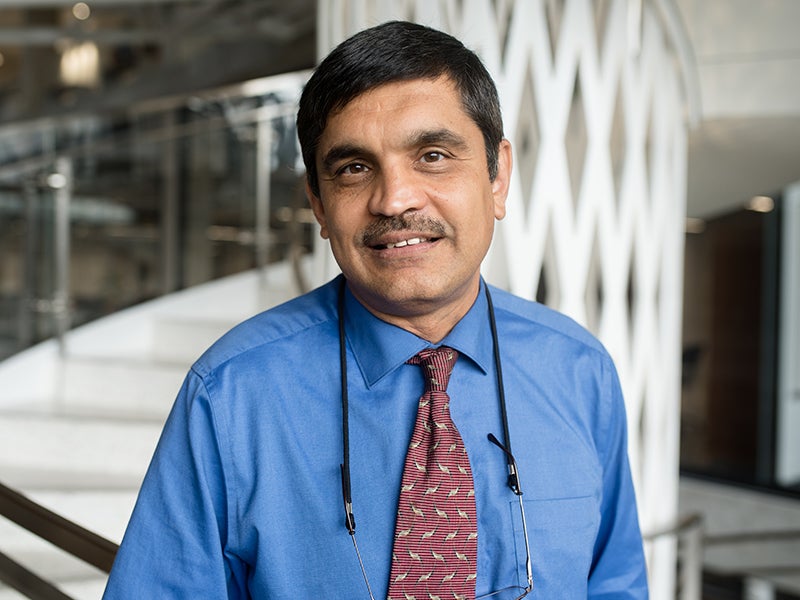
Chandra Bhat

Chandra Bhat

· Professor Civil, Architectural and Environmental EngineeringVerified

University of Texas at Austin · Civil, Architectural and Environmental Engineering

Active 1991–2025

h-index91
Citations33.5k
Papers722109 last 5y
Funding
See your match with Chandra Bhat — sign in to PhdFit.Sign in

About

Chandra Bhat is the Joe J. King Chair in Engineering at The University of Texas at Austin, where he teaches courses in transportation systems analysis and transportation planning. He is also the Director of the USDOT-funded National Center for Understanding Future Travel Behavior and Demand. Bhat has served as the Director of the Data-Supported Transportation Operations and Planning (D-STOP) Tier 1 USDOT University Transportation Center, the Associate Chairman of the Department of Civil, Architectural and Environmental Engineering, and the Director of the Center for Transportation Research. He is recognized nationally and internationally as a leading expert in travel demand modeling and travel behavior analysis. His methodological works are widely referenced across economics, marketing, geography, statistics, and transportation fields, and have been included in econometric textbooks and software packages. Bhat has authored several book chapters focusing on improved methods for choice modeling and land use-travel demand modeling. His research has been funded by organizations such as the National Science Foundation, the Environmental Protection Agency, the National Institute of Statistical Sciences, State Departments of Transportation including TxDOT, the Bureau of Transportation Statistics, and the U.S. Department of Transportation.

Research topics

  • Computer Science
  • Machine Learning
  • Data Mining
  • Business
  • Data science
  • Human–computer interaction
  • Advertising
  • Econometrics
  • Economics
  • Internet privacy
  • Psychology
  • Risk analysis (engineering)
  • Marketing

Selected publications

  • Data and Technology for Equitable Public Administration: Understanding City Government Employees' Challenges and Needs

    ArXiv.org · 2025-05-27

    preprintOpen access

    City governments in the United States are increasingly pressured to adopt emerging technologies. Yet, these systems often risk biased and disparate outcomes. Scholars studying public sector technology design have converged on the need to ground these systems in the goals and organizational contexts of employees using them. We expand our understanding of employees' contexts by focusing on the equity practices of city government employees to surface important equity considerations around public sector data and technology use. Through semi-structured interviews with thirty-six employees from ten departments of a U.S. city government, our findings reveal challenges employees face when operationalizing equity, perspectives on data needs for advancing equity goals, and the design space for acceptable government technology. We discuss what it looks like to foreground equity in data use and technology design, and considerations for how to support city government employees in operationalizing equity with and without official equity offices.

  • Modeling spatial and social interdependency effects on commuting mode choice

    Transportation Research Part A Policy and Practice · 2025-04-17 · 2 citations

    articleOpen access

    • An autoregressive mode choice model is constructed to capture interdependency effects. • Interdependencies derive from both spatial proximity and attitudinal similarity. • Direct policy impacts can be separated from indirect effects of interdependency. • Social interactions account for 40 % of total policy effects on public transit use. • Travel time and bus stops proximity boost transit use more than travel costs changes. In daily life, individuals are influenced by the behaviors of others. The question of how far-reaching this social influence extends to travel behaviors has received significant attention in recent decades, through the capture of dyadic interaction effects that may exist among individuals. Along these lines, in the current study, we apply a Spatial-Attitudinal Probit Model (SAPM) that assumes an autoregressive lag structure in the utilities underlying individuals’ travel mode choice, specifically focusing on the choice between car and public transportation for commuting trips. Notably, the magnitude of interdependency among decision agents is measured by a global weight matrix, accounting for a dual source of influence: (1) spatial proximity, measured as the Euclidean distance between individuals’ residential locations, and (2) attitudinal similarities, specifically perceptions regarding sustainable mobility and environmental awareness. To our knowledge, this represents the first application of an autoregressive travel mode choice model accounting for both geographical and attitudinal proximity as simultaneous sources of interaction. The dataset for our analysis includes 2,347 observations, corresponding to the one-way commute trips of 2,347 individuals, as reported during a survey conducted between October 2019 and January 2020 in the metropolitan area of Cagliari, Italy. Our results reveal the significant role of social autoregressive parameters and the presence of interdependency effects among individuals’ commute mode choices. The utilization of a social lag structure allows for the separate identification of direct and indirect effects of explanatory variables. Notably, around 40% of the total effect is attributed to the indirect effects arising from individuals’ social interdependencies. This finding holds important implications for evaluating and planning potential future measures aimed at increasing public transit usage.

  • Data and Technology for Equitable Public Administration: Understanding City Government Employees' Challenges and Needs

    Proceedings of the ACM on Human-Computer Interaction · 2025-10-16 · 2 citations

    articleOpen access

    City governments in the United States are increasingly pressured to adopt emerging technologies. Yet, these systems often risk biased and disparate outcomes. Scholars studying public sector technology design have converged on the need to ground these systems in the goals and organizational contexts of employees using them. We expand our understanding of employees' contexts by focusing on the equity practices of city government employees to surface important equity considerations around public sector data and technology use. Through semi-structured interviews with thirty-six employees from ten departments of a U.S. city government, our findings reveal challenges employees face when operationalizing equity, perspectives on data needs for advancing equity goals, and the design space for acceptable government technology. We discuss what it looks like to foreground equity in data use and technology design, and considerations for how to support city government employees in operationalizing equity with and without official equity offices.

  • Multivariate analysis of frequency, duration and companionship in walking behaviors among adults over 50

    Journal of Transport & Health · 2025-09-10

    articleSenior authorCorresponding
  • Exploring the relationship between mode selection and usage frequency in multi-day mode choice patterns for commute trips

    Current Science · 2025-11-10

    articleOpen access
  • A model of electric vehicle adoption and motivating reasons for adoption

    Transportation Research Part D Transport and Environment · 2025-07-15 · 4 citations

    articleSenior authorCorresponding
  • A rank-based model of residential location preferences before and during the COVID-19 pandemic

    Transportation Research Part A Policy and Practice · 2025-11-20

    articleSenior author
  • Data collection, weighting, and modeling techniques to estimate consistent population parameters

    Transportation Research Part B Methodological · 2025-11-03 · 4 citations

    articleSenior author
  • An investigation of physical participation dissonance and virtual activity participation in the United States

    Transportation Research Part A Policy and Practice · 2025-10-09

    articleSenior authorCorresponding
  • A flexible non-normal random coefficient multinomial probit model: Application to investigating commuter's mode choice behavior in a developing economy context

    Transportation Research Part B Methodological · 2025-03-14 · 4 citations

    article1st authorCorresponding

Frequent coauthors

  • Ram M. Pendyala

    158 shared
  • Sebastián Astroza

    University of Concepción

    83 shared
  • Abdul Rawoof Pinjari

    76 shared
  • Aupal Mondal

    The University of Texas at Austin

    59 shared
  • Patrícia S. Lavieri

    51 shared
  • Naveen Eluru

    48 shared
  • Rajesh Paleti

    45 shared
  • Venu Garikapati

    National Renewable Energy Laboratory

    42 shared

Education

  • Ph.D., Civil Engineering

    Northwestern University

    1991
  • M.S., Transportation Engineering

    Virginia Polytechnic Institute and State University

    1987
  • B.Tech., Civil Engineering

    Indian Institute of Technology Madras

    1985

Awards & honors

  • W.N. Carey Jr. Award (2024)
  • Joe J. King Professional Engineering Achievement Award – The…
  • Theodore M. Matson Memorial Award – Institute of Transportat…
  • Lifetime Achievement Award – Council of University Transport…
  • Frank M. Masters Transportation Engineering Award – ASCE (20…
  • Resume-aware match score
  • Save to shortlist
  • AI-drafted outreach

See your match with Chandra Bhat

PhdFit ranks faculty by your research interests, methods, and publications — grounded in their actual work, not templates.

  • Free to start
  • No credit card
  • 30-second signup