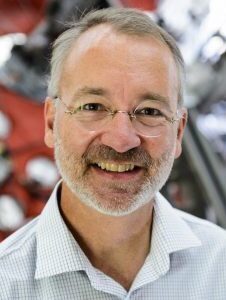
Cary Forest
· ProfessorVerifiedUniversity of Wisconsin-Madison · Nuclear Engineering & Engineering Physics
Active 1986–2026
Research topics
- Physics
- Quantum mechanics
- Computational physics
- Nuclear physics
- Atomic physics
- Astrophysics
- Quantum electrodynamics
- Condensed matter physics
- Classical mechanics
- Mechanics
Selected publications
Nonlinear anisotropic equilibrium reconstruction in axisymmetric magnetic mirrors
Physics of Plasmas · 2026-03-01
articleOpen accessSenior authorMagnetic equilibrium reconstruction is a crucial simulation capability for interpreting diagnostic measurements of experimental plasmas. Equilibrium reconstruction has mostly been applied to systems with isotropic pressure and relatively low plasma β=2μ0p/B2. This work extends nonlinear equilibrium reconstruction to high-β plasmas with anisotropic pressure and applies it to the Wisconsin high-temperature superconducting axisymmetric magnetic mirror (WHAM) experiments to infer the presence of sloshing ions. A novel basis set for the plasma profiles and machine-learning algorithm using scalable constrained Bayesian optimization allows accurate nonlinear reconstructions with uncertainty quantification to be made more quickly with fewer experimental diagnostics and improves the robustness of reconstructions at high β. In addition to WHAM and other mirrors, such reconstruction techniques are potentially attractive in high-performance devices with constrained diagnostic capabilities such as fusion power plants.
AIP Advances · 2025-11-01 · 1 citations
articleOpen accessWe present an application of the Portable Diagnostic Package (PDP) on the Wisconsin High-temperature-superconducting Axisymmetric Mirror (WHAM), which integrates an optical emission spectroscopy (OES) system and an active Thomson scattering (TS) system. The OES system facilitates a comprehensive impurity line survey and enables flow measurements through the Doppler effect observed on impurity lines. Plasma rotation profiles were successfully derived from doubly charged carbon lines. The TS system enabled the first measurements of the electron temperature in commissioning plasmas on WHAM. Notably, the PDP was installed, commissioned, and used to obtain OES and TS data within ∼6 months from project start, enabled by its designed portability and standardized interfaces. These results demonstrate the PDP’s potential to accelerate diagnostic readiness and advance experimental plasma studies.
Confinement performance predictions for a high field axisymmetric tandem mirror
Journal of Plasma Physics · 2025-07-31 · 12 citations
articleOpen accessSenior authorThis paper presents a Hammir tandem mirror confinement performance analysis based on Realta Fusion’s first-of-a-kind model for axisymmetric magnetic mirror fusion performance. This model uses an integrated end plug simulation model including, heating, equilibrium and transport combined with a new formulation of the plasma operation contours (POPCONs) technique for the tandem mirror central cell. Using this model in concert with machine learning optimization techniques, it is shown that an end plug utilizing high temperature superconducting magnets and modern neutral beams enables a classical tandem mirror pilot plant producing a fusion gain Q > 5. The approach here represents an important advance in tandem mirror design. The high-fidelity end plug model enables calculations of heating and transport in the highly non-Maxwellian end plug to be made more accurately. The detailed end plug modelling performed in this work has highlighted the importance of classical radial transport and neutral beam absorption efficiency on end plug viability. The central cell POPCON technique allows consideration of a wide range of parameters in the relatively simple near-Maxwellian central cell, facilitating the selection of more optimal central cell plasmas. These advances make it possible to find more conservative classical tandem mirror fusion pilot plant operating points with lower temperatures, neutral beam energies and end plug performance requirements than designs in the literature. Despite being more conservative, it is shown that these operating points have sufficient confinement performance to serve as the basis of a viable fusion pilot plant provided that they can be stabilized against magnetohydrodynamic and trapped particle modes.
Plasma generator with permanent magnet divertor
OSTI OAI (U.S. Department of Energy Office of Scientific and Technical Information) · 2025-05-05
otherOpen access1st authorCorrespondingA divertor for system supporting plasma for fusion employs permanent magnets providing far weaker magnetic field strength than conventionally used in cryogenic magnetic systems through an ability to place the permanent magnets in close proximity to the plasma containment volume.
Deuterium retention in cold spray tantalum coatings vs. polycrystalline tungsten and tantalum
Nuclear Fusion · 2025-06-16 · 2 citations
articleOpen accessCorrespondingAbstract Enhanced deuterium retention in tantalum (Ta) cold spray coatings, compared to reference polycrystalline tantalum and tungsten materials, has been evaluated using the thermal desorption spectrometry technique. Tantalum coatings, deposited via cold spray technology on 316L stainless steel substrates, are proposed as plasma-facing material surfaces with hydrogen gettering functionality for advanced fusion concepts. The materials were exposed to 95 eV D ions at a flux of 1.6– <mml:math xmlns:mml="http://www.w3.org/1998/Math/MathML" overflow="scroll"> <mml:mrow> <mml:mn>3.5</mml:mn> <mml:mo>×</mml:mo> <mml:msup> <mml:mn>10</mml:mn> <mml:mrow> <mml:mn>21</mml:mn> </mml:mrow> </mml:msup> </mml:mrow> </mml:math> D m −2 s −1 . Retention was measured as a function of incident ion fluence and surface temperature. The results highlight an increased deuterium inventory in Ta cold spray coatings by a factor of 3.5 compared to polycrystalline tantalum and by two orders of magnitude compared to polycrystalline tungsten. A tendency for retention saturation in tantalum is observed at a fluence above <mml:math xmlns:mml="http://www.w3.org/1998/Math/MathML" overflow="scroll"> <mml:mrow> <mml:mn>1</mml:mn> <mml:mo>×</mml:mo> <mml:msup> <mml:mn>10</mml:mn> <mml:mrow> <mml:mn>24</mml:mn> </mml:mrow> </mml:msup> </mml:mrow> </mml:math> D m −2 . While deuterium retention gradually decreases with increasing surface temperature from 400 K to 925 K for polycrystalline tungsten, it remains constant for polycrystalline tantalum. In contrast, retention in Ta coatings significantly decreases when the surface temperature exceeds 750 K. The microstructure of the cold spray Ta coatings plays a crucial role in the dynamics of deuterium trapping and release. Tantalum also exhibits a superior resistance to blister formation compared to tungsten when subjected to a high dose of deuterium.
Drift-cyclotron loss-cone instability in 3-D simulations of a sloshing-ion simple mirror
Journal of Plasma Physics · 2025-06-01 · 6 citations
articleOpen accessThe kinetic stability of collisionless, sloshing beam-ion ( $45^\circ$ pitch angle) plasma is studied in a three-dimensional (3-D) simple magnetic mirror, mimicking the Wisconsin high-temperature superconductor axisymmetric mirror experiment. The collisional Fokker–Planck code CQL3D-m provides a slowing-down beam-ion distribution to initialize the kinetic-ion/fluid-electron code Hybrid-VPIC, which then simulates free plasma decay without external heating or fuelling. Over $1$ – $10\;\mathrm{\unicode{x03BC} s}$ , drift-cyclotron loss-cone (DCLC) modes grow and saturate in amplitude. The DCLC scatters ions to a marginally stable distribution with gas-dynamic rather than classical-mirror confinement. Sloshing ions can trap cool (low-energy) ions in an electrostatic potential well to stabilize DCLC, but DCLC itself does not scatter sloshing beam-ions into the said well. Instead, cool ions must come from external sources such as charge-exchange collisions with a low-density neutral population. Manually adding cool $\mathord {\sim } 1\;\mathrm{keV}$ ions improves beam-ion confinement several-fold in Hybrid-VPIC simulations, which qualitatively corroborates prior measurements from real mirror devices with sloshing ions.
Drift-Cyclotron Loss-Cone Instability in 3D Simulations of a Sloshing-Ion Simple Mirror
Qeios · 2025-01-10 · 1 citations
preprintOpen accessThe kinetic stability of collisionless, sloshing beam-ion (\(45^{\circ}\) pitch angle) plasma is studied in a 3D simple magnetic mirror, mimicking the Wisconsin High-temperature superconductor Axisymmetric Mirror (WHAM) experiment. The collisional Fokker-Planck code CQL3D-m provides a slowing-down beam-ion distribution to initialize the kinetic-ion/fluid-electron code Hybrid-VPIC, which then simulates free plasma decay without external heating or fueling. Over \(1\)–\(10\;\mathrm{\mu s}\), drift-cyclotron loss-cone (DCLC) modes grow and saturate in amplitude. DCLC scatters ions to a marginally-stable distribution with gas-dynamic rather than classical-mirror confinement. Sloshing ions can trap cool (low-energy) ions in an electrostatic potential well to stabilize DCLC, but DCLC itself does not scatter sloshing beam-ions into said well. Instead, cool ions must come from external sources such as charge-exchange collisions with a low-density neutral population. Manually adding cool \(\mathord{\sim}1\;\mathrm{keV}\) ions improves beam-ion confinement \(\mathord{\sim}2\)–\(5\times\) in Hybrid-VPIC simulations, which qualitatively corroborates measurements from real mirror devices with sloshing ions.
Particle-based modelling of axisymmetric tandem mirror devices
Journal of Plasma Physics · 2025-04-01
articleOpen accessIn this work, we describe the use of a 1D-2V quasi-neutral hybrid electrostatic PIC with Monte-Carlo Coulomb collisions and non-uniform magnetic field to model the parallel transport and confinement in an axisymmetric tandem mirror device. End-plugs, based on simple-mirrors, are positioned at each end of the device and fueled with neutral beams (25 and 100 keV) to produce a sloshing ion population and increase the density of the end-plugs relative to the central cell. Results show the formation of a potential difference barrier between the central cell and the end-plugs. This potential confines a large fraction of the low energy thermal ions in the central cell which would otherwise be lost in a simple mirror, demonstrating the advantage of the beam-driven tandem mirror configuration relative to simple mirrors. In addition, we explore the effect of end-plug electron temperature on the confinement time of the device and compare it with theoretical estimates. Finally, we discuss the limitations of the code in its present form and describe the next logical steps to improve its predictive capability such as a fully nonlinear Fokker–Planck collision operator, multiply nested flux surface solutions and modeling the exhaust region up to the wall.
Creating and studying a scaled interplanetary coronal mass ejection
Physics of Plasmas · 2024-04-01 · 5 citations
articleOpen accessSenior authorThe Sun, being an active star, undergoes eruptions of magnetized plasma that reach the Earth and cause the aurorae near the poles. These eruptions, called coronal mass ejections (CMEs), send plasma and magnetic fields out into space. CMEs that reach planetary orbits are called interplanetary coronal mass ejections (ICMEs) and are a source of geomagnetic storms, which can cause major damage to our modern electrical systems with limited warning. To study ICME propagation, we devised a scaled experiment using the Big Red Ball (BRB) plasma containment device at the Wisconsin Plasma Physics Laboratory. These experiments inject a compact torus of plasma as an ICME through an ambient plasma inside the BRB, which acts as the interplanetary medium. Magnetic and temperature probes provide three-dimensional magnetic field information in time and space, as well as temperature and density as a function of time. Using this information, we can identify features in the compact torus that are consistent with those in real ICMEs. We also identify the shock, sheath, and ejecta similar to the structure of an ICME event. This experiment acts as a first step to providing information that can inform predictive models, which can give us time to shield our satellites and large electrical systems in the event that a powerful ICME were to strike.
Tokamak Plasmas with Density up to 10 Times the Greenwald Limit
Physical Review Letters · 2024-07-29 · 8 citations
articleOpen accessSenior authorCurrent-carrying, toroidal laboratory plasmas typically cannot be sustained with an electron density above the empirical Greenwald limit. Presented here are tokamak experiments in the Madison Symmetric Torus with a density up to an unprecedented level about 10 times this limit. This is thought to be made possible in part by a thick, stabilizing, conductive wall, and a high-voltage, feedback-controlled power supply driving the plasma current. The radial profile of the toroidal current flattens around twice the limit, without the edge collapse routinely observed in other experiments.
Recent grants
NSF · $15k · 2010–2013
Laboratory Studies of the Magneto-Rotational Instability in Plasma
NSF · $413k · 2015–2019
Experimental Investigation of Reconnection in a Line-tied Plasma
NSF · $524k · 2009–2013
Laboratory Studies of the Magneto-Rotational Instability in a Plasma
NSF · $255k · 2012–2015
Laboratory Studies of the Magneto-Rotational Instability in a Plasma
NSF · $431k · 2008–2012
Frequent coauthors
- 108 shared
J. K. Anderson
- 97 shared
M. D. Nornberg
University of Wisconsin–Madison
- 97 shared
John Wallace
University of Wisconsin–Madison
- 87 shared
J. S. Sarff
University of Wisconsin–Madison
- 76 shared
R. Kendrick
Indiana University Bloomington
- 65 shared
Jason Milhone
University of Wisconsin–Madison
- 62 shared
G. Fiksel
University of Michigan–Ann Arbor
- 62 shared
R. W. Harvey
CompX (United States)
Labs
Education
- 1992
Ph.D., Astrophysical Sciences
Princeton University
- 1986
Applied Math, Engineering and Physics BS, Physics
University of Wisconsin Madison
- Resume-aware match score
- Save to shortlist
- AI-drafted outreach
See your match with Cary Forest
PhdFit ranks faculty by your research interests, methods, and publications — grounded in their actual work, not templates.
- Free to start
- No credit card
- 30-second signup