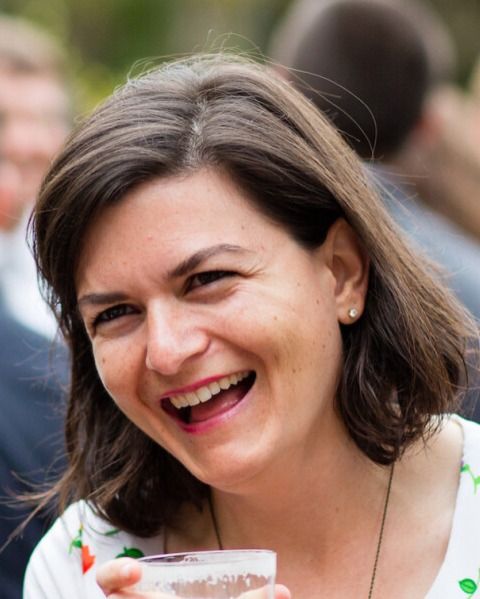
Emily Drumsta
· Assistant Professor; MES & MELC GSCVerifiedUniversity of Texas at Austin · Comparative Literature
Active 2016–2024
About
Emily Drumsta is an Assistant Professor in the College of Liberal Arts at the University of Texas at Austin. Her academic interests include Arabic and Francophone literatures, Comparative Literature, and Translation. She is involved in the Graduate Studies Committee for MES and MELC programs, contributing to the academic development of graduate students in these fields.
Research topics
- Philosophy
- Political Science
- Computer Science
- Law
- Art
- Theology
- World Wide Web
- Medicine
- Psychology
- Literature
Selected publications
The Detective as Conscript: Tawfiq al-Hakim and Driss Chraïbi on the Margins of the Law
University of California Press eBooks · 2024
1st authorCorresponding- Political Science
- Law
- Political Science
Luminos is University of California Press’ Open Access publishing program for monographs. With the same high standards for selection, peer review, production and marketing as our traditional program, Luminos is a transformative model, built as a partnership where costs and benefits are shared.
Reading Byron in Palestine: Jabra Ibrahim Jabra, translation, and the liberal poetics of exile
Middle Eastern Literatures · 2024-05-03 · 1 citations
article1st authorCorrespondingUniversity of California Press eBooks · 2024
1st authorCorresponding- Computer Science
- Psychology
- Medicine
Luminos is University of California Press’ Open Access publishing program for monographs. With the same high standards for selection, peer review, production and marketing as our traditional program, Luminos is a transformative model, built as a partnership where costs and benefits are shared.
Epic Fails: Sonallah Ibrahim’s Modern Myths of Seeking
University of California Press eBooks · 2024
1st authorCorresponding- Literature
- Art
Luminos is University of California Press’ Open Access publishing program for monographs. With the same high standards for selection, peer review, production and marketing as our traditional program, Luminos is a transformative model, built as a partnership where costs and benefits are shared.
2024-02-20
book-chapterOpen access1st authorCorrespondingStill Under Western Eyes? Three Recent Books on Modern Arabic Poetry
Modernism/modernity · 2023-04-01
article1st authorCorrespondingStill Under Western Eyes? Three Recent Books on Modern Arabic Poetry1 Emily Drumsta City of Beginnings: Poetic Modernism in Beirut. Robyn Creswell. Princeton, NJ: Princeton University Press, 2019. Pp. 259. $49.95 (cloth). The Arabic Prose Poem: Poetic Theory and Practice. Huda Fakhreddine. Edinburgh: Edinburgh University Press, 2021. Pp. 288. $105.00 (cloth). The Dangers of Poetry: Culture, Politics, and Revolution in Iraq. Kevin Jones. Stanford, CA: Stanford University press, 2020. Pp. 320. $70.00 (cloth). In December of 1976, a heated debate about Arabic poetry raged on the pages of the Times Literary Supplement. It began as a book review. The work in question was British-Egyptian scholar M. M. Badawi’s A Critical Introduction to Modern Arabic Poetry. The review, “Under Western Eyes,” was written by an up-and-coming Palestinian scholar named Edward Said. Said calls Badawi’s method “remorselessly serial,” his optic “not critical . . . but archival,” his voice “more like a harassed cataloguer than a literary critic,” and ultimately suggests, by not-so-subtle implication, that the product of Badawi’s labor is “uninteresting” and “unsophisticated.”2 He claims that Badawi views “Arabic literature as something to be judged principally by Western literature, or by ideas about Western literature that were current a century ago” (Said, “Under Western Eyes,” 1560). In a response published the next month, Badawi pointed out what he calls “errors of fact” in Said’s analysis. He calls Said’s reading of his book “hasty and careless” and chalks these [End Page 421] problems up to Said’s “obvious ignorance of the subject” of modern Arabic poetry. Charging that Said’s “complaint” about the book’s chronological framework is one “no Arab schoolboy would make,” Badawi claims Said’s review “casts doubt on his credentials, on his competence to judge such a book.”3 The exchange unfolded in a now-familiar cant: the younger scholar challenged the elder on questions of method and approach, while the older scholar marshaled “credentials” and “qualifications” to discredit his rival and shore up his own empire of expertise. What is most relevant for the purposes of this essay, however, is how Said and Badawi argue across disciplinary lines. Said, the comparatist, longs for close readings of Arabic poetry that might challenge the “categories, conceptual schemes, and metaphors which most critics of Western literature assume have a universal validity” and allow for “new critical formulations” (“Under Western Eyes,” 1599). Badawi, meanwhile, is determined to die on the hill of area studies. His responses epitomize the old-school Arabist’s allergy to what is now known as “theory.” “Unlike Mr. Said,” he writes, “I am not infatuated by the latest fashion, nor am I anxious to use the most up-to-date term, as if literary criticism was a branch of technology” (“Modern Arabic Poetry,” 12). Although this debate seems to have passed largely unnoticed by scholars of modernism (perhaps because it was concerned with the oft-sidelined field of Arabic poetry), it is nevertheless remarkable how little things have changed in the fifty years since Said and Badawi came to rhetorical blows. Scholars of Arabic poetry still find themselves caught between the “plodding empiricism” of area studies and the clubby Eurocentrism of comparative literature, and the academic publishing market also reflects this dilemma.4 Presses claiming to specialize in “literary studies” usually publish only on English, Anglophone, and European literatures, while those with specialties in “Middle Eastern studies” prefer historical and anthropological approaches to “the region,” as it is called. When it comes to the Middle East, in other words, Anglo-American readers are usually presumed to be seeking information, not imagination.5 Despite these constraints, three recent books offer new, very different, all refreshing takes on modern Arabic poetry. Robyn Creswell’s City of Beginnings: Poetic Modernism in Beirut, Kevin Jones’s The Dangers of Poetry: Culture, Politics, and Revolution in Iraq, and Huda Fakhreddine’s The Arabic Prose Poem: Poetic Theory and Practice study very different archives yet continue to ask where exactly Arabic poetry belongs as a field of study (indeed, if it is a discrete field of study at all). Published in the Translation/Transnation series at Princeton University Press, edited by...
Journal of World Literature · 2023-04-21 · 1 citations
article1st authorCorrespondingAbstract This article examines two modern women poets’ ambivalent engagements with Arabic elegy: the Iraqi Nazik al-Malaʾikah and the Egyptian Iman Mersal. Although they wrote in different national contexts and historical eras, with utterly distinct political and aesthetic projects, a close look at their verse reveals a specter of the bereft-yet-eloquent “ancient Arab woman” haunting their respective poetic voices. Looking in particular at a conventionally metered and rhymed ode like al-Malaʾikah’s “To My Late Aunt” ( Ila ʿAmmati al-Rahilah ) and at the quasi-elegiac threads woven through the prose poems in Mersal’s 1992 collection, A Dark Corridor Suitable for Learning How to Dance ( Mamarr Muʾtam Yuslah Li-Taʿallum al-Raqs ) allows us to see how durable and omnipresent the woman-elegy association is in Arabic – surfacing everywhere from the heyday of Iraqi modernism, with its revaluation of conventional metrical forms, all the way through the unmetered, unrhymed experimentations of the “nineties generation” in Egypt.
Interview with ʿAbdulʾilāh Ḥamdūšī
Harrassowitz Verlag eBooks · 2021-02-25
book-chapter1st authorCorrespondingGender, Authorship, and Translation in Modern Arabic Literature of the Mashriq
Oxford Research Encyclopedia of Literature · 2021-09-28 · 2 citations
reference-entry1st authorCorrespondingAbstract Among the many challenges facing Arabic literature in translation, the question of gender has historically been one of the most fraught, particularly as it presses upon Arab women writers. The persistence of Orientalist tropes such as the veil and the harem; the continual othering of the exotic and supposedly untranslatable East; the frequent lumping together of Arab, Muslim, and Middle Eastern identities; the slippage between memoir, or autobiography, and fiction; and the tendency to isolate gender issues from their political, historical, and social contexts—these are some of the many phenomena that scholars and translators have examined in the Western academy. Some issues, such as the burden of mimesis, the tendency to depoliticize the work of controversial authors, and the continual association of Arabic with the Qurʾān (and thereby with the untranslatable and the sacred), face all works of Arabic in their translation for the English-language marketplace. Other issues, such as the stereotyping of Arab women as either helpless victims, exceptional escapees, or deluded pawns of Arab patriarchy, in Mohja Kahf’s reading, affect Arab women’s writing (and literature featuring Arab women characters) with particular force. Many scholars have highlighted the division between the simplistic, flattening representations of Arab women writers offered in mainstream Western publishing and the more nuanced, literarily sensitive presentations in translated works published by small, specialist, and university presses. Pressing issues of genre are also at play: the desire among American publics for a sociological, ethnographic “glimpse behind the veil” of Middle Eastern society has created a preference for both documentary memoirs and mimetic–realist works of fiction that has drawn attention away from works of experimental prose and—most notably—from poetry. Whereas male poets such as the Palestinian Maḥmūd Darwīsh (Mahmoud Darwish) and the Syro-Lebanese Adūnīs (Adunis) have multiple discrete volumes in English translation, Arab women tend to be confined to the realm of anthologies, where one or two poems are meant to represent an entire life of variegated poetic creation, and where the emphasis on their personal identity (“Arab woman”) is highlighted above their role in a more complex literary, social, and historical world. Although several contemporary poets have managed to break from the anthology loop, early-21st-century works in translation suggest that the stereotype of the Muslim woman in need of “saving” has not yet gone away. Still, scholars and translators have also offered numerous strategies and tactics for “rewiring the circuits” that govern the representation of Arab women in the West.
2019-12-09
book-chapterThis chapter discusses translation practice and theory through consideration of Tahrir Documents, a project to push the boundaries of Arabic-English translation and begun in the aftermath of the 2011 Egyptian uprising against Hosni Mubarak. Working with a collection of paper-based ephemera produced during the revolution, Tahrir Documents complicated the increasingly widespread characterization of the direct actions in Tahrir Square as a revolution fueled by social media platforms. Tahrir Documents was an experiment in large-scale crowd-sourced translation that negotiated the demand for faithful, careful renderings of Arabic political speech into English alongside a pressing desire for immediate distribution. In this chapter, we engage in a conversation with recent theoretical engagements from the emerging field of Arabic translation studies. First, we offer an overview of our process and some reflections on the numerous issues that our collectors, translators and editors faced over the course of the archive’s creation. Then, we build off these concrete details to advance an alternative, if tentative, theory for how to practice Arabic-to-English translation in a rapidly changing, revolutionary political context like Tahrir Square. We argue that revolutionary practices like those performed in Tahrir Square demand an approach to translation that prioritizes speed and accessibility over academic contemplation and deliberation.
Frequent coauthors
- 1 shared
Elias G. Saba
Grinnell College
- 1 shared
Levi Thompson
The University of Texas at Austin
- 1 shared
Keith Feldman
University of Missouri–Kansas City
- 1 shared
ʿAbdulʾilāh Ḥamdūšī
Education
- 2016
PhD, Comparative Literature
University of California Berkeley
- 2006
BA, Comparative Literature
Brown University
- Resume-aware match score
- Save to shortlist
- AI-drafted outreach
See your match with Emily Drumsta
PhdFit ranks faculty by your research interests, methods, and publications — grounded in their actual work, not templates.
- Free to start
- No credit card
- 30-second signup