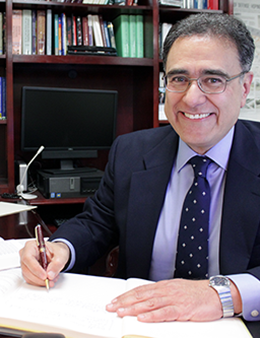
Bilal M. Ayyub
· Civil and Environmental Engineering, Center for Risk and Reliability, Maryland Robotics Center, The Institute for Systems ResearchVerifiedUniversity of Maryland, College Park · Civil and Environmental Engineering
Active 1983–2026
About
Bilal M. Ayyub is a professor in the Department of Civil and Environmental Engineering at the University of Maryland, where he also serves as the Director of the Center for Technology and Systems Management, the Center for Risk and Reliability, the Maryland Robotics Center, and the Institute for Systems Research. He earned his Ph.D. from Georgia Institute of Technology in 1983, specializing in measurement science for resilience and sustainability, with a focus on design and adaptation to a changing climate, infrastructure resilience, risk, and reliability. His main research interests include risk, resilience, sustainability, uncertainty, and decision analysis, applied across civil, infrastructure, energy, defense, maritime fields, and climate-resilient infrastructure. Dr. Ayyub has completed numerous research and development projects for governmental agencies such as NSF, DOD, DOT, NIST, DHS, and for private and multinational corporations worldwide. He is a distinguished member of ASCE, an honorary member of ASME, and a fellow of the Society of Naval Architects and Marine Engineers, the Structural Engineering Institute, and the Society for Risk Analysis, where he also served as treasurer. His contributions to engineering include the development of reliability-based design methods for nuclear piping, ship structures, and marine vessels, as well as methodologies for assessing structural life expectancy and resilience of infrastructure systems. Dr. Ayyub is an accomplished author with over 650 publications, including books, textbooks, and journal articles, and serves as the editor-in-chief of the ASCE-ASME Journal on Risk and Uncertainty in Engineering Systems. His work has been recognized with numerous awards, notably the 2018 ASCE Alfredo Ang Award, the 2019 ASCE President Medal, and the 2016 ASNE Solberg Award, among others. He is a pioneer in climate-adaptive design and climate resilience, actively contributing to the advancement of climate-smart infrastructure and policy, and has been featured in various professional outlets for his leadership in risk analysis, climate adaptation, and infrastructure resilience.
Research topics
- Computer Science
- Engineering
- Computer Security
- Mathematics
- Computer network
- Business
- Transport engineering
- Risk analysis (engineering)
- Mathematical optimization
- Reliability engineering
- Architectural engineering
Selected publications
Systems Optimization and Risk Management of Sensor Networks for Detection of Wildfires
2026-04-06
articleAn urgent topic of systems engineering and engineering management is the design and evaluation of sensor networks for societal resilience. Wildfires are threatening communities with impacts on landscapes, health, and economies. Early detection of new wildfires is essential for effective responses and improving risk mitigation. In this application, cameras are used to monitor landscapes and identify anomalies. However, line-of-sight, financial, jurisdictional, and other factors complicate efforts to deploy cameras across a region. Camera and other sensor deployments are typically chosen to maximize the coverage area subject to limited resources. However, wildfire risk varies by location and terrain. Existing camera networks can be expanded over time as more resources are available, and once-optimal solutions may become sub-optimal with the addition of new cameras, potentially requiring expensive relocation of existing camera towers. The complexity of camera network design thus calls for an approach that incorporates risk metrics and supports decision-making over time from a perspective of large-scale systems. This paper formulates the network design as a weighted maximum coverage problem and describes a greedy algorithm for sequential system design. The approach provides insights into system design, balancing coverage of high-risk and low-risk areas, and cost-coverage tradeoffs. The approach is applied to a case study in Erice, Trapani, Italy.
Reliability Engineering & System Safety · 2026-02-09
articleOpen accessBackground for Numerical Methods
2026-02-26
book-chapter1st authorCorrespondingJournal of Engineering Materials and Technology · 2026-05-21
articleSenior authorAbstract Materials subjected to cyclic loading accumulate thermodynamic entropy until a critical value known as the fatigue fracture entropy (FFE) is reached, whereupon they experience final fracture. Research into FFE values commonly rely upon deformation entropy generation (DEG) theory to derive a model that is then validated with constant amplitude fatigue tests under low cycle fatigue (LCF) conditions. Yet many engineering structures experience variable amplitude fatigue and/or high cycle fatigue (HCF) conditions. In addition, the traditional DEG-based approach requires an adjustment to account for internal friction, which requires empirical relations with parameters whose values are known only through material-specific testing. This paper presents an alternative approach to FFE estimation for aluminum alloys that accommodates variable stress amplitudes under either LCF or HCF conditions without the need to know the initial temperature rise in the test specimen or to account for internal friction. This alternative approach estimates FFE within the same bounds of variability as the FFE values provided by other researchers using the traditional DEG-based approach. Empirical fatigue test data validates the alternative approach for all test specimens except those with only two loading blocks in the LCF region, which produced results displaying the most variability.
Differential Equations: Fundamentals
2026-02-26
book-chapter1st authorCorrespondingClimate-Resilient Structures and Infrastructures
2026-04-28
book2026-02-26
book-chapter1st authorCorrespondingClimate Impact Analytics for the US Freight Rail Network
2026-04-28
book-chapterSenior authorTo better quantify the impact of climate change on railroads, we develop a methodology that uses a network to represent the system and node/link importance metrics to identify relative component importance. We then use extreme temperatures as a case study to demonstrate how the methodology may be used to enhance existing research. We find that temperature increases are expected to cause a corresponding decrease in network performance (around 2.7% year-round and 18% on the hottest days). The proposed methodology provides the ability to scale our analysis based on the resolution and precision of the available data.
2026-02-26
book-chapter1st authorCorresponding2026-02-26
book-chapter1st authorCorresponding
Frequent coauthors
- 43 shared
Michael Beer
- 35 shared
William L. McGill
- 29 shared
Cao Wang
University of Wollongong
- 29 shared
Jerry Foster
- 28 shared
Richard N. Wright
- 27 shared
Gregory J. White
- 27 shared
Ted S. Vinson
- 25 shared
Sue McNeil
UNSW Sydney
Education
PhD
Georgia Institute of Technology
Awards & honors
- 2018 ASCE Alfredo Ang Award on risk analysis and management…
- 2019 ASCE President Medal for efforts to bring adaptive desi…
- 2019 ASCE Le Val Lund Award for contributions to resilience…
- 2018 ENR Newsmaker award for guidance in resilient infrastru…
- 2016 ASNE Solberg Award for engineering research in ship sur…
- Resume-aware match score
- Save to shortlist
- AI-drafted outreach
See your match with Bilal M. Ayyub
PhdFit ranks faculty by your research interests, methods, and publications — grounded in their actual work, not templates.
- Free to start
- No credit card
- 30-second signup