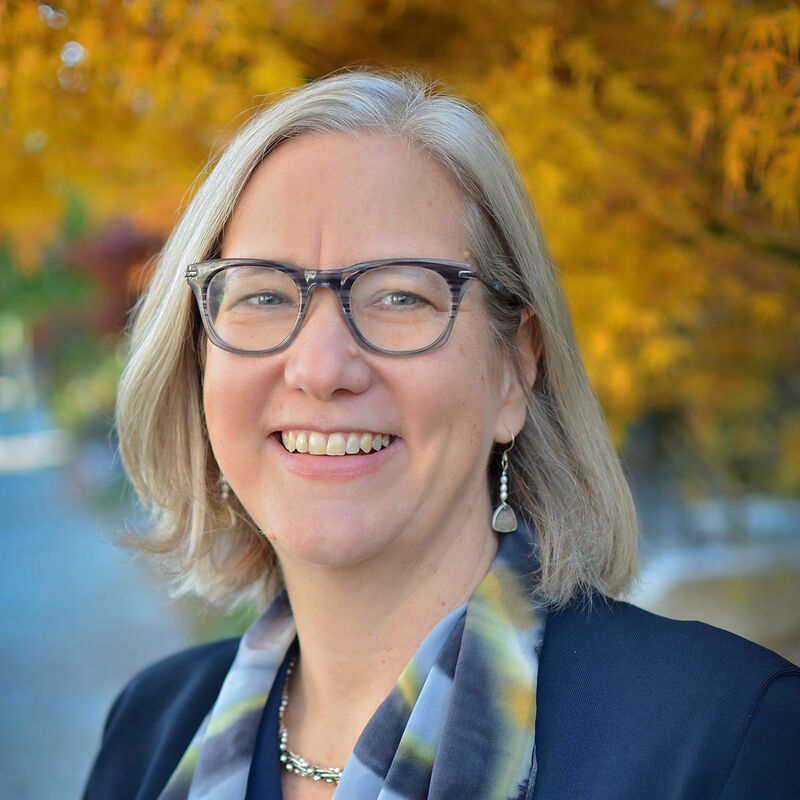
Beth Angell
· Dean and Phillip Fellin Collegiate Professor of Social WorkUniversity of Michigan · Department of Social Work
Active 2002–2024
About
Dr. Beth Angell is dean and professor of social work at the University of Michigan School of Social Work, having begun her appointment on July 1, 2022. Her research focuses on behavioral health, particularly on serious mental illness and its intersection with substance abuse and criminal justice involvement. Her studies have addressed treatment seeking, treatment engagement and adherence, consumer-provider interactions and relationships, sources and consequences of stigma, and mandated or involuntary treatment. Her projects have been funded by organizations including the National Institute of Mental Health, the NARSAD Foundation, the John D. and Catherine T. MacArthur Foundation Research Network on Mandated Community Treatment, the New Jersey Division of Mental Health and Addiction Services, and the Chicago Community Trust. Angell was inducted as a Fellow in the Society for Social Work and Research and has served on a consensus study for the National Academies of Engineering, Science, and Medicine. Prior to her current role, she held faculty positions at the University of Chicago Crown School of Social Work, Policy, and Practice, Rutgers University School of Social Work and the Institute for Health, Health Care Policy, and Aging Research, and served as dean and professor at Virginia Commonwealth University School of Social Work. She holds a Bachelor of Arts degree from the University of North Carolina, a Master of Science in social work with a subconcentration in severe and persistent mental illness, and a doctorate in social welfare, both from the University of Wisconsin.
Research topics
- Business
- Environmental health
- Economic growth
- Economics
- Medicine
- Political Science
- Finance
- Development economics
- Virology
- Psychology
Selected publications
The Lancet Nigeria Commission: investing in health and the future of the nation
The Lancet · 2022 · 332 citations
- Economic growth
- Development economics
- Business
Health is central to the development of any country. Nigeria’s gross domestic product is the largest in Africa, but its per capita income of about ₦770 000 (US$2000) is low with a highly inequitable distribution of income, wealth, and therefore, health. It is a picture of poverty amidst plenty. Nigeria is both a wealthy country and a very poor one. About 40% of Nigerians live in poverty, in social conditions that create ill health, and with the ever-present risk of catastrophic expenditures from high out-of-pocket spending for health. Even compared with countries of similar income levels in Africa, Nigeria’s population health outcomes are poor, with national statistics masking drastic differences between rich and poor, urban and rural populations, and different regions.
The Lancet · 2021 · 156 citations
- Political Science
- Economic growth
- Business
BACKGROUND: The rapid spread of COVID-19 renewed the focus on how health systems across the globe are financed, especially during public health emergencies. Development assistance is an important source of health financing in many low-income countries, yet little is known about how much of this funding was disbursed for COVID-19. We aimed to put development assistance for health for COVID-19 in the context of broader trends in global health financing, and to estimate total health spending from 1995 to 2050 and development assistance for COVID-19 in 2020. METHODS: We estimated domestic health spending and development assistance for health to generate total health-sector spending estimates for 204 countries and territories. We leveraged data from the WHO Global Health Expenditure Database to produce estimates of domestic health spending. To generate estimates for development assistance for health, we relied on project-level disbursement data from the major international development agencies' online databases and annual financial statements and reports for information on income sources. To adjust our estimates for 2020 to include disbursements related to COVID-19, we extracted project data on commitments and disbursements from a broader set of databases (because not all of the data sources used to estimate the historical series extend to 2020), including the UN Office of Humanitarian Assistance Financial Tracking Service and the International Aid Transparency Initiative. We reported all the historic and future spending estimates in inflation-adjusted 2020 US$, 2020 US$ per capita, purchasing-power parity-adjusted US$ per capita, and as a proportion of gross domestic product. We used various models to generate future health spending to 2050. FINDINGS: In 2019, health spending globally reached $8·8 trillion (95% uncertainty interval [UI] 8·7-8·8) or $1132 (1119-1143) per person. Spending on health varied within and across income groups and geographical regions. Of this total, $40·4 billion (0·5%, 95% UI 0·5-0·5) was development assistance for health provided to low-income and middle-income countries, which made up 24·6% (UI 24·0-25·1) of total spending in low-income countries. We estimate that $54·8 billion in development assistance for health was disbursed in 2020. Of this, $13·7 billion was targeted toward the COVID-19 health response. $12·3 billion was newly committed and $1·4 billion was repurposed from existing health projects. $3·1 billion (22·4%) of the funds focused on country-level coordination and $2·4 billion (17·9%) was for supply chain and logistics. Only $714·4 million (7·7%) of COVID-19 development assistance for health went to Latin America, despite this region reporting 34·3% of total recorded COVID-19 deaths in low-income or middle-income countries in 2020. Spending on health is expected to rise to $1519 (1448-1591) per person in 2050, although spending across countries is expected to remain varied. INTERPRETATION: Global health spending is expected to continue to grow, but remain unequally distributed between countries. We estimate that development organisations substantially increased the amount of development assistance for health provided in 2020. Continued efforts are needed to raise sufficient resources to mitigate the pandemic for the most vulnerable, and to help curtail the pandemic for all. FUNDING: Bill & Melinda Gates Foundation.
Frequent coauthors
- 113 shared
Stephen Jan
George Institute for Global Health
- 73 shared
Rohina Joshi
UNSW Sydney
- 63 shared
Belinda Ford
The George Institute for Global Health
- 61 shared
Andrew White
Westmead Hospital
- 58 shared
Lisa Keay
UNSW Sydney
- 43 shared
Sikhumbuzo A. Mabunda
The George Institute for Global Health
- 37 shared
Andrea Durbach
UNSW Sydney
- 33 shared
Gerald Liew
Westmead Institute for Medical Research
Labs
Research DiscoveriesPI
Awards & honors
- Phillip Fellin Collegiate Professor of Social Work (2022)
- Fellow, Society for Social Work and Research (2018)
- Appointed Member, Standing Committee on Changing Behavioral…
- 2016 Council on Social Work Education Summer Leadership Scho…
Similar researchers at University of Michigan
- Resume-aware match score
- Save to shortlist
- AI-drafted outreach
See your match with Beth Angell
PhdFit ranks faculty by your research interests, methods, and publications — grounded in their actual work, not templates.
- Free to start
- No credit card
- 30-second signup