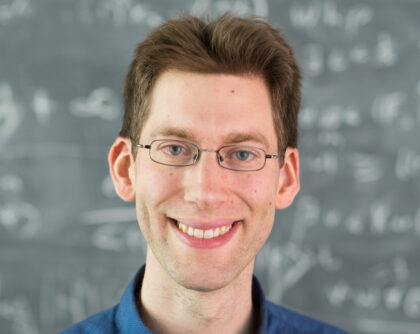
Aram Harrow
VerifiedMassachusetts Institute of Technology · Physics
Active 2001–2026
About
Aram Harrow is a Professor of Physics at MIT, with a research focus on quantum information and computing. His work encompasses theoretical quantum information science, quantum algorithms, and the role of quantum information in many-body physics. Harrow grew up in Michigan and completed his undergraduate studies in math and physics at MIT in 2001, followed by a PhD in physics from MIT in 2005. He then served as a lecturer at the University of Bristol for five years and as a research assistant professor at the University of Washington for two years. In 2013, he joined the MIT Physics department as an assistant professor, was promoted to Associate Professor with tenure in 2018, and became a full Professor in 2022. His contributions have been recognized with several awards, including the 2018 Rolf Landauer and Charles H. Bennett Award in Quantum Computing and the 2023 Simons Investigator award.
Research topics
- Mathematics
- Computer science
- Discrete mathematics
- Physics
- Combinatorics
Selected publications
Quantum Purity Amplification for Arbitrary Eigenstates and Multiple Outputs
arXiv (Cornell University) · 2026-05-20
preprintOpen accessQuantum purity amplification (QPA) is the task of coherently transforming $n$ copies of a mixed state into high-fidelity copies of a chosen eigenstate. We solve QPA in the general setting of $n$ input copies, $m$ output copies, arbitrary target eigenstates, arbitrary local dimension $d$, and generic input spectra. We characterize the optimal channel and derive its all-site and one-site performance laws across output regimes. For the asymptotic analysis, we use a path-graph parametrization to show that, when the target eigenvalue has a constant spectral gap $D_{k,\mathrm{min}}$, achieving all-site error $\varepsilon$ requires a number of input copies independent of $d$ and scaling as $O(m/(\varepsilon D_{k,\mathrm{min}}^2))$. When $m/n$ approaches a constant, the performance exhibits phase-like regimes, which we characterize explicitly. For the nonasymptotic analysis, we develop a theory of generalized Young diagrams that yields tight sample complexity bounds and provides the first dimension-uniform guarantee for optimal QPA. We also provide asymptotically efficient implementations of the optimal protocol. Together, these results establish QPA as a rigorous example of coherent quantum information processing with dimension-uniform sample complexity, supplying the technical foundation for the coherent-incoherent separation developed in the companion work.
ArXiv.org · 2026-02-09
articleOpen accessSome representation-theoretic multiplicities, such as the Kostka and the Littlewood-Richardson coefficients, admit a combinatorial interpretation that places their computation in the complexity class #P. Whether this holds more generally is considered an important open problem in mathematics and computer science, with relevance for geometric complexity theory and quantum information. Recent work has investigated the quantum complexity of particular multiplicities, such as the Kronecker coefficients and certain special cases of the plethysm coefficients. Here, we show that a broad class of representation-theoretic multiplicities is in #BQP. In particular, our result implies that the plethysm coefficients are in #BQP, which was only known in special cases. It also implies all known results on the quantum complexity of previously studied coefficients as special cases, unifying, simplifying, and extending prior work. We obtain our result by multiple applications of the Schur transform. Recent work has improved its dependence on the local dimension, which is crucial for our work. We further describe a general approach for showing that representation-theoretic multiplicities are in #BQP that captures our approach as well as the approaches of prior work. We complement the above by showing that the same multiplicities are also naturally in GapP and obtain polynomial-time classical algorithms when certain parameters are fixed.
An Exponential Sample-Complexity Advantage for Coherent Quantum Inference
ArXiv.org · 2026-05-20
articleOpen accessStandard quantum inference converts quantum data into classical outputs. We study an alternative inference setting in which the desired output is quantum, preserving coherence. Such settings include quantum purity amplification (QPA), mixed-state approximate purification or cloning, and density matrix exponentiation. We show that such protocols can achieve exponentially lower sample complexity than incoherent, measurement-mediated protocols. For QPA with principal eigenstate targets and $d$-dimensional inputs, coherent processing achieves error $\varepsilon$ using $O(1/\varepsilon)$ copies, versus the $Ω(d/\varepsilon)$ copies required by any incoherent protocol. Together, these sharp coherent-incoherent separations seed a theory of coherent quantum inference, with an entanglement-breaking limit identifying the optimal incoherent counterpart of each coherent protocol.
Open MIND · 2026-02-09
preprintSome representation-theoretic multiplicities, such as the Kostka and the Littlewood-Richardson coefficients, admit a combinatorial interpretation that places their computation in the complexity class #P. Whether this holds more generally is considered an important open problem in mathematics and computer science, with relevance for geometric complexity theory and quantum information. Recent work has investigated the quantum complexity of particular multiplicities, such as the Kronecker coefficients and certain special cases of the plethysm coefficients. Here, we show that a broad class of representation-theoretic multiplicities is in #BQP. In particular, our result implies that the plethysm coefficients are in #BQP, which was only known in special cases. It also implies all known results on the quantum complexity of previously studied coefficients as special cases, unifying, simplifying, and extending prior work. We obtain our result by multiple applications of the Schur transform. Recent work has improved its dependence on the local dimension, which is crucial for our work. We further describe a general approach for showing that representation-theoretic multiplicities are in #BQP that captures our approach as well as the approaches of prior work. We complement the above by showing that the same multiplicities are also naturally in GapP and obtain polynomial-time classical algorithms when certain parameters are fixed.
Quantum Purity Amplification for Arbitrary Eigenstates and Multiple Outputs
ArXiv.org · 2026-05-20
articleOpen accessQuantum purity amplification (QPA) is the task of coherently transforming $n$ copies of a mixed state into high-fidelity copies of a chosen eigenstate. We solve QPA in the general setting of $n$ input copies, $m$ output copies, arbitrary target eigenstates, arbitrary local dimension $d$, and generic input spectra. We characterize the optimal channel and derive its all-site and one-site performance laws across output regimes. For the asymptotic analysis, we use a path-graph parametrization to show that, when the target eigenvalue has a constant spectral gap $D_{k,\mathrm{min}}$, achieving all-site error $\varepsilon$ requires a number of input copies independent of $d$ and scaling as $O(m/(\varepsilon D_{k,\mathrm{min}}^2))$. When $m/n$ approaches a constant, the performance exhibits phase-like regimes, which we characterize explicitly. For the nonasymptotic analysis, we develop a theory of generalized Young diagrams that yields tight sample complexity bounds and provides the first dimension-uniform guarantee for optimal QPA. We also provide asymptotically efficient implementations of the optimal protocol. Together, these results establish QPA as a rigorous example of coherent quantum information processing with dimension-uniform sample complexity, supplying the technical foundation for the coherent-incoherent separation developed in the companion work.
Quantum Speedups for Derivative Pricing Beyond Black-Scholes
Open MIND · 2026-02-03
preprintSenior authorThis paper explores advancements in quantum algorithms for derivative pricing of exotics, a computational pipeline of fundamental importance in quantitative finance. For such cases, the classical Monte Carlo integration procedure provides the state-of-the-art provable, asymptotic performance: polynomial in problem dimension and quadratic in inverse-precision. While quantum algorithms are known to offer quadratic speedups over classical Monte Carlo methods, end-to-end speedups have been proven only in the simplified setting over the Black-Scholes geometric Brownian motion (GBM) model. This paper extends existing frameworks to demonstrate novel quadratic speedups for more practical models, such as the Cox-Ingersoll-Ross (CIR) model and a variant of Heston's stochastic volatility model, utilizing a characteristic of the underlying SDEs which we term fast-forwardability. Additionally, for general models that do not possess the fast-forwardable property, we introduce a quantum Milstein sampler, based on a novel quantum algorithm for sampling Lévy areas, which enables quantum multi-level Monte Carlo to achieve quadratic speedups for multi-dimensional stochastic processes exhibiting certain correlation types. We also present an improved analysis of numerical integration for derivative pricing, leading to substantial reductions in the resource requirements for pricing GBM and CIR models. Furthermore, we investigate the potential for additional reductions using arithmetic-free quantum procedures. Finally, we critique quantum partial differential equation (PDE) solvers as a method for derivative pricing based on amplitude estimation, identifying theoretical barriers that obstruct achieving a quantum speedup through this approach. Our findings significantly advance the understanding of quantum algorithms in derivative pricing, addressing key challenges and open questions in the field.
Quantum Machine Intelligence · 2026-01-20
articleOpen accessAn Exponential Sample-Complexity Advantage for Coherent Quantum Inference
arXiv (Cornell University) · 2026-05-20
preprintOpen accessStandard quantum inference converts quantum data into classical outputs. We study an alternative inference setting in which the desired output is quantum, preserving coherence. Such settings include quantum purity amplification (QPA), mixed-state approximate purification or cloning, and density matrix exponentiation. We show that such protocols can achieve exponentially lower sample complexity than incoherent, measurement-mediated protocols. For QPA with principal eigenstate targets and $d$-dimensional inputs, coherent processing achieves error $\varepsilon$ using $O(1/\varepsilon)$ copies, versus the $Ω(d/\varepsilon)$ copies required by any incoherent protocol. Together, these sharp coherent-incoherent separations seed a theory of coherent quantum inference, with an entanglement-breaking limit identifying the optimal incoherent counterpart of each coherent protocol.
Quantum Speedups for Derivative Pricing Beyond Black-Scholes
arXiv (Cornell University) · 2026-02-03
articleOpen accessSenior authorThis paper explores advancements in quantum algorithms for derivative pricing of exotics, a computational pipeline of fundamental importance in quantitative finance. For such cases, the classical Monte Carlo integration procedure provides the state-of-the-art provable, asymptotic performance: polynomial in problem dimension and quadratic in inverse-precision. While quantum algorithms are known to offer quadratic speedups over classical Monte Carlo methods, end-to-end speedups have been proven only in the simplified setting over the Black-Scholes geometric Brownian motion (GBM) model. This paper extends existing frameworks to demonstrate novel quadratic speedups for more practical models, such as the Cox-Ingersoll-Ross (CIR) model and a variant of Heston's stochastic volatility model, utilizing a characteristic of the underlying SDEs which we term fast-forwardability. Additionally, for general models that do not possess the fast-forwardable property, we introduce a quantum Milstein sampler, based on a novel quantum algorithm for sampling Lévy areas, which enables quantum multi-level Monte Carlo to achieve quadratic speedups for multi-dimensional stochastic processes exhibiting certain correlation types. We also present an improved analysis of numerical integration for derivative pricing, leading to substantial reductions in the resource requirements for pricing GBM and CIR models. Furthermore, we investigate the potential for additional reductions using arithmetic-free quantum procedures. Finally, we critique quantum partial differential equation (PDE) solvers as a method for derivative pricing based on amplitude estimation, identifying theoretical barriers that obstruct achieving a quantum speedup through this approach. Our findings significantly advance the understanding of quantum algorithms in derivative pricing, addressing key challenges and open questions in the field.
How to Use Quantum Computers for Biomolecular Free Energies
Journal of Chemical Theory and Computation · 2026-04-19 · 2 citations
articleOpen accessCorrespondingFree energy calculations are at the heart of physics-based analyses of biochemical processes. They allow us to quantify molecular recognition mechanisms, which determine a wide range of biological phenomena, from how cells send and receive signals to how pharmaceutical compounds can be used to treat diseases. Quantitative and predictive free energy calculations require computational models that accurately capture both the varied and intricate electronic interactions between molecules as well as the entropic contributions from the motions of these molecules and their aqueous environment. However, accurate quantum-mechanical energies and forces can be obtained only for small atomistic models and not for large biomacromolecules. Here, we demonstrate how to consistently link accurate quantum-mechanical data obtained for substructures to the overall potential energy of biomolecular complexes using machine learning in an integrated algorithm. We do so using a two-fold quantum embedding strategy where the innermost quantum cores are treated at a very high level of accuracy. We demonstrate the viability of this approach for the molecular recognition of a ruthenium-based anticancer drug by its protein target by applying traditional quantum chemical methods. As such methods scale unfavorably with system size, we analyze the requirements for quantum computers to provide highly accurate energies that affect the resulting free energies. Once the requirements are met, our computational pipeline, FreeQuantum, is able to make efficient use of the quantum-computed energies, thereby enabling quantum computing-enhanced modeling of biochemical processes. This approach combines the exponential speedups of quantum computers for simulating interacting electrons with modern classical simulation techniques that incorporate machine learning to model large molecules.
Recent grants
CAREER: Applications of Quantum Information Theory
NSF · $600k · 2015–2021
EMT/QIS: Robust Quantum Simulation Techniques for Fault-Tolerant Quantum Computation
NSF · $324k · 2008–2012
Quantum Concatenated Code Hamiltonians
NSF · $320k · 2008–2012
NSF · $403k · 2015–2017
Frequent coauthors
- 22 shared
Andreas Winter
Universitat Autònoma de Barcelona
- 21 shared
Ashley Montanaro
- 20 shared
Fernando G. S. L. Brandão
- 17 shared
Debbie Leung
- 14 shared
Isaac L. Chuang
- 13 shared
Dave Bacon
- 10 shared
Steven T. Flammia
- 10 shared
Igor Devetak
Awards & honors
- 2023 Simons Investigator
- 2020 Applied NISQ Computing paper award, USRA-Q2B
- 2018 Rolf Landauer and Charles H. Bennett Award in Quantum C…
- 2017 Best Paper Award, IEEE Information Theory Society
- 2017 Buechner Faculty Award for Undergraduate Advising, MIT…
- Resume-aware match score
- Save to shortlist
- AI-drafted outreach
See your match with Aram Harrow
PhdFit ranks faculty by your research interests, methods, and publications — grounded in their actual work, not templates.
- Free to start
- No credit card
- 30-second signup