
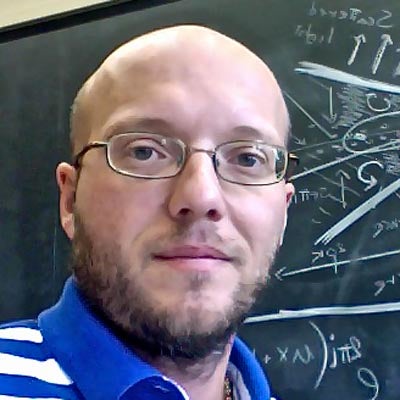
Andrea Isella
· Professor, Physics and AstronomyRice University · Earth Science
Active 2005–2026
Academic metrics are sourced from OpenAlex and public funding records; values may differ from Google Scholar.
About
Dr. Andrea Isella is the William V. Vietti Associate Professor in the Department of Physics and Astronomy at Rice University and serves as the Director of Research at the Rice Space Institute. His professional affiliation is with Rice University, located in Houston, Texas. Dr. Isella's research group focuses on the study of planet formation and circumstellar disks, which are critical areas in understanding the processes that lead to the birth of planets. The group is actively engaged in modeling and imaging circumplanetary disks, contributing to the broader field of astrophysics and planetary science. Dr. Isella's leadership in this research area is reflected in his mentorship of current and former postdoctoral scholars and graduate students, who pursue advanced studies in related topics. His contact information and departmental association underscore his active role in academic research and education at Rice University.
Research topics
- Physics
- Astronomy
- Astrophysics
- Optics
Selected publications
Planetesimal rings as the cause of the Solar System’s planetary architecture
Nature Astronomy · 2021 · 113 citations
Senior authorCorrespondingA Multifrequency ALMA Characterization of Substructures in the GM Aur Protoplanetary Disk
The Astrophysical Journal · 2020 · 95 citations
Abstract The protoplanetary disk around the T Tauri star GM Aur was one of the first hypothesized to be in the midst of being cleared out by a forming planet. As a result, GM Aur has had an outsized influence on our understanding of disk structure and evolution. We present 1.1 and 2.1 mm ALMA continuum observations of the GM Aur disk at a resolution of ∼50 mas (∼8 au), as well as HCO + J = 3 − 2 observations at a resolution of ∼100 mas. The dust continuum shows at least three rings atop faint, e…
exoALMA. III. Line-intensity Modeling and System Property Extraction from Protoplanetary Disks
The Astrophysical Journal Letters · 2025-04-28 · 33 citations
articleOpen accessAbstract The ALMA large program exoALMA offers a unique window into the three-dimensional physical and dynamical properties of 15 circumstellar disks where planets may be actively forming. Here, we present an analysis methodology to map the gas disk structure and substructure encoded in 12 CO, 13 CO, and CS line emission from our targets. To model and characterize the disk structure probed by optically thin species, such as CS and, in some cases, 13 CO, we introduce a composite line profile kern…
exoALMA. IV. Substructures, Asymmetries, and the Faint Outer Disk in Continuum Emission
The Astrophysical Journal Letters · 2025-04-28 · 31 citations
articleOpen accessAbstract The exoALMA Large Program targeted a sample of 15 disks to study gas dynamics within these systems, and these observations simultaneously produced continuum data at 0.9 mm (331.6 GHz) with exceptional surface brightness sensitivity at high angular resolution. To provide a robust characterization of the observed substructures, we performed a visibility space analysis of the continuum emission from the exoALMA data, characterizing axisymmetric substructures and nonaxisymmetric residuals o…
exoALMA. XII. Weighing and Sizing exoALMA Disks with Rotation Curve Modelling
The Astrophysical Journal Letters · 2025-04-28 · 31 citations
articleOpen accessAbstract The exoALMA large program offers a unique opportunity to investigate the fundamental properties of protoplanetary disks, such as their masses and sizes, providing important insights into the mechanism responsible for the transport of angular momentum. In this work, we model the rotation curves of CO isotopologues 12 CO and 13 CO of 10 sources within the exoALMA sample, and we constrain the stellar mass, the disk mass, and the density scale radius through precise characterization of the…
Recent grants
Probing the Origins of Solar Systems with Millimeter-wave Interferometry
NSF · $84k · 2014–2017
Probing the Origins of Solar Systems with Millimeter-wave Interferometry
NSF · $545k · 2011–2015
Studying Planet Formation by Mapping Small-scale Structures in Circumstellar Disks
NSF · $487k · 2017–2021
Frequent coauthors
- 160 shared
M. Benisty
Centre National de la Recherche Scientifique
- 98 shared
L. Testi
- 83 shared
Laura M. Pérez
University of Chile
- 83 shared
Luca Ricci
- 74 shared
John M. Carpenter
Atacama Large Millimeter Submillimeter Array
- 69 shared
Sean M. Andrews
- 65 shared
David J. Wilner
- 60 shared
F. Ménard
Labs
Similar researchers at Rice University
- Resume-aware match score
- Save to shortlist
- AI-drafted outreach
See your match with Andrea Isella
PhdFit ranks faculty by your research interests, methods, and publications — grounded in their actual work, not templates.
- Free to start
- No credit card
- 30-second signup