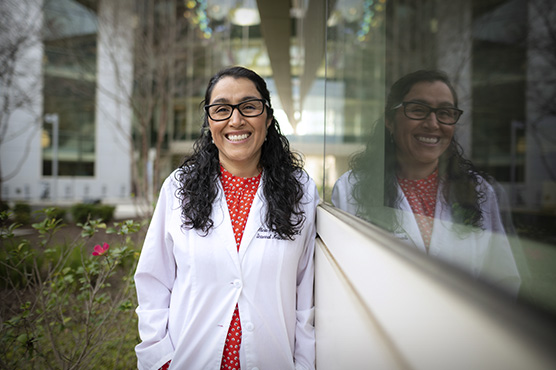
Alicia Flores Gonzalez
· Clinical Professor of Family Nurse Practitioner and Physician Assistant StudiesVerifiedUniversity of California, Davis · Department of Family Nurse Practitioner and Physician Assistant Studies
Active 2014–2025
Research signals
Five dimensions sourced from public faculty / publication signals. Sign in to compare against your own profile and see your match score.
Research topics
- Computer Science
- Medicine
- Family medicine
- Internal medicine
- Psychology
- Nursing
- Medical education
- Applied psychology
- Computer network
- Psychiatry
Selected publications
Revista Clínica Española · 2025-11-01
articleBMC Psychiatry · 2025-11-28
articleOpen accessEarly intervention for psychosis is associated with better clinical outcomes. The clinical high-risk for psychosis (CHRP) state is pluripotent with heterogenous outcomes. Early intervention for CHRP must focus on identifying and treating both psychosis-continuum and non-psychosis concerns. Despite the increasing focus on treatment development, accessibility of specialized interventions for CHRP is limited. Implementation of interventions for CHRP in real-life community-based settings can be challenging. Barriers include general access to affordable and affirming mental health care, limited resources and specialized workforce available in community mental health (CMH) settings, lack of community knowledge about early signs of CHRP, and difficulties engaging youth with CHRP in psychosis specialty clinics. Stepped care is a promising approach to address the above limitations. To bridge the current gap in research and practice, the SCIP-Step Program implements universal screening and a stepped-care intervention involving Cognitive Behavioral Case Management (CBCM) to identify CHRP syndromes and treat individuals presenting for care at CMH clinics. Stepped care is provided by community clinicians, starting with lower intensity treatment targeting more generalized, non-specific clinical concerns. Those who do not respond to initial stages “step up” to more intensive treatments that typically require specialized training. The SCIP-Step Program aims to: 1) increase capacity of non-psychosis-specialty CMH agencies to identify and treat individuals with CHRP, and 2) to evaluate the clinical utility of a stepped-care intervention embedded in community settings. In this protocol paper, we outline our innovative stepped-care intervention for CHRP, approach to community partnership, and evaluation plan. ClinicalTrials.gov, identifier: NCT06640803; registered 10/11/2024.
Telemedicine Journal and e-Health · 2023-11-27 · 4 citations
articleOpen accessBackground: Asynchronous telepsychiatry (ATP) consultations are a novel form of psychiatric consultation. Studies comparing patient and provider satisfaction for ATP with that for synchronous telepsychiatry (STP) do not exist. Methods: This mixed-methods study is a secondary analysis of patients' and primary care providers' (PCPs) satisfaction from a randomized clinical trial of ATP compared with STP. Patients and their PCPs completed satisfaction surveys, and provided unstructured feedback about their experiences with either ATP or STP. Differences in patient satisfaction were assessed using mixed-effects logistic regression models, and the qualitative data were analyzed using thematic analysis with an inductive coding framework. Results: Patient satisfaction overall was high with 84% and 97% of respondents at 6 months reported being somewhat or completely satisfied with ATP and STP, respectively. Patients in the STP group were more likely to report being completely satisfied, to recommend the program to a friend, and to report being comfortable with their care compared with ATP (all p < 0.05). However, there was no difference between the patients in ATP and STP in perceived change in clinical outcomes ( p = 0.51). The PCP quantitative data were small, and thus only summarized descriptively. Conclusions: Patients expressed their overall satisfaction with both STP and ATP. Patients in ATP reported more concerns about the process, likely because feedback after ATP was slower than that after STP consultations. PCPs had no apparent preference for STP or ATP, and reported implementing the psychiatrists' recommendations for both groups when such recommendations were made, which supports our previous findings. Trial Registration: ClinicalTrials.gov NCT02084979; https://clinicaltrials.gov/ct2/show/NCT02084979.
2022-05-13
preprintOpen access<sec> <title>BACKGROUND</title> Patients with Limited English Proficiency (LEP) frequently receive substandard healthcare. Asynchronous Telepsychiatry (ATP) has been established as a clinically valid method for psychiatric assessments (1). The addition of automated speech recognition (ASR) and automated machine translation (AMT) technologies to ATP may be a viable Artificial Intelligence (AI)-language interpretation option. </sec> <sec> <title>OBJECTIVE</title> This project measured the frequency and accuracy of translation of figurative language devices (FLDs), and the patient word count per minute in a subset of psychiatric interviews from a larger trial, as an approximation to patient speech complexity and quantity in clinical encounters requiring interpretation. </sec> <sec> <title>METHODS</title> Six patients were selected from the original trial, where they had undergone two assessments, once by an English-speaking psychiatrist through a Spanish-speaking human interpreter and once in Spanish by a trained mental health interviewer-researcher with AI-interpretation. Three patients were interviewed via videoconferencing because of the COVID-19 pandemic. Interview transcripts were created by ASR with manual corrections for transcriptional accuracy and assessment for translational accuracy of FLDs. </sec> <sec> <title>RESULTS</title> Both human and AI-interpreted FLDs were frequently translated inaccurately, while human-interpreted interviews were found to have a significant reduction in the use of FLDs and the patient word count per minute; FLD translation was more accurate on videoconferencing. </sec> <sec> <title>CONCLUSIONS</title> AI-interpretation is not sufficiently accurate at this time for use in clinical settings. However, this study suggests that alternatives to human interpretation are needed to circumvent modifications to patients’ speech. While AI-interpretation technologies are being further developed, using videoconferencing for human interpreting may be more accurate than in-person interpreting. </sec> <sec> <title>CLINICALTRIAL</title> Clinicaltrials.gov NCT03538860; https://clinicaltrials.gov/ct2/show/NCT03538860 </sec>
JMIR Mental Health · 2022-07-11 · 13 citations
articleOpen accessBACKGROUND: Patients with limited English proficiency frequently receive substandard health care. Asynchronous telepsychiatry (ATP) has been established as a clinically valid method for psychiatric assessments. The addition of automated speech recognition (ASR) and automated machine translation (AMT) technologies to asynchronous telepsychiatry may be a viable artificial intelligence (AI)-language interpretation option. OBJECTIVE: This project measures the frequency and accuracy of the translation of figurative language devices (FLDs) and patient word count per minute, in a subset of psychiatric interviews from a larger trial, as an approximation to patient speech complexity and quantity in clinical encounters that require interpretation. METHODS: A total of 6 patients were selected from the original trial, where they had undergone 2 assessments, once by an English-speaking psychiatrist through a Spanish-speaking human interpreter and once in Spanish by a trained mental health interviewer-researcher with AI interpretation. 3 (50%) of the 6 selected patients were interviewed via videoconferencing because of the COVID-19 pandemic. Interview transcripts were created by automated speech recognition with manual corrections for transcriptional accuracy and assessment for translational accuracy of FLDs. RESULTS: AI-interpreted interviews were found to have a significant increase in the use of FLDs and patient word count per minute. Both human and AI-interpreted FLDs were frequently translated inaccurately, however FLD translation may be more accurate on videoconferencing. CONCLUSIONS: AI interpretation is currently not sufficiently accurate for use in clinical settings. However, this study suggests that alternatives to human interpretation are needed to circumvent modifications to patients' speech. While AI interpretation technologies are being further developed, using videoconferencing for human interpreting may be more accurate than in-person interpreting. TRIAL REGISTRATION: ClinicalTrials.gov NCT03538860; https://clinicaltrials.gov/ct2/show/NCT03538860.
Journal of Medical Internet Research · 2021 · 30 citations
- Computer Science
- Medicine
- Psychology
BACKGROUND: Asynchronous telepsychiatry (ATP; delayed-time) consultations are a novel form of psychiatric consultation in primary care settings. Longitudinal studies comparing clinical outcomes for ATP with synchronous telepsychiatry (STP) are lacking. OBJECTIVE: This study aims to determine the effectiveness of ATP in improving clinical outcomes in English- and Spanish-speaking primary care patients compared with STP, the telepsychiatry usual care method. METHODS: Overall, 36 primary care physicians from 3 primary care clinics referred a heterogeneous sample of 401 treatment-seeking adult patients with nonurgent psychiatric disorders. A total of 184 (94 ATP and 90 STP) English- and Spanish-speaking participants (36/184, 19.6% Hispanic) were enrolled and randomized, and 160 (80 ATP and 80 STP) of them completed baseline evaluations. Patients were treated by their primary care physicians using a collaborative care model in consultation with the University of California Davis Health telepsychiatrists, who consulted with patients every 6 months for up to 2 years using ATP or STP. Primary outcomes (the clinician-rated Clinical Global Impressions [CGI] scale and the Global Assessment of Functioning [GAF]) and secondary outcomes (patients' self-reported physical and mental health and depression) outcomes were assessed every 6 months. RESULTS: For clinician-rated primary outcomes, ATP did not promote greater improvement than STP at 6-month follow-up (ATP vs STP, adjusted difference in follow-up at 6 months vs baseline differences for CGI: 0.2, 95% CI -0.2 to 0.6; P=.28; and GAF: -0.6, 95% CI -3.1 to 1.9; P=.66) or 12-month follow-up (ATP vs STP, adjusted difference in follow-up at 12 months vs baseline differences for CGI: 0.4, 95% CI -0.04 to 0.8; P=.07; and GAF: -0.5, 95% CI -3.3 to 2.2; P=.70), but patients in both arms had statistically and clinically significant improvements in both outcomes. There were no significant differences in improvement from baseline between ATP and STP on any patient self-reported ratings at any follow-up (all P values were between .17 and .96). Dropout rates were higher than predicted but similar between the 2 arms. Of those with baseline visits, 46.8% (75/160) did not have a follow-up at 1 year, and 72.7% (107/147) did not have a follow-up at 2 years. No serious adverse events were associated with the intervention. CONCLUSIONS: This is the first longitudinal study to demonstrate that ATP can improve clinical outcomes in English- and Spanish-speaking primary care patients. Although we did not find evidence that ATP is superior to STP in improving clinical outcomes, it is potentially a key part of stepped mental health interventions available in primary care. ATP presents a possible solution to the workforce shortage of psychiatrists and a strategy for improving existing systems of care. TRIAL REGISTRATION: ClinicalTrials.gov NCT02084979; https://clinicaltrials.gov/ct2/show/NCT02084979.
Variables predicting participation in institutional academic support services (IAS)
Repositorio Académico de la Universidad Católica de Temuco (Universidad Católica de Temuco) · 2021-10-04
articleOpen accessTelemedicine Journal and e-Health · 2021 · 8 citations
- Medicine
- Family medicine
- Internal medicine
.
Telemedicine Journal and e-Health · 2021 · 8 citations
- Computer Science
- Medical education
- Psychology
We describe and provide a suggested training model for the use of ATP integrated behavioral health. The training needs for ATP clinicians were assessed on a limited convenience sample of experts and clinicians, and more rigorous studies of training for ATP and other technology-focused, behavioral health services are needed. Clinical Trials number: NCT03538860.
2020-09-03
preprintOpen access<sec> <title>BACKGROUND</title> Asynchronous telepsychiatry (ATP; delayed-time) consultations are a novel form of psychiatric consultation in primary care settings. Longitudinal studies comparing clinical outcomes for ATP with synchronous telepsychiatry (STP) are lacking. </sec> <sec> <title>OBJECTIVE</title> This study aims to determine the effectiveness of ATP in improving clinical outcomes in English- and Spanish-speaking primary care patients compared with STP, the telepsychiatry <i>usual care</i> method. </sec> <sec> <title>METHODS</title> Overall, 36 primary care physicians from 3 primary care clinics referred a heterogeneous sample of 401 treatment-seeking adult patients with nonurgent psychiatric disorders. A total of 184 (94 ATP and 90 STP) English- and Spanish-speaking participants (36/184, 19.6% Hispanic) were enrolled and randomized, and 160 (80 ATP and 80 STP) of them completed baseline evaluations. Patients were treated by their primary care physicians using a collaborative care model in consultation with the University of California Davis Health telepsychiatrists, who consulted with patients every 6 months for up to 2 years using ATP or STP. Primary outcomes (the clinician-rated Clinical Global Impressions [CGI] scale and the Global Assessment of Functioning [GAF]) and secondary outcomes (patients’ self-reported physical and mental health and depression) outcomes were assessed every 6 months. </sec> <sec> <title>RESULTS</title> For clinician-rated primary outcomes, ATP did not promote greater improvement than STP at 6-month follow-up (ATP vs STP, adjusted difference in follow-up at 6 months vs baseline differences for CGI: 0.2, 95% CI −0.2 to 0.6; <i>P</i>=.28; and GAF: −0.6, 95% CI −3.1 to 1.9; <i>P</i>=.66) or 12-month follow-up (ATP vs STP, adjusted difference in follow-up at 12 months vs baseline differences for CGI: 0.4, 95% CI −0.04 to 0.8; <i>P</i>=.07; and GAF: −0.5, 95% CI −3.3 to 2.2; <i>P</i>=.70), but patients in both arms had statistically and clinically significant improvements in both outcomes. There were no significant differences in improvement from baseline between ATP and STP on any patient self-reported ratings at any follow-up (all <i>P</i> values were between .17 and .96). Dropout rates were higher than predicted but similar between the 2 arms. Of those with baseline visits, 46.8% (75/160) did not have a follow-up at 1 year, and 72.7% (107/147) did not have a follow-up at 2 years. No serious adverse events were associated with the intervention. </sec> <sec> <title>CONCLUSIONS</title> This is the first longitudinal study to demonstrate that ATP can improve clinical outcomes in English- and Spanish-speaking primary care patients. Although we did not find evidence that ATP is superior to STP in improving clinical outcomes, it is potentially a key part of stepped mental health interventions available in primary care. ATP presents a possible solution to the workforce shortage of psychiatrists and a strategy for improving existing systems of care. </sec> <sec> <title>CLINICALTRIAL</title> ClinicalTrials.gov NCT02084979; https://clinicaltrials.gov/ct2/show/NCT02084979. </sec>
Frequent coauthors
- 14 shared
Steven Chan
Stanford University
- 9 shared
Michelle Burke Parish
California State University, Sacramento
- 9 shared
Peter Yellowlees
University of California, Davis
- 6 shared
Robert M. McCarron
- 6 shared
Glen L. Xiong
University of California, Davis
- 6 shared
Lorin M. Scher
University of California Davis Medical Center
- 6 shared
Donald M. Hilty
- 5 shared
A. Sciolla
University of California Davis Medical Center
Education
Master of Arts/Psychology (Counseling), Psychology
California State University, Sacramento
Bachelor's Degree/Psychology , Psychology
California State University, Sacramento
- Resume-aware match score
- Save to shortlist
- AI-drafted outreach
See your match with Alicia Flores Gonzalez
PhdFit ranks faculty by your research interests, methods, and publications — grounded in their actual work, not templates.
- Free to start
- No credit card
- 30-second signup