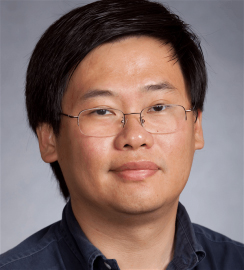
Melvin Leok
· ProfessorVerifiedUniversity of California, San Diego · Mathematics
Active 2004–2026
About
Melvin Leok received his Ph.D. in Control and Dynamical Systems from Caltech in 2004. Prior to joining UCSD in 2009, he was an assistant professor of mathematics at Purdue University, a visiting assistant professor of control and dynamical systems at the California Institute of Technology, and a T.H. Hildebrandt research assistant professor of mathematics at the University of Michigan, Ann Arbor. Leok's research is on computational geometric mechanics, which is an area of computational and applied mathematics with increasingly important applications to modern science and engineering. Leok's work uses a synthesis of differential geometric and numerical analysis techniques to provide long-time solutions to differential equations that are stable and robust, and thus provide methods for modeling and controlling modern engineering systems.
Research topics
- Mathematics
- Mathematical optimization
- Artificial Intelligence
- Computer Science
- Mathematical physics
- Applied mathematics
- Mathematical analysis
- Quantum mechanics
- Physics
- Engineering
Selected publications
Noether-Type Theorems and the Generalized Herglotz Principle in $q$-Contact Geometry
arXiv (Cornell University) · 2026-04-07
preprintOpen access1st authorCorrespondingWe develop a unified geometric framework for dissipative mechanical systems based on uniform $q$-contact manifolds, which provide an extended phase space equipped with multiple contact $1$-forms. Within this setting, we construct both Hamiltonian and Lagrangian formalisms and establish a generalized Noether-type theorem describing the relationship between symmetries and dissipated quantities. We further show that $q$-contact Lagrangian systems admit a genuine variational origin through a generalized Herglotz principle involving multiple action variables. The resulting $q$-contact Euler--Lagrange equations naturally depend on the scalar combination $\sum_{i=1}^q \partial L/\partial z_i$, reflecting the intrinsic structure of uniform $q$-contact geometry. We prove that this variational formulation is fully equivalent to the geometric $q$-contact Hamiltonian dynamics generated by the energy function. Several explicit examples involving multi-parameter dependent dynamics illustrate the effectiveness of the theory and demonstrate its potential to provide geometric insight into complex dissipative systems, thereby extending the scope of classical Lagrangian mechanics beyond symplectic and single-contact structures.
Noether-Type Theorems and the Generalized Herglotz Principle in $q$-Contact Geometry
arXiv (Cornell University) · 2026-04-07
articleOpen access1st authorCorrespondingWe develop a unified geometric framework for dissipative mechanical systems based on uniform $q$-contact manifolds, which provide an extended phase space equipped with multiple contact $1$-forms. Within this setting, we construct both Hamiltonian and Lagrangian formalisms and establish a generalized Noether-type theorem describing the relationship between symmetries and dissipated quantities. We further show that $q$-contact Lagrangian systems admit a genuine variational origin through a generalized Herglotz principle involving multiple action variables. The resulting $q$-contact Euler--Lagrange equations naturally depend on the scalar combination $\sum_{i=1}^q \partial L/\partial z_i$, reflecting the intrinsic structure of uniform $q$-contact geometry. We prove that this variational formulation is fully equivalent to the geometric $q$-contact Hamiltonian dynamics generated by the energy function. Several explicit examples involving multi-parameter dependent dynamics illustrate the effectiveness of the theory and demonstrate its potential to provide geometric insight into complex dissipative systems, thereby extending the scope of classical Lagrangian mechanics beyond symplectic and single-contact structures.
GeoEdit: Local Frames for Fast, Training-Free On-Manifold Editing in Diffusion Models
ArXiv.org · 2026-04-27
articleOpen accessSenior authorDiffusion models are a leading paradigm for data generation, but training-free editing typically re-runs the full denoising trajectory for every edit strength, making iterative refinement expensive. To address this issue, we instead edit near the data manifold, where small local updates can replace repeated re-synthesis. To enable this, we estimate a local manifold tangent space directly from perturbed samples and prove that this sample-based estimator closely approximates the true tangent. Building on this guarantee, we devise a Jacobian-free algorithm that constructs a tangent frame via small perturbations to the initial noise and alternates small tangent moves with diffusion-based projections. Updates within this frame follow principled on-manifold directions while suppressing off-manifold drift, enabling fine-grained edits without full re-diffusion or additional training. Edit strength is controlled by the number of steps for rapid, continuous adjustments that preserve fidelity and plug into existing samplers. Empirically, the resulting tangent directions yield smooth, semantic unsupervised traversals and effective CLIP-guided optimization, demonstrating practical interactive continuous editing.
Integration on q-Cosymplectic Manifolds
Journal of Nonlinear Science · 2026-05-20
articleOpen access1st authorAbstract This paper presents a unified framework for studying dynamics and integration on $$ q $$ <mml:math xmlns:mml="http://www.w3.org/1998/Math/MathML"> <mml:mi>q</mml:mi> </mml:math> -cosymplectic manifolds. After outlining the geometric foundations of $$ q $$ <mml:math xmlns:mml="http://www.w3.org/1998/Math/MathML"> <mml:mi>q</mml:mi> </mml:math> -cosymplectic structures, we derive new results concerning integrable systems and the characterization of Liouville coordinates and further investigate the Lie integrability of q -evolution systems in this setting. We then develop a Hamilton–Jacobi theory tailored to multi-time Hamiltonian systems, both from an intrinsic geometric perspective and via symplectification techniques. To illustrate the applicability of the framework, we construct a $$ q $$ <mml:math xmlns:mml="http://www.w3.org/1998/Math/MathML"> <mml:mi>q</mml:mi> </mml:math> -cosymplectic Hamiltonian model for an extended FitzHugh–Nagumo system, providing a biologically relevant example involving three distinct temporal scales.
Neural Configuration-Space Barriers for Manipulation Planning and Control
IEEE Transactions on Automation Science and Engineering · 2026-01-01
articlePlanning and control for high-dimensional robot manipulators in cluttered dynamic environments require computational efficiency and robust safety guarantees. Inspired by recent advances in learning configuration-space distance functions (CDFs) as representations of robot bodies, we propose a unified approach for motion planning and control that formulates safety constraints as CDF barriers. A CDF barrier approximates the local free configuration space, substantially reducing the number of collision-checking operations during motion planning. However, learning a CDF barrier with a neural network and relying on online sensor observations introduces uncertainties that must be considered during control synthesis. To address this, we develop a distributionally robust CDF barrier formulation for control that accounts for modeling errors and sensor noise without assuming a known underlying distribution. Simulations and hardware experiments on a UFactory xArm6 manipulator show that our neural CDF barrier formulation enables efficient planning and robust safe control in cluttered and dynamic environments, relying only on onboard point-cloud observations.
GeoEdit: Local Frames for Fast, Training-Free On-Manifold Editing in Diffusion Models
arXiv (Cornell University) · 2026-04-27
preprintOpen accessSenior authorDiffusion models are a leading paradigm for data generation, but training-free editing typically re-runs the full denoising trajectory for every edit strength, making iterative refinement expensive. To address this issue, we instead edit near the data manifold, where small local updates can replace repeated re-synthesis. To enable this, we estimate a local manifold tangent space directly from perturbed samples and prove that this sample-based estimator closely approximates the true tangent. Building on this guarantee, we devise a Jacobian-free algorithm that constructs a tangent frame via small perturbations to the initial noise and alternates small tangent moves with diffusion-based projections. Updates within this frame follow principled on-manifold directions while suppressing off-manifold drift, enabling fine-grained edits without full re-diffusion or additional training. Edit strength is controlled by the number of steps for rapid, continuous adjustments that preserve fidelity and plug into existing samplers. Empirically, the resulting tangent directions yield smooth, semantic unsupervised traversals and effective CLIP-guided optimization, demonstrating practical interactive continuous editing.
Variational principles for Hamiltonian systems
Geometric Mechanics · 2025-03-01
articleSenior authorMotivated by recent developments in Hamiltonian variational principles, Hamiltonian variational integrators, and their applications such as to optimization and control, we present a new Type II variational approach for Hamiltonian systems, based on a virtual work principle that enforces the Type II boundary conditions through a combination of essential and natural boundary conditions; particularly, this approach allows us to define this variational principle intrinsically on manifolds. We first develop this variational principle on vector spaces and subsequently extend it to parallelizable manifolds, general manifolds, as well as to the infinite-dimensional setting. Furthermore, we provide a review of variational principles for Hamiltonian systems in various settings as well as their applications.
q-Cosymplectic Geometry, Integrability and Reduction
ArXiv.org · 2025-09-07
preprintOpen access1st authorCorrespondingIn the present paper, we define the concept of a \( q \)-cosymplectic manifold, on which we study the Hamiltonian, gradient, local gradient, and \( q \)-evolution vector fields. Several Liouville--Arnold-type theorems and a \( q \)-cosymplectic Marsden--Weinstein reduction theorem are established. We also provide physical examples illustrating the application of the structure to multitime dynamics (Fast-slow dynamical system). To make our work more self-contained, we include detailed proofs for some results that may resemble those known for cosymplectic manifolds.
Lie Group Variational Collision Integrators for a Class of Hybrid Systems
SIAM Journal on Applied Dynamical Systems · 2025-05-14 · 1 citations
articleSenior authorA Type II Hamiltonian Variational Principle and Adjoint Systems for Lie Groups
Journal of Dynamical and Control Systems · 2025-02-15
articleOpen accessSenior authorWe present a novel Type II variational principle on the cotangent bundle of a Lie group which enforces Type II boundary conditions, i.e., fixed initial position and final momentum. In general, such Type II variational principles are only globally defined on vector spaces or locally defined on general manifolds; however, by left translation, we are able to define this variational principle globally on cotangent bundles of Lie groups. Type II boundary conditions are particularly important for adjoint sensitivity analysis, which is our motivating application. As such, we additionally discuss adjoint systems on Lie groups, their properties, and how they can be used to solve optimization problems subject to dynamics on Lie groups.
Recent grants
Collaborative Research: Ergodic Trajectories in Discrete Mechanics
NSF · $195k · 2013–2017
CAREER: Computational Geometric Mechanics: Foundations, Computation, and Applications
NSF · $425k · 2009–2015
LTB: Generalized Variational Integrators for Large-Scale Scientific Computation
NSF · $131k · 2009–2011
LTB: Generalized Variational Integrators for Large-Scale Scientific Computation
NSF · $164k · 2007–2010
CAREER: Computational Geometric Mechanics: Foundations, Computation, and Applications
NSF · $202k · 2008–2010
Frequent coauthors
- 81 shared
Taeyoung Lee
- 77 shared
N. Harris McClamroch
- 15 shared
Jerrold E. Marsden
- 13 shared
Valentin Duruisseaux
- 12 shared
Evan S. Gawlik
- 12 shared
Brian Tran
- 12 shared
Diana Sosa
- 11 shared
Nikolay Atanasov
Education
- 2004
Ph.D., Control and Dynamical Systems
California Institute of Technology
- 2000
M.S., Mathematics
California Institute of Technology
- 2000
B.S. (honors), Mathematics
California Institute of Technology
Awards & honors
- Simons Fellowship in Mathematics
- DoD Newton Award for Transformative Ideas
- National Academy of Sciences Kavli Frontiers of Science Fell…
- NSF CAREER Award
- SciCADE New Talent Award
- Resume-aware match score
- Save to shortlist
- AI-drafted outreach
See your match with Melvin Leok
PhdFit ranks faculty by your research interests, methods, and publications — grounded in their actual work, not templates.
- Free to start
- No credit card
- 30-second signup