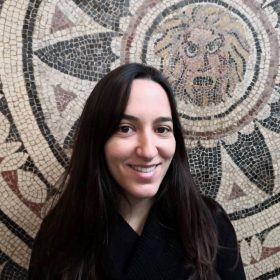
Adriana Vazquez
· Assistant Professor of ClassicsVerifiedUniversity of California, Los Angeles · Classics
Active 2020–2024
About
Adriana Vazquez received her BA and MA in Classics from Stanford University in 2009 and 2010, respectively, and completed her Ph.D. in Classics at the University of Washington, Seattle, in 2017. She joined the Department of Classics at UCLA upon completing her degree. Her research interests originate in the poetry of the Augustan period, with a particular focus on its interactions with other texts. Currently, her research concentrates on the reception of Latin literature in lusophone and hispanophone literature of the 17th and 18th centuries. Her current book project, tentatively titled Arcadia Ultramarina: Studies in the Neoclassical Literature of Portuguese America, explores the cultural production of the Arcadia Ultramarina, a literary academy working in colonial Brazil in the second half of the 18th century. She is especially interested in questions of bilingual intertextuality and literature produced under colonial conditions. In addition to this project, she is engaged in a collaborative effort to produce a critical edition and the first English translation of José de Anchieta’s Latin epic De Gestis Mendi de Saa (1560), which is contracted to be published in the Brill Jesuit Studies series. Adriana Vazquez is also the cofounder of Hesperides: Classics in the Luso-Hispanic World, a scholarly interest group focusing on Classical legacies in the Ibero-global world. She has co-organized panels and workshops at major conferences for organizations such as the Society for Classical Studies, the Renaissance Society of America, the Society for Renaissance and Baroque Hispanic Poetry, and the Fédération Internationale des associations d'études classiques.
Research signals
Five dimensions sourced from public faculty / publication signals. Sign in to compare against your own profile and see your match score.
Research topics
- Sociology
- Humanities
- Literature
- Political Science
- Art
- Philosophy
- Art history
- Classics
- Law
- History
- Epistemology
- Linguistics
- Physics
- Theology
- Astrobiology
Selected publications
TAPA · 2024 · 1 citations
1st authorCorresponding- Sociology
- Literature
- Philosophy
summary: This article considers the adaptation of mystery cult language and discursive modes to the erotodidactic program of Ovid’s Ars amatoria , with a special focus on the sustained engagement with cult of Ars am . 2.601–40. In this passage, Ovid introduces the concept of cult secrecy in a lesson in erotic discretion, inviting a reconsideration of the intimacies available to elegy on the model of the cultic. Ovid’s engagement with cult terminology has implications for the epistemic entailments of the erotic, the figure of Ovid’s teacher-poet as a hierophant, and the consideration of his poem as a hieros logos .
International Journal of the Classical Tradition · 2022 · 1 citations
1st authorCorresponding- Humanities
- Literature
- Art
Antiquities and Classical Traditions in Latin America ed. by Andrew Laird and Nicola Miller
The American Journal of Philology · 2020
1st authorCorresponding- Political Science
- Classics
- History
Reviewed by: Antiquities and Classical Traditions in Latin America ed. by Andrew Laird and Nicola Miller Adriana Vazquez Andrew Laird and Nicola Miller, eds. Antiquities and Classical Traditions in Latin America. London: Wiley, 2018. 240 pp. Paper, $35.00. Recent trends in classical reception studies have begun to shift beyond Europe and the culture of its elites, with Latin America as one area of especially energetic scholarly interest. This volume, the result of a 2016 colloquium hosted at the Warburg Institute in London titled "Classical Traditions in Latin American History," advances this burgeoning discourse by presenting discrete studies in the classical traditions present throughout Latin America. The ideological approach that is the organizing principle of the volume is especially progressive for its concerted interest in decolonizing the legacies of classical antiquity and its reception. Where classical reception studies have established robust lines of inquiry concerning the "different ways in which early modern views of antiquity shaped European responses to the New World," as summarized in the preface, this volume focuses on the traditions that emerged from within Latin America itself, shaped by or adapting classical antiquity. The scope of the contributions, taken altogether, is admirably ambitious and exceptionally rich, especially for how slim a volume it is at 240 pages: the studies included in the volume, arranged chronologically, variously examine material beginning in the 1500s and culminating in the 20th century, with a wide-ranging geographic span that includes Argentina, Puerto Rico, Paraguay, Cuba, Nicaragua, Mexico, and Chile, to name just a few countries. This sprawling overview of time period and geographic area provides convincing testimony of the "many vibrant classical traditions all over Spanish America" and its relevance for classicists (Cañizares-Esguerra, "Envoi," 198), thus firmly establishing the premises required for further research and, consequently, accomplishing one of the tasks set out by the editors in the preface to the volume, namely the integration of Latin American cultural production into global intellectual and cultural history. Such breadth of scope runs the risk of flattening the rich distinctions between Latin American cultures and time periods, but because the majority of the contributions are focused in subject and concise in argument, a sense for various distinct classical traditions and for subtle differences between regions and cultures emerges from the case studies. The volume simultaneously generates a view for some of the general characteristics common to a pan-Latin American engagement with the classics that can be set in contrast to other global regions and a trajectory of a diachronic evolution between earlier and later stages of engagement. There is a clear prioritization throughout the volume of bringing attention to historically marginalized presences while acknowledging that encoded behind the scholarly inquiry central to the project are historical processes predicated upon suppression, conquest, and colonization. Nicola Miller's contribution, eschewing elite cultural production exemplified by epic poetry, historical writing, and political thought, analyzes the classical references of popular poetry, sayings, and song, with examples from Argentina, Cuba, and Chile, to demonstrate how "marginalised groups deployed classical references both to debate and dispute [End Page 136] creole visions of the future of their nations" (146) in a learned double-speak that appropriated classical references for distinct aims. Miller's analysis concludes with a nuanced reading that places this cultural production "in between the conventional poles of opposition and acceptance" (154). Andrew Laird's analysis of the local histories of three indigenous Mexican chroniclers who used classical references as a means of "affirming a global value for their histories" (100) elevates the writings of indigenous thinkers as working within but also rivaling traditions of European antiquarian learning. Where elite or European cultural production is the focus of study, the approach is one that thoughtfully complicates familiar reception narratives. Desiree Arbo demonstrates that the 18th-century treatise of the Catalan José Manuel Peramás comparing the Jesuit mission in Paraguay to the ideal society projected in Plato's Republic functioned to "[present] the indigenous communities in the missions as ordered societies . . . composed of active and intelligent citizens" (121) within broader debates concerning identity, nation, and the condition of the indigenous. Similarly, Stuart McManus documents the transmission of Greco-Roman theories and...
Education
- 2017
Ph.D., Classics
University of Washington
- 2010
M.A., Classics
Stanford University
- 2009
B.A., Classics
Stanford University
Similar researchers at University of California, Los Angeles
- Resume-aware match score
- Save to shortlist
- AI-drafted outreach
See your match with Adriana Vazquez
PhdFit ranks faculty by your research interests, methods, and publications — grounded in their actual work, not templates.
- Free to start
- No credit card
- 30-second signup