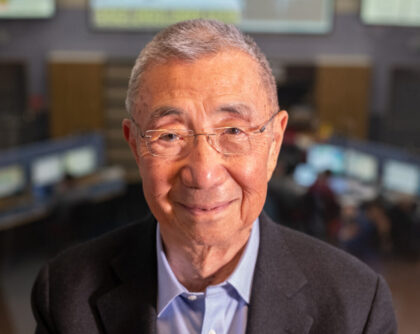
Samuel C.C. Ting
VerifiedMassachusetts Institute of Technology · Physics
Active 1966–2024
Research topics
- Astrophysics
- Physics
- Astronomy
- Nuclear physics
- Optics
Selected publications
Properties of Iron Primary Cosmic Rays: Results from the Alpha Magnetic Spectrometer
Physical Review Letters · 2021 · 111 citations
- Physics
- Nuclear physics
- Astrophysics
We report the observation of new properties of primary iron (Fe) cosmic rays in the rigidity range 2.65 GV to 3.0 TV with 0.62×10^{6} iron nuclei collected by the Alpha Magnetic Spectrometer experiment on the International Space Station. Above 80.5 GV the rigidity dependence of the cosmic ray Fe flux is identical to the rigidity dependence of the primary cosmic ray He, C, and O fluxes, with the Fe/O flux ratio being constant at 0.155±0.006. This shows that unexpectedly Fe and He, C, and O belong to the same class of primary cosmic rays which is different from the primary cosmic rays Ne, Mg, and Si class.
Physics Reports · 2020 · 421 citations
- Physics
- Nuclear physics
- Astrophysics
The Alpha Magnetic Spectrometer (AMS) is a precision particle physics detector on the International Space Station (ISS) conducting a unique, long-duration mission of fundamental physics research in space. The physics objectives include the precise studies of the origin of dark matter, antimatter, and cosmic rays as well as the exploration of new phenomena. Following a 16-year period of construction and testing, and a precursor flight on the Space Shuttle, AMS was installed on the ISS on May 19, 2011. In this report we present results based on 120 billion charged cosmic ray events up to multi-TeV energies. This includes the fluxes of positrons, electrons, antiprotons, protons, and nuclei. These results provide unexpected information, which cannot be explained by the current theoretical models. The accuracy and characteristics of the data, simultaneously from many different types of cosmic rays, provide unique input to the understanding of origins, acceleration, and propagation of cosmic rays.
Frequent coauthors
- 801 shared
K.L. Tung
- 775 shared
A.A. Vorobyov
- 771 shared
U. Becker
European Organization for Nuclear Research
- 677 shared
G.G.G. Massaro
FHNW University of Applied Sciences and Arts
- 676 shared
W. Krenz
- 646 shared
R. Y. Zhu
- 633 shared
J.D. Burger
Massachusetts Institute of Technology
- 615 shared
W. Lohmann
- Resume-aware match score
- Save to shortlist
- AI-drafted outreach
See your match with Samuel C.C. Ting
PhdFit ranks faculty by your research interests, methods, and publications — grounded in their actual work, not templates.
- Free to start
- No credit card
- 30-second signup