Al Tillery
· Professor of Political ScienceVerifiedNorthwestern University · Comparative and Historical Social Science
Active 1999–2025
About
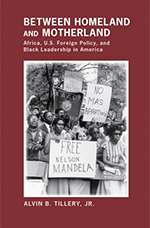
Alvin B. Tillery, Jr. is a Professor of Political Science and the Director of the Center for the Study of Diversity and Democracy at Northwestern University. His research and teaching interests are in the fields of American politics and political theory, with a focus on racial and ethnic politics, American political development, and social movements. His work in political theory concentrates on American political thought and critical race theory. Professor Tillery authored the book 'Between Homeland and Motherland: Africa, U.S. Foreign Policy and Black Leadership in America,' which received the W.E.B. Du Bois Distinguished Book Award from the National Conference of Black Political Scientists. His scholarly articles have been published in prominent journals such as the American Political Science Review, Studies in American Political Development, Political Research Quarterly, and the Journal of Black Studies. As the founding director of the Center for the Study of Diversity and Democracy, he has contributed significantly to the academic exploration of diversity, democracy, and race in American politics.
Research signals
Five dimensions sourced from public faculty / publication signals. Sign in to compare against your own profile and see your match score.
Research topics
- Political Science
- Law
- Sociology
- History
- Art
- Aesthetics
- Gender studies
- Public administration
- Political economy
Selected publications
The Journal of Race Ethnicity and Politics · 2025-12-11
articleOpen accessSenior authorAbstract Do appeals to Black voters necessarily detract white voters from supporting the left? Extant studies have yielded mixed answers to this question by examining voter turnout data. We use two survey experiments to test how framing politicians as either supportive of or hostile to the #BlackLivesMatter (BLM) and #SayHerName (SHN) movements affected the willingness of voters to support them during the 2020 Senate runoff elections in Georgia. We find that Democratic-leaning respondents in both a national sample of Black respondents and a sample of White respondents in Georgia were more likely to support politicians whom we framed as supportive of the BLM and SHN movements. These findings illustrate the potential potency of messaging strategies grounded in racial justice themes for mobilizing Democratic-leaning voters in American elections.
The #BlackLivesMatter Movement and Black Public Opinion
Cambridge University Press eBooks · 2023
1st authorCorresponding- Political Science
- Political Science
- History
Hundreds of grassroots protests have taken place across the United States under the banner of #BlackLivesMatter (BLM) movement since 2013. These protests were frequently animated by populist rhetoric that questioned both the performance of elected officials, chided the middle class for leaving the poor behind, and rejected the "respectability politics" that defined earlier movements for racial justice. In short, the core activists of the BLM movement are attempting to invent a new fiction of African American peoplehood that "centers the most marginal" members of the community. This chapter examines the extent to which the rise of the BLM movement has generated fissures in African American public opinion. The main finding is that public opinion on the effectiveness of the BLM movement is segmented by age, gender, and income.
Race and the Bully Pulpit: The U.S. Presidency and the Quest of Equality in America
The Journal of Race Ethnicity and Politics · 2021-10-28
articleSenior authorCorrespondingAn abstract is not available for this content. As you have access to this content, full HTML content is provided on this page. A PDF of this content is also available in through the ‘Save PDF’ action button.
Harvard Dataverse · 2020-01-01
datasetOpen accessSenior author:unav
Harvard Dataverse · 2020-01-01
datasetOpen accessSenior author:unav
Harvard Dataverse · 2020-01-01
datasetOpen accessSenior author:unav
Harvard Dataverse · 2020-01-01
datasetOpen accessSenior author:unav
Harvard Dataverse · 2020-01-01
datasetOpen accessSenior author:unav
Routledge eBooks · 2020 · 7 citations
1st authorCorresponding- Political Science
- Political Science
- Public administration
The social media and microblogging site Twitter has emerged as both a vehicle for political expression and a powerful tool for political organizing within the African American community. This paper examines the extent to which members of the Congressional Black Caucus (CBC) utilize Twitter to communicate with their constituents about racial issues. An analysis of CBC members’ tweets during the 113th Congress (2013–2014) shows that the organization’s members do talk about race and occasionally use racially distinct hashtags. Moreover, statistical analyses show that the best predictors of a CBC members’ engagement with racial issues on Twitter are being a woman legislator, the size of their margin of victory in the 2012 elections, and the percentage of whites living within the boundaries of their district.
Harvard Dataverse · 2020-01-01
datasetOpen accessSenior author:unav
Frequent coauthors
- 65 shared
Tabitha Bonilla
Northwestern University
- 4 shared
Juliet Hooker
Brown University
- 2 shared
Hanes Walton
- 2 shared
Leah Wright-Rigueur
Johns Hopkins University
- 2 shared
Josephine A. V. Allen
- 1 shared
Christina M. Greer
Fordham University
- 1 shared
Jessica Franklin
- 1 shared
Dianne M. Pinderhughes
University of Notre Dame
Education
- 1992
Ph.D., Political Science
University of Chicago
- 1987
M.A., Political Science
University of Chicago
- 1984
B.A., Political Science
University of California, Los Angeles
Awards & honors
- W.E.B. Du Bois Distinguished Book Award from the National Co…
- Resume-aware match score
- Save to shortlist
- AI-drafted outreach
See your match with Al Tillery
PhdFit ranks faculty by your research interests, methods, and publications — grounded in their actual work, not templates.
- Free to start
- No credit card
- 30-second signup