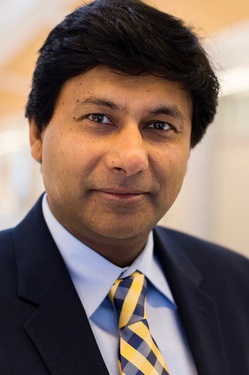
Amit Misra
VerifiedUniversity of Michigan · Materials Science and Engineering
Active 1973–2026
About
Amit Misra is the Edward DeMille Campbell Collegiate Professor of Materials Science and Engineering at the University of Michigan. His profile indicates his role within the Michigan Materials Science and Engineering Group, where he is involved in research related to materials science and engineering. The page provides detailed information about his group members, research staff, and students, but does not include specific details about his research focus, background, or key contributions. Therefore, no further biographical or research content is available from the provided page text.
Research topics
- Thermodynamics
- Physics
- Metallurgy
- Condensed matter physics
- Materials science
- Composite material
- Mathematics
- Optics
- Geometry
- Crystallography
Selected publications
Austenite phase evolution in duplex stainless steels printed using laser directed energy deposition
MRS Communications · 2026-04-17
articleOpen accessSenior authorAbstract Direct energy deposition–laser beam (DED-LB) was performed using duplex stainless steel (DSS) 2507 powders. Single and multilayer samples were printed to determine how reheating from additional layers affects austenite formation. Unlike laser powder bed fusion (PBF-LB) of DSS producing negligible austenite, DED-LB-printed DSS exhibited ~ 20% austenite in the single layer that increased to ~ 25% after printing subsequent layers. Transient-thermal numerical simulations and thermodynamic calculations were performed to predict phase formation. The calculations suggest that the increased austenite is due to solid-state (ferrite to austenite) phase formation after solidification and subsequent reheating followed by relatively slower cooling rates. Graphical abstract
The Road to SDV: A Maturity Model for Software-Defined Transformation
SAE technical papers on CD-ROM/SAE technical paper series · 2026-01-16
article<div class="section abstract"><div class="htmlview paragraph">Software Defined Vehicles (SDV), Software Defined Networks (SDN), Software Defined (Power) Grids (SDG) are just a few examples of how the Software Defined Transformation is unfolding across many industries today (collectively being referred to as Software Defined X – SDX). This paper defines a maturity model for Software Defined Transformation and evaluates different industries including Automotive on their evolution so far. This cross-industry view of SDX helps in analyzing where SDV’s could be headed.</div><div class="htmlview paragraph">A 2020 paper [<span class="xref">1</span>] lays out the complexity of the automotive software, with companies pursuing several directions in this transformation. The automotive industry has not yet reached a consensus on the direction it is taking on SDV. While companies like Tesla are already making software centric cars, traditional OEMs like General Motors, Toyota, Ford etc. are making huge investments and redefining their business models, tech stacks and operations to leverage the power of software. There is an opportunity to introduce an overarching framework to compare SDX across industries. We propose a three-step “Define-Evaluate-Forecast” Framework</div><div class="htmlview paragraph">We “Define” a multi-dimensional SDX Maturity Model around three strategic areas: Technical/Product, Operating Model and Business/Financial. Technical areas include State of the Architecture, Reusable Innovation Enablers and level of Autonomy &amp; Abstraction between Hardware and Software. Operational parameters considered are Organization Alignment for Software, Availability/Adoption of Regulations &amp; Standards. Business aspects include Customer Experience, Ecosystem value proposition, Total Cost of Product &amp; Ownership, Return on Investment.</div><div class="htmlview paragraph">We “Evaluate” similar traditional industries like Telecom, Storage, Power Grid and score them per the SDX maturity levels, accounting for their differences in complexity.</div><div class="htmlview paragraph">We “Forecast” the course for Software Defined Vehicle over this decade and the next, based on the observations, analysis and understanding of the journey of the other industries.</div><div class="htmlview paragraph">This paper studies the evolving software defined transformation across several industries and provides a “Define-Evaluate-Forecast” framework to compare them and prognosticate the future of SDV, leveraging the advancements and learnings from other industries.</div></div>
Correction: Materials laboratories of the future for alloys, amorphous, and composite materials
MRS Bulletin · 2025-02-28
articleOpen accessBroadening the impact of MRS Bulletin
MRS Bulletin · 2025-12-15
articleOpen access1st authorCorrespondingMaterials Science and Engineering A · 2025-03-17 · 4 citations
articleOpen accessSenior authorTransmission or reflection of a glide dislocation at interphase boundaries
Scripta Materialia · 2025-10-28 · 2 citations
articleCorrespondingnpj Computational Materials · 2025-11-27 · 1 citations
articleOpen accessPrediction of solute clustering kinetics in aged multicomponent alloys requires a quantitative understanding of complex vacancy-cluster interactions across multiple scales. Here, we develop an integrated computational framework combining on-lattice kinetic Monte Carlo (KMC) simulations, absorbing Markov chain models, and mesoscale cluster dynamics (CD) to investigate these interactions in Al-Mg-Zn alloys. The Markov chain model yields vacancy escape times from solute clusters and identifies a two-stage behavior of the vacancy-cluster binding energy. These binding energies are used to estimate residual vacancy concentrations in the Al matrix after quenching, which serve as critical inputs to CD simulations to predict long-term cluster evolution kinetics during natural aging. Our results quantitatively demonstrate the significant impact of quench rate on natural aging kinetics. Results provide insights to guide alloy chemistry, quench rates, and aging time at finite temperatures to control the evolution of solute clusters and eventual precipitates in aged multicomponent alloys.
Journal of Nuclear Materials · 2025-01-18 · 3 citations
articleOpen accessWe investigate the effect of high-temperature helium (He) implantation on microstructural evolution in physical-vapor-co-deposited nanocomposite thin films of copper (Cu) and molybdenum (Mo). The microstructure morphologies of He-implanted and He-free domains are characterized using transmission electron microscopy and statistical analysis. High implantation temperatures (500 °C and 750 °C) lead to coarsening of Cu and Mo domains and their eventual reorientation. The microstructure evolution in He-implanted and He-free domains is comparable, indicating that implantation-induced defects do not accelerate the coarsening of the nanocomposite as compared to annealing alone. This observation contrasts with previously reported effects of implantation-induced defects on single-phase nanocrystalline metals , which include enhancement of grain growth by increasing self-diffusivity or its inhibition by pinning of grain boundaries.
Materials laboratories of the future for alloys, amorphous, and composite materials
MRS Bulletin · 2025-01-29 · 4 citations
articleOpen accessAbstract In alignment with the Materials Genome Initiative and as the product of a workshop sponsored by the US National Science Foundation, we define a vision for materials laboratories of the future in alloys, amorphous materials, and composite materials; chart a roadmap for realizing this vision; identify technical bottlenecks and barriers to access; and propose pathways to equitable and democratic access to integrated toolsets in a manner that addresses urgent societal needs, accelerates technological innovation, and enhances manufacturing competitiveness. Spanning three important materials classes, this article summarizes the areas of alignment and unifying themes, distinctive needs of different materials research communities, key science drivers that cannot be accomplished within the capabilities of current materials laboratories, and open questions that need further community input. Here, we provide a broader context for the workshop, synopsize the salient findings, outline a shared vision for democratizing access and accelerating materials discovery, highlight some case studies across the three different materials classes, and identify significant issues that need further discussion. Graphical abstract
High strength ultrafine eutectic composites with metastable intermetallic phases
Journal of Material Science and Technology · 2025-04-04 · 5 citations
articleOpen accessSenior authorCorresponding
Recent grants
Frequent coauthors
- 97 shared
Jian Wang
University of Nebraska–Lincoln
- 96 shared
Nan Li
Air Force Medical University
- 84 shared
Nathan A. Mara
- 73 shared
R.G. Hoagland
Los Alamos National Laboratory
- 69 shared
Jon K. Baldwin
- 56 shared
M. Nastasi
Texas A&M University
- 54 shared
Michael J. Demkowicz
- 50 shared
X. Zhang
Purdue University West Lafayette
Labs
Van Vlack LabPI
Education
- 1994
PhD, Materials Science and Engineering
University of Michigan
Awards & honors
- TMS Cyril Stanley Smith Award, 2021
- Fellow, AAAS (American Association for the Advancement of Sc…
- Brimacombe Medalist, The Minerals, Metals and Materials Soci…
- Fellow, Materials Research Society (MRS), Class of 2016
- DISTINGUISHED SERVICE AWARD, The Minerals, Metals and Materi…
- Resume-aware match score
- Save to shortlist
- AI-drafted outreach
See your match with Amit Misra
PhdFit ranks faculty by your research interests, methods, and publications — grounded in their actual work, not templates.
- Free to start
- No credit card
- 30-second signup