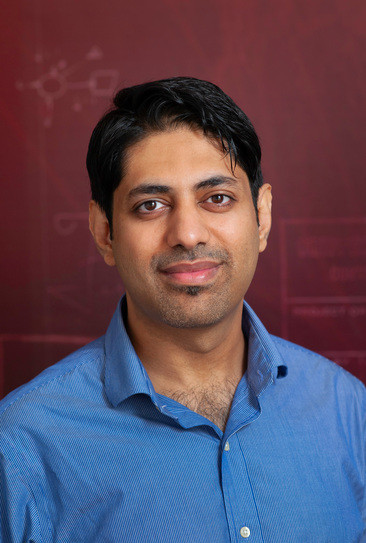
Ali Anwar
· nullVerifiedUniversity of Minnesota
Research signals
Five dimensions sourced from public faculty / publication signals. Sign in to compare against your own profile and see your match score.
Research topics
- Computer Science
- Artificial Intelligence
- Machine Learning
- Computer Security
- Distributed computing
- Computer network
- Operating system
- Embedded system
- Database
Selected publications
2021 · 126 citations
- Computer Science
- Computer Science
- Distributed computing
Federated learning (FL) involves training a model over massive distributed devices, while keeping the training data localized and private. This form of collaborative learning exposes new tradeoffs among model convergence speed, model accuracy, balance across clients, and communication cost, with new challenges including: (1) straggler problem---where clients lag due to data or (computing and network) resource heterogeneity, and (2) communication bottleneck---where a large number of clients communicate their local updates to a central server and bottleneck the server. Many existing FL methods focus on optimizing along only one single dimension of the tradeoff space. Existing solutions use asynchronous model updating or tiering-based, synchronous mechanisms to tackle the straggler problem. However, asynchronous methods can easily create a communication bottleneck, while tiering may introduce biases that favor faster tiers with shorter response latencies.
Large-Scale Analysis of Docker Images and Performance Implications for Container Storage Systems
IEEE Transactions on Parallel and Distributed Systems · 2020 · 59 citations
- Computer Science
- Computer Science
- Operating system
Docker containers have become a prominent solution for supporting modern enterprise applications due to the highly desirable features of isolation, low overhead, and efficient packaging of the application’s execution environment. Containers are created from images which are shared between users via a registry. The amount of data registries store is massive. For example, Docker Hub, a popular public registry, stores at least half a million public images. In this article, we analyze over 167 TB of uncompressed Docker Hub images, characterize them using multiple metrics and evaluate the potential of file-level deduplication. Our analysis helps to make conscious decisions when designing storage for containers in general and Docker registries in particular. For example, only 3 percent of the files in images are unique while others are redundant file copies, which means file-level deduplication has a great potential to save storage space. Furthermore, we carry out a comprehensive analysis of both small I/O request performance and copy-on-write performance for multiple popular container storage drivers. Our findings can motivate and help improve the design of data reduction and caching methods for images, pulling optimizations for registries, and storage drivers.
TiFL: A Tier-based Federated Learning System
2020 · 308 citations
- Computer Science
- Computer Science
- Machine Learning
Federated Learning (FL) enables learning a shared model acrossmany clients without violating the privacy requirements. One of the key attributes in FL is the heterogeneity that exists in both resource and data due to the differences in computation and communication capacity, as well as the quantity and content of data among different clients. We conduct a case study to show that heterogeneity in resource and data has a significant impact on training time and model accuracy in conventional FL systems. To this end, we propose TiFL, a Tier-based Federated Learning System, which divides clients into tiers based on their training performance and selects clients from the same tier in each training round to mitigate the straggler problem caused by heterogeneity in resource anddata quantity. To further tame the heterogeneity caused by non-IID (Independent and Identical Distribution) data and resources, TiFL employs an adaptive tier selection approach to update the tiering on-the-fly based on the observed training performance and accuracy. We prototype TiFL in a FL testbed following Google's FL architecture and evaluate it using the state-of-the-art FL benchmarks. Experimental evaluation shows that TiFL outperforms the conventional FL in various heterogeneous conditions. With the proposed adaptive tier selection policy, we demonstrate that TiFL achieves much faster training performance while achieving the same or better test accuracy across the board.
- Resume-aware match score
- Save to shortlist
- AI-drafted outreach
See your match with Ali Anwar
PhdFit ranks faculty by your research interests, methods, and publications — grounded in their actual work, not templates.
- Free to start
- No credit card
- 30-second signup