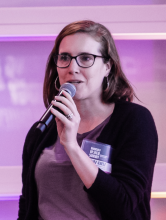
Amy Hurst
· Professor of Occupational Therapy and Integrated Digital Media; Director of Ability ProjectVerifiedNew York University · Occupational Therapy
Active 1996–2026
About
Amy Hurst is an Associate Professor with a joint appointment in the Department of Occupational Therapy at NYU Steinhardt and the Department of Technology, Culture and Society at the Tandon School of Engineering. She is the director of the Ability Project, an interdisciplinary research space dedicated to exploring the intersection between disability and technology. Dr. Hurst holds an M.S. and Ph.D. in Human-Computer Interaction from the HCII at Carnegie Mellon University and a B.S. in Computer Science from the Georgia Institute of Technology. Her research focuses on understanding social problems and identifying opportunities for technology to empower individuals impacted by those issues. She employs qualitative methods to analyze environments, design and build technology that fits within environmental constraints, and evaluate these technologies with target users. Her work sits at the intersection of assistive technology, interaction design, and engineering education, contributing to the development of innovative solutions to improve accessibility and inclusion.
Research topics
- Computer Science
- Human–computer interaction
- Multimedia
- Engineering
- World Wide Web
- Electrical engineering
- Artificial Intelligence
- Computer graphics (images)
- Sociology
- Medicine
- Psychology
- Art
- Mathematics education
- Software engineering
- Speech recognition
- Pedagogy
- Neuroscience
- Physics
- Mathematics
- Embedded system
- Visual arts
Selected publications
OSF Preprints (OSF Preprints) · 2026-04-25
otherThe overarching aim of this line of research is to learn from autistic adolescents how to effectively engage neurodivergent youth in informal STEM learning opportunities that promote self-efficacy, self-determination, and self-advocacy skills that will empower them to seek out career opportunities aligned with their interests and skills. The pilot randomized trial that we are using to assess a Game Design and Employment Workshop this summer (2023) builds upon two summers of quasi-experimental assessments of prior game design workshops (in 2021 and 2022; which were each pre-registered separately before each workshop began). This pre-registration focuses on a randomized assessment of two versions of a Game Design and Employment workshop that will be conducted this summer (2023).
DIY in Action: Understanding Do-It-Yourself Practices from Tangible Symbol Cards
2025-10-22
articleSenior authorDo-It-Yourself (DIY) assistive technology can be better suited to the needs of people with disabilities than commercial ‘off-the-shelf’ devices. Yet, DIY practices conventionally involve barriers to entry that can dissuade or intimidate practitioners. Tangible symbols (TS) are low-tech augmentative and alternative communication (AAC) products with a history of practitioners working alongside end-users to DIY. In this paper, we study the enthusiasm and practice of DIY with TS. We present results from an initial investigation into DIY practices by practitioners that use TS. We analyze survey data collected by Brady et al. (2025) from 107 respondents, and 73 self-reported customizing their TS products to meet the needs and contexts of the individuals they serve. We share the survey self-reported motivations for engaging in DIY activities. We find that this data offers evidence that there is sustained enthusiasm in DIY with TS by practitioners. We reflect on these findings and draw connections between DIY and assistive technology abandonment, and how commercial products can be designed to support DIY practice. The use of DIY by practitioners signals both a desire to further integrate DIY into their profession, and an interest in future assistive technology products that employ a similar DIY-centered design framework.
An exploration of students’ experiences of participating in a photovoice project
Research in Autism · 2025-08-30 · 1 citations
articleAn Accessible Solution to Unlock Museums
Communications of the ACM · 2024-10-03 · 1 citations
article1st authorCorresponding"Different and Boundary-Pushing:" How Blind and Low Vision Youth Live Code Together
Creativity and Cognition · 2024-06-22 · 5 citations
articleSenior authorLive coding, or real-time algorithmic performance, is a rich medium for engaging novices in informal creative STEM learning. However, despite inclusive and open-source communities, disabled practitioners are underrepresented in live coding, and prior work highlights numerous accessibility barriers. To understand the perspectives of Blind and Low Vision (BLV) live coders, we formed FiLOrk (Fil Laptop Orchestra) with five BLV teens. Across two semesters, FiLOrk performed three original works, each guided by a core concept and improvisational structure for manipulating code and maintaining shared awareness. We interviewed four musicians to understand how they felt about the learning environment and how their creative identities formed individually and in relation to one another. We reflect on FiLOrk’s outcomes and propose strategies for future live coding ensembles to meaningfully include novices with and without disabilities.
The Impact of participating in an Afterschool Professional Training Program on Youth Employees
2024-02-07
articleOpen accessSenior authorAfterschool professional training programs for youth can provide valuable opportunities to learn hands-on real-world technical and social skills while earning income. Understanding how to design, implement, and evaluate these programs can inform future innovative ways to engage youth in technology-rich learning and motivate them to pursue technical career pathways. Furthermore, it is important to understand how youth experience these programs and reflect on their own learning. In this study, we collaborated with a community-organization providing technology-rich learning experiences for youth to setup an afterschool professional training program involving running a 3D printshop for youth focused on digital modeling and fabrication. Over two years, two cohorts of youth (a total of 12 participants) participated in the project and worked at the 3D printshop at tasks that included interacting with clients from the local community, completing 3D modeling and 3D printing tasks, maintaining digital fabrication equipment, and representing the printshop at different outreach events. In this paper, we report on findings from qualitative exit interviews with the youth and focus on understanding the impact of participating in the program from their perspectives. The results show a range of motivations for youth to interview for the experience, including family and peer support, interest in learning skills, affinity for the organization, and desire for income. Additionally, we found that the experience increased youths’ confidence in their ability to pursue technical careers, including those in digital fabrication, engineering, and management, and demonstrated a career path that can be both technical and rewarding. Youth also described learning how to effectively troubleshoot different issues and collaborate with others to address problems as skills they gained during the program. Finally, youth described how their communication skills and ability to work in a team had significantly improved through the program and described how specialized roles helped them stay motivated and engaged by learning new skills during their experience. We conclude with several recommendations for creating similar future professional development programs for youth.
2024-12-28 · 1 citations
articleSenior authorLive coding is a performance art in which media, commonly music and video, are generated and manipulated with open-source tools. While live coding initially centered upon local meet-ups, many individuals and loosely organized groups now learn, collaborate, and share work online. This expansion of interest may offer new, informal opportunities to learn computer programming, but little is known about how releveant online forums operate. To better understand this online space, we gathered and analyzed content from 414 threads in two popular live coding forums, Tidal Club and in_thread. We found that while both communities include discussions about using and extending core programming tools, significantly more posts on Tidal Club pertain to installation difficulties, while in_thread possesses a wider culture of sharing creative artifacts. We reflect on these findings and offer suggestions for future work in understanding the motivations behind why live coders post code, how they receive help, and the extent to which informal learning in live coding forums aligns with formal computer programming and music teaching.
A participatory approach to iteratively adapting game design workshops to empower autistic youth
Frontiers in Education · 2023-07-31 · 2 citations
articleOpen accessIntroduction Autistic people face systemic barriers to fair employment. Informal learning may promote the self-determination transition-age autistic youth need to overcome and/or transform these barriers. This report focuses on the iterative process of developing video game design workshops guided by feedback from autistic students about instructional strategies they found engaging. This study is part of a three-year-long NSF-funded program of research that seeks to empower autistic youth to move toward successful careers by teaching educators how to more effectively guide them. Methods In the Summer of 2021, educators at an award-winning NYC-based, not-for-profit, education program, Tech Kids Unlimited (TKU) collaborated with researchers, including autistic students, to iteratively develop and assess two online game design workshops for transition-age autistic youth. Participants selected which workshop they were available for (Workshop 1: n = 18; M age = 16.72 years; Workshop 2: n = 16; M age = 16.56 years). Students in Workshop 2 had more varied support needs and were less motivated to learn video game design than students in Workshop 1. Students completed assessments before and after each workshop and rated their interest in specific workshop activities after each activity. Guided by data from Workshop 1, we revised instructional strategies before conducting Workshop 2. Results We found little evidence for our hypothesis that attentional style would impact educational engagement. However, video game design self-efficacy and self-determination were often positively associated with engagement. Two industry speakers, one of whom was autistic, were among the highest-rated activities. As hypothesized, video game design self-efficacy and self-determination (and unexpectedly) spatial planning improved from pre- to post-test following Workshop 1. Despite our efforts to use what we learned in Workshop 1 to improve in Workshop 2, Workshop 2 did not lead to significant improvements in outcomes. However, students highlighted instructional strategies as a strength of Workshop 2 more often than they had for Workshop 1. Educators highlighted the importance of group “temperature checks,” individualized check-ins, social–emotional support for students and educators, and fostering a positive atmosphere. Discussion Findings suggest that interactive multimodal activities, stimulating discussions, and opportunities to engage with neurodivergent industry professionals may engage and empower diverse autistic youth.
Exploring Roundabout Navigation Training with 3D-Printed Tactile Maps
2023-10-19 · 1 citations
articleSenior authorNavigating new traffic patterns can be challenging for everyone, but it poses particular difficulties for individuals who are blind or visually impaired (BVI). With the recent introduction of roundabouts in intersection design in the United States, many BVI individuals tend to be unfamiliar with them. Orientation and Mobility (O&M) specialists have been teaching their clients to cross traditional intersections for decades leveraging rectilinear geometry and the predictable rhythm of vehicular and pedestrian traffic to ensure safe street crossing. Conventional training methods for crossing intersections do not directly translate to roundabout navigation since they present unique challenges due to the continuous flow of traffic, complex layouts, and the absence of predictable auditory cues. We propose the development and integration of 3D-printed tactile maps into roundabout navigation training tools to address these challenges and provide tactile educational materials that are portable, durable, lightweight, and informative. Through iterative modifications based on feedback from an O&M specialist, we refined the tactile maps to improve usability and conceptual understanding of roundabout intersections. Our work highlights the potential of 3D-printed tactile maps to empower BVI individuals to confidently and independently navigate roundabout intersections.
Tangible Progress: Tools, Techniques, and Impacts of Teaching Web Development to Screen Reader Users
ACM Transactions on Accessible Computing · 2023-02-24 · 7 citations
articleSenior authorDespite a growing demand for Web Development and adjacent tech skills, there is a lack of accessible skills training for screen reader users. To address this gap, we developed tools and techniques to support screen reader users in learning web development. In this article, we describe our design, implementation, and evaluation of a nine-week web development workshop, designed to introduce screen reader users to HTML, CSS, and JavaScript. We taught the remote workshop using synchronous lectures followed by one-on-one time with Teaching Assistants (TAs) and included a resource-rich website, tactile diagrams, and discussion forum. We evaluated the effectiveness of our tools and the impact of the workshop during, immediately following, and one year after the workshop. At its conclusion, students demonstrated their knowledge of web development basics by creating and publishing their own websites; showed an increase in self-efficacy; and maintained a high level of interest in the subject. Participation also benefited TAs who reported increased confidence in understanding accessibility concepts, increased interest in pursuing work related to accessibility, and plans to apply what they learned. One year after the workshop, both students and TAs reported a lasting impact. Most notably, students had applied their understanding of design concepts, reported that the workshop helped them prepare for career changes or helped them in their current job functions, and that it gave them both the language and confidence to problem-solve web and accessibility issues. TAs felt that the workshop broadened their understanding of blind students’ abilities; especially when provided with accessible materials and tools, it gave them a better understanding of digital accessibility and assistive technologies, and they shared examples of how they continue to apply learnings and advocate for accessibility. Based on these findings, we recommend techniques and tools to support screen reader users’ learning web development, the inclusion of job-focused sub-topics, and suggestions for engaging with post-secondary institutions to pair service learning with tech skills training. We close with recommendations for implementing and adapting the workshop using our open-educational materials to expand the availability and breadth of accessible tech skills training and co-learning experiences for post-secondary students.
Recent grants
EAGER: Exploring Appropriate 3D Printing Paradigms in Special Education
NSF · $160k · 2014–2018
Frequent coauthors
- 64 shared
C Michalak
University of Geneva
- 64 shared
Andreas Savin
Laboratoire de Chimie Théorique
- 64 shared
Hans‐Joachim Freund
Fritz Haber Institute of the Max Planck Society
- 64 shared
Paul Geerlings
Vrije Universiteit Brussel
- 64 shared
W. Kohn
- 64 shared
Pietro Cortona
CentraleSupélec
- 64 shared
Jacques Weber
- 64 shared
Jean‐Luc Brédas
University of Arizona
Awards & honors
- Best Paper Technical Award Winner (2022)
- Resume-aware match score
- Save to shortlist
- AI-drafted outreach
See your match with Amy Hurst
PhdFit ranks faculty by your research interests, methods, and publications — grounded in their actual work, not templates.
- Free to start
- No credit card
- 30-second signup