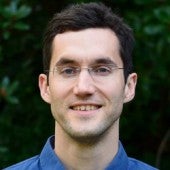
Reinhard W. Heckel
· Electrical and Computer EngineeringVerifiedRice University · Electrical and Computer Engineering
Active 2010–2024
Research topics
- Artificial Intelligence
- Computer Science
- Computer Security
- Algorithm
- Machine Learning
- Mathematics
- Genetics
- Biology
- Computer hardware
- Mathematical optimization
Selected publications
Information-Theoretic Foundations of DNA Data Storage
Foundations and Trends® in Communications and Information Theory · 2022 · 54 citations
Senior authorCorresponding- Computer Science
- Computer Science
- Algorithm
Due to its longevity and enormous information density, DNA is an attractive medium for archival data storage. Natural DNA more than 700.000 years old has been recovered, and about 5 grams of DNA can in principle hold a Zetabyte of digital information, orders of magnitude more than what is achieved on conventional storage media. Thanks to rapid technological advances, DNA storage is becoming practically feasible, as demonstrated by a number of experimental storage systems, making it a promising solution for our society's increasing need of data storage. While in living things, DNA molecules can consist of millions of nucleotides, due to technological constraints, in practice, data is stored on many short DNA molecules, which are preserved in a DNA pool and cannot be spatially ordered. Moreover, imperfections in sequencing, synthesis, and handling, as well as DNA decay during storage, introduce random noise into the system, making the task of reliably storing and retrieving information in DNA challenging. This unique setup raises a natural information-theoretic question: how much information can be reliably stored on and reconstructed from millions of short noisy sequences? The goal of this monograph is to address this question by discussing the fundamental limits of storing information on DNA. Motivated by current technological constraints on DNA synthesis and sequencing, we propose a probabilistic channel model that captures three key distinctive aspects of the DNA storage systems: (1) the data is written onto many short DNA molecules that are stored in an unordered fashion; (2) the molecules are corrupted by noise and (3) the data is read by randomly sampling from the DNA pool. Our goal is to investigate the impact of each of these key aspects on the capacity of the DNA storage system. Rather than focusing on coding-theoretic considerations and computationally efficient encoding and decoding, we aim to build an information-theoretic foundation for the analysis of these channels, developing tools for achievability and converse arguments.
Theoretical Perspectives on Deep Learning Methods in Inverse Problems
IEEE Journal on Selected Areas in Information Theory · 2022 · 31 citations
- Computer Science
- Artificial Intelligence
- Computer Science
In recent years, there have been significant advances in the use of deep learning methods in inverse problems such as denoising, compressive sensing, inpainting, and super-resolution. While this line of works has predominantly been driven by practical algorithms and experiments, it has also given rise to a variety of intriguing theoretical problems. In this paper, we survey some of the prominent theoretical developments in this line of works, focusing in particular on generative priors, untrained neural network priors, and unfolding algorithms. In addition to summarizing existing results in these topics, we highlight several ongoing challenges and open problems.
A Provably Convergent Scheme for Compressive Sensing Under Random Generative Priors
Journal of Fourier Analysis and Applications · 2021 · 11 citations
- Computer Science
- Artificial Intelligence
- Mathematics
Recent grants
RI: Small: Actively Learning From The Crowd
NSF · $474k · 2018–2023
Frequent coauthors
- 30 shared
Robert N. Grass
- 28 shared
Helmut Bölcskei
- 27 shared
Kannan Ramchandran
University of California, Berkeley
- 23 shared
Ilan Shomorony
University of Illinois Urbana-Champaign
- 19 shared
Mahdi Soltanolkotabi
- 17 shared
Wendelin J. Stark
- 15 shared
Christophe Dessimoz
SIB Swiss Institute of Bioinformatics
- 14 shared
Martin J. Wainwright
Massachusetts Institute of Technology
- Resume-aware match score
- Save to shortlist
- AI-drafted outreach
See your match with Reinhard W. Heckel
PhdFit ranks faculty by your research interests, methods, and publications — grounded in their actual work, not templates.
- Free to start
- No credit card
- 30-second signup